By James Mann
Tuesday, February 17, 2004; Page A19
Has China been transformed? That is the suggestion of French President Jacques
Chirac, who is trying to persuade the European Union to lift its embargo on
arms sales to China. Europe, like the United States, imposed the arms ban in
1989, soon after the Chinese regime brought its tanks and army into Beijing
to end the weeks of demonstrations in Tiananmen Square.
Urged on by the French defense industry, Chirac contends that China today is
different from 10 or 15 years ago. That argument seems to dovetail with visitors’
impressions of a glitzy China and with the currently fashionable cliches about
how China is being integrated into the international community.
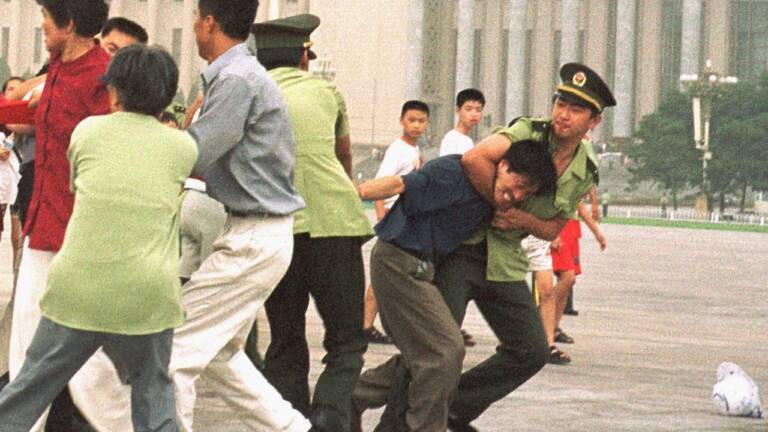
The problem is that in fundamental ways relating to human rights and political
repression, China today is not much different than it was a decade ago. Yes,
China has been brought into the international community, if we define that phrase
exclusively in terms of economics. But ordinarily the international community
is not defined solely by membership in the World Trade Organization.
To illustrate this point, let’s take an example: China’s unwillingness to grant
the International Committee of the Red Cross access to its prisons.
China has never allowed the ICRC (which is an excellent example of the international
community) to visit its prisons. One stumbling block has been that the Red Cross
insists on the right to interview prisoners privately and with its own interpreters.
Over a decade ago, on the eve of President Bill Clinton’s first meeting with
Chinese President Jiang Zemin, Foreign Minister Qian Qichen said at a news conference
that China was prepared to let the ICRC into Chinese jails. This was treated
as a great breakthrough, and it eased the climate for Clinton’s meeting.
But nothing happened. At first there were suggestions that China might give
the Red Cross access to its prisons only after the Clinton administration dropped
its attempt to impose human rights conditions on China’s trade benefits. Clinton
did that, but China didn’t act on the ICRC. The Clinton administration raised
the issue of prison access again and again in Clinton’s second term, without
success. The current Bush administration has tried too, but today, 10 years
after China first hinted it was about to open up its prisons to inspection by
the international community, it still hasn’t done so.
This is not some abstract or bureaucratic issue. The significance of ICRC access
to prisons was explained by one International Red Cross official in this way:
"At a minimum, our visits give the prisoner the solace of an hour’s conversation
with a reasonable human being in his own language. In the most extreme cases,
a visit can prevent the prisoner from disappearance and death."
Those eloquent words happen to have been spoken with a particular case in mind
— the U.S. detention camps at Guantanamo Bay, Cuba. Last year, the ICRC said
publicly that the U.S. policies at Guantanamo were unacceptable, and its criticisms,
many of them legitimate, were widely reported in Europe.
But please note that at least the United States permitted the ICRC to visit
Guantanamo. That’s more than China has done for its entire prison system. And
yet the Europeans who are so forthright in condemning American policies at Guantanamo
seem to be silent about a Chinese regime whose jails are still considered entirely
off-limits to the ICRC. That is a classic double standard.
Over the past 10 years, China has managed to defuse international human rights
complaints by channeling them into endless disputes over meetings, visits, human
rights "dialogues," requests by various organizations for offices
in Beijing — anything that doesn’t substantively require China to alter its
policies.
Yes, China has changed in some ways in the past decade. The Chinese people
now have the freedom to wear what they want. Ordinary citizens can generally
say what they want in private or in some public settings — so long as they
remain completely unorganized and unchallenging to the regime.
But when it comes to tolerance of any political opposition, or to human rights
standards as generally defined by the international community, China is essentially
the same as it was a decade ago. The regime has never expressed the slightest
remorse for using weaponry against its own people.
Chirac is right about one thing — something has changed over the past decade.
But it’s not China. Rather, the rest of the world has become far more tolerant
of the same Chinese political repression that it condemned in the early 1990s.
A lifting of the EU arms embargo would be one more big step in this tawdry policy
of accepting repression.
James Mann is a senior writer-in-residence at the Center for Strategic and
International Studies and a former China correspondent for the Los Angeles Times.
http://www.washingtonpost.com/wp-dyn/articles/A46671-2004Feb16.html
Posting date: 24/Feb/2004
Original article date: 17/Feb/2004
Category: Media Report