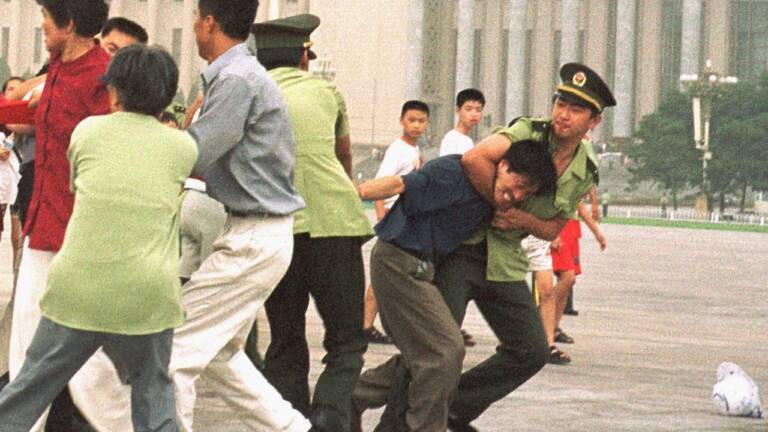
The Falun Gong spiritual movement seems innocuous anough but the Chinese
Government is torturing thousands of practitioners, claims its WA followers.
NORMAN AISBETT reports.
Sean and Vanessa Hutchison are expecting a telephone call. And sure enough,
it comes half an hour after the last one, just as they predicted. The same
recorded message too, from a woman speaking with a Chinese accent.
“I would like to tell you the truth, listen carefully. Thank you,” she says
politely but firmly. Then follows a short, sharp criticism of a spiritual
movement that has incurred the wrath of officialdom in communist China. And
some advice, that “it is not a good idea” to phone the communist state in
support of Falun Gong, also known as Falun Dafa.
For the Hutchisons, of Mandurah, the calls are a reminder they are people of
great concern to Beijing. Both are part of the spiritual movement known as
Falun Gong, which, to most Australians’ eyes, would seem incapable of
bothering anyone, let alone a budding superpower.
Practitioners talk of a peaceful practice that~ improves physical, mental
and moral health through the daily practice of four gentle exercises and a
seated meditation; plus their adherence to universal principals of
truthfulness, compassion and forbearance (tolerance).
And, of a spiritual concept, not a religion. Says Sean Hutchison: “There’s
no worship of any individual; no attendance at churches or other places of
worship; no monetary contributions; and no hierarchy or leadership levels to
fund.”
But the Chinese Government calls it an “xx” (a tag also put on some
Christian churches, with ministers recently charged under anti-cult laws and
given severe sentences). Liu Jing, a senior official in a nationwide
crackdown on Falun Gong in China, has said the movement does as much harm to
its followers as illicit drugs. “These are people in a different mental
state to ordinary people,” he said.
In 2001, a Chinese consulate official in Perth said Falun Gong was
anti-human, anti-society, anti-science and a poisonous tumour that enslaved
people, caused instability and endangered lives.
“Now they have become tools of anti-China forces abroad and within China. We
have to educate them and liberate them,” the official said.
The clampdown on Falun Gong began in 1999 after a special police “6-10
Office” was formed. The name comes from the unit’s foundation date, June 10.
It has built a fearsome reputation but Liu has denied reports of abuse,
saying: “They are treated like teachers treat their students (or) the same
as doctors treating patients or parents with their children.”
Falun Gong followers tell a different story, of hundreds of thousands of
people held in inhumane labour camps where “re-education” occurs through
hard labour and brutality. The victims have allegedly included pregnant
women, the elderly and children.
United Nations and European Union human rights agencies have raised their
concerns, including allegations of torture and mistreatment. The US Congress
has called for the persecution to end.
Falun Gong followers, who have no centralised bur~eaucracy, claim to hold
thousands of authentic photographs showing torture and beatings, all
smuggled from China. Many have been published by them, to try to stir the
international community into action. The alleged cruelties include beatings,
sleep deprivation, starvation, applying electric batons to sexual organs and
other body areas; locking people in cages suspended in filthy water, and in
black boxes; strapping victims to “death boards” without movement for weeks
or months; hanging people up by ropes; and shackling people in extremely
stressful positions for long periods.
Hunger strikers were allegedly force-fed through plastic tubes that were
painfully pushed through their noses to their stomachs. This was often done
several times, causing internal bleeding. Many have landed in mental
hospitals where the horrors allegedly include “electric shock acupuncture”
and the forced administration of psychiatric drugs.
Even if people were “transformed” by renouncing their beliefs, they often
must prove their sincerity by helping to “transform” others with the same
tortures they’d suffered, it is claimed. One former detainee, Zhao Ming, now
in Ireland, has told of feeling intense shame for having renounced Falun
Gong during electric-baton torture. He said: “I thought, “That’s it. I don’t
want to bear any more (but) I stepped out of the labour camp without any
happiness, hope or relief because my spirit had been murdered.”
But there are stories, also, of amazing courage by detainees who do not
resist the violence allegedly perpetrated on them. Instead, they focused on
maintaining a calm and compassionate state that gave them a buffer against
it.
Many had even expressed sympathy for their torturers because of the moral
harm they were doing to themselves. In this sense, the abusers were also
victims of the repression.
Falun Gong sources say 2800 people are known to have died but the true toll
will be much higher. China denies these reports.
Falun Gong was introduced to China by Master (teacher) Li Hongzhi in 1992
~and was initially permitted and even encouraged by the Government as many
Communist Party members and some top government officials were drawn to its
reputed health benefits.
In 1996, Li published his book of core teachings, Zhuan Falun, or Law of the
Wheel. It was a bestseller, though produced under state sponsorship with
most financial returns going to the Government.
But the mood changed after a 1998 Government health survey revealed 70-100
million practitioners in China. The California-based Falun Gong Human Rights
Working Group says some Communist Party ideologues were affronted by its
huge popularity.
The “atheist party vanguards” could not accept that after more than 40 years
of Marxist indoctrination, so many people, including party members, had
turned away to seek moral and spiritual guidance from Falun Gong, says the
group.
“They also had a vested interest in finding fault with Falun Gong as an
excuse to mount ideological strikes against those more open-minded and
supportive officials and to cleanse the party to their liking,” says the
group.
(In 1998 Li left China to settle in New York. His daughter’s educational
aspirations were a reason for moving.)
By early 1999, the Government was tightening the screws on Falun Gong and
various other spiritual movements, prompting 10,000 practitioners to hold a
silent, non-violent protest outside the Communist Party headquarters in
Beijing on April 25, 1999.
The Government was reportedly frightened by the size of the protest. Then
president Jiang Zemin is supposed to have ranted about an emergent threat to
the party itself and the 6-10 Office was formed.
In July 1999 Falun Gong was declared a crime and, say Falun Gong sources, a
huge propaganda campaign was launched to “foment lies and produce
hatred-inciting materials to turn the populace against the practice”.
Sean Hutchison says he knew nothing of all this when he and Vanessa lived in
Perth in 2001 and a Falun Gong brochure landed in the letterbox. The
brochure led him to the Rose Garden park in Nedlan~ds, where a Taiwanese
couple held introductory lessons free of charge, which is always the case
with Falun Gong activities. Li Hongzhi has said: “When you promote it (Falun
Gong), you should not seek fame or profit. You should serve others
voluntarily.”
Sean has practised Falun Gong ever since. Vanessa became a “diligent”
practitioner only last year, after noticing Sean was more peaceful, happier
and less prone to stress. A friendly, quietly spoken couple with a busy
photographic business, they are among about 30 practitioners in WA and both
help to raise public awareness of the persecution in China.
“The Chinese communists hope to silence us. Do I sit and keep quiet or do I
address the fact that people are being murdered and tortured?” says Sean.
He has assembled a photographic exhibition which powerfully intersperses his
own shots of tranquil land and waterscapes against a sampling of the torture
pictures allegedly smuggled out of China. It has been shown around WA.
In February, the Hutchisons were among several local practitioners bombarded
by recorded telephone calls attacking Falun Gong. Some of the calls were in
English, others in Mandarin.
They came on the half-hour or hour between about 8am and 7.30pm for about
two days. They complained to the police but a Telstra trace produced only an
unknown international number.
Sean says similar calls have been received by practitioners in 60 countries.
US authorities identified China as the source.
“I think they (the Chinese) have recognised a growing momentum and perhaps
an increase in activities around the world as more and more people are
learning what’s happening,” he says. The head of the crackdown, Luo Gan, has
said they need to smash these activities in China and abroad.”
The issue flared in Australia this year with the defection of Chinese
diplomat Chen Yonglin and the asylum application of Hao Fengjun, a former
6-10 officer who left China with a suitcase full of documents allegedly
revealing key aspects of China’s anti-Falun Gong strategy. Austra~lia was
listed among some foreign countries warranting a secret task force. Both men
claimed China had a spy network in Australia. One of its main duties was the
monitoring of Falun Gong.
In another development, two Falun Gong practitioners have taken Foreign
Minister Alexander Downer to the Australian Capital Territory’s Supreme
Court in Canberra.
Jane Dai and Zhang Cui Ying want an injunction to stop Downer using
Diplomatic Privileges and Immunities (DPI) regulations to prevent the
display of Falun Gong banners, amplified sound and car signage outside the
Chinese Embassy in Canberra. A ban to this effect was imposed in March,
under certificates signed monthly by Downer.
Dai’s husband allegedly died from persecution in China. Zhang claims she was
arrested, illegally imprisoned, tortured and humiliated when she visited
China several years ago to appeal for justice for Falun Gong practitioners.
Human rights lawyer Bernard Collaery, who is representing the women, would
not comment on the eve of the case but has previously said: “The desire to
advance bilateral relations with China, including economic relations, has
resulted in a supine position on human rights and is a national disgrace.
This is a test case of freedom of expression in Australia.”
Another WA practitioner, Denmark-based Jana Shearer, put it this way: “We
are talking about an horrendous persecution of conscience that has infected
politicians and business people around the world. “They have been encouraged
to turn a blind eye to what is happening in China in order to keep their
trade exchange open.”
In response to questions, a spokesman for Mr Downer’s department told
Weekend Extra: “The right to peaceful protest is an essential feature of our
democracy but that right is not unlimited.
“Australia is obliged under the Vienna Convention on Diplomatic Relations to
prevent any disturbance of the peace or impairment of the dignity of
diplomatic missions, residences and staff.”
The spokesman said that, apart from the specifics of the certificates,
p~eaceful protests could be conducted.
“Indeed, this is a right that Falun Gong protesters continue to exercise
outside the Chinese Embassy on an almost daily basis.”
The spokesman said Australia took no position on the doctrine or practices
of Falun Gong but believed China’s ban on the practice had breached
fundamental rights of assembly and free expression.
Falun Gong practitioners are unimpressed. They note that a bipartisan Senate
committee has recently criticised Australia for having a timid approach to
the human rights dialogue and for the “bland” statements of progress coming
from the closed-door meetings.
Falun Gong, also known as Falun Dafa, is an ancient form of Chinese
cultivation (self-improvement) practice that remains a mystery to most
Western people – as does its founder. It embraces the concept of the oneness
of heaven and man. Oneness, or the true self, is said to be achieved through
a daily set of gentle meditative exercises, a seated meditation and
adherence to core principles of truth, compassion and forbearance
(tolerance).
Practitioners say this makes people healthier in mind, body and spirit. They
were also enhanced morally, giving up selfish and harmful thoughts and false
concepts like fame, wealth and lust. Falun Gong is not a religion and is
non-political. It was revealed to the public in China by Master Li Hongzhi
in 1992. Master simply means teacher. Li, who is 53 or 54, reportedly
devoted himself full-time to Falun Gong in 1991. Before that he was a clerk.
His teachings are explained in his book, Zhuan Falun, which is available
free on the internet. There has been debate on whether he leads a
personality cult or is a benign leader. Practitioners assure it is the
latter. They say that having grasped Falun Gong’s core principles, they are
encouraged to follow their own path.
A 1999 Time magazine article quoted Li as saying “aliens” from another
dimension had come to corrupt the human mind but the report’s accuracy has
been challenged. The i~nterpreter for the interview, former Harvard
University fellow Erping Zhang, said from New York that aliens only came up
in casual conversation after the formal interview “and, worse, he (Li) was
taken out of context”.
Gail Rachlan, a New York practitioner who helped with Li’s media commitments
in the 90s, said the Time reporter phoned her to apologise after the article
appeared. ” . . . he told me that what he discussed was a private issue
after the interview and it was taken out of context,” she told Weekend
Extra.
“He also mentioned that he did the interview and several editors wrote the
article. I had calls from him asking us to please say he was very sorry that
it was not the article he hoped it would be.”
Posting Date: 13/12/05
Original Article Date: 12/12/05
Category: Media Report