Introduction
The Falun Gong incident of April 25, 1999 was not a sudden, accidental event.
Nor was it the kind of political demonstration involving the besieging of a
government compound as claimed by Jiang Zemin. From the written attacks begun
during the July 1996 Guangming Daily incident in July, 1996 to the mobilisation
of police and using violence in Tianjin in April, 1999, the development and
escalation of the persecution actually happened over a period of three or four
years.
On April 25, 1999, more than 10,000 Falun Gong practitioners in China went to
the Appeals Office of the State Council on Fuyou Street in Beijing to make an
appeal in accordance with the law. They wished to ask the authorities to release
the Falun Gong practitioners who had been arrested by the Tianjin public security
officers. After Premier Zhu Rongji, the official head of the State Council,
personally came out and met with practitioners, the situation was handled and
a resolution was reached that was acceptable to both the government and the
practitioners. However, after the “April 25th Incident,” Chinese president
Jiang Zemin used two secret documents to accuse Falun Gong of two crimes that
he wanted to charge them with – namely conspiring with foreign forces and
being directed by senior insiders in the Communist Party. In the absence of
any corroborating evidence, Jiang decided on a policy of persecution.
To allow the reader to have a relatively comprehensive understanding of this
important “April 25th Incident,” this document provides a synopsis
of the events surrounding the incident in chronological order. For the first
time, among the facts presented are excerpts from interviews with those who
participated in the April 25th events, including the dialogue between Premier
Zhu Rongji and those who went to appeal. Included are also crucial comments
made by Jiang Zemin in two classified documents as he decided to crack down
on Falun Gong based on information recently revealed by certain high level officials
in the Communist Party. This document is provided as reference for those who
are interested in learning the truth of the “April 25th Incident.”
1. The introduction of Falun Gong to the public
On May 13 1992, Mr. Li Hongzhi held the first Falun Gong workshop in Changchun.
After that, the Qigong Research Association of China (QRAC) awarded Mr. Li Hongzhi
a Qigong Master certificate. In 1993, QRAC also issued the Beijing Falun Gong
Research Association a “QRAC Accredited Qigong School Registration Certificate,”
officially indicating the classification of the Falun Gong Research Association
as an “academic organisation.” Its range of operations was “theoretical
studies and research, promoting the practice, consultative services” and
the scope of the activities was all of China.
On August 31, 1993, the China Jianyi Yongwei Foundation (CJYF; a foundation
under the administration of the Ministry of Public Security for awarding the
people who voluntarily combat criminals out of their conscience and morality)
wrote a letter to QRAC to thank Mr. Li Hongzhi for offering free healing and
rehabilitation treatments to the delegates at the “Third National Outstanding
CJYF Individuals Honouring Conference.” The People’s Public Security
Newspaper published by the Public Security Ministry even featured this event
on September 21, 1993. On December 27, CJYF conferred on Mr. Li Hongzhi an honorary
certificate.
In 1993, Mr. Li Hongzhi was honoured by the Beijing Oriental Health Expo with
the highest award in the conference, “The Award for Advancing Frontier
Sciences,” as well the “Special Gold Award.” He was also given
the title of “Most Acclaimed Qigong Master.”
The book Zhuan Falun written by Mr. Li Hongzhi was published by a government-run
publisher, China Broadcasting and Television Publishing House, in January 1995.
The book became one of the best sellers listed in the Beijing Youth Daily in
January 1996.
By early 1999, based on a Chinese government survey, there were at least 70
million people of all walks of life practising Falun Gong all over China.
2. The beginning of the hardships and the result of government surveys
Guangming Daily, the mouthpiece of the State Council, published an article
by a columnist denouncing Falun Gong on June 17, 1996. On July 24, 1996, the
Chinese News Publication Office issued a nationwide circular banning the distribution
of all Falun Gong publications.
In early 1997, the Public Security Bureau began a nationwide investigation
to gather evidence in the hopes of casting Falun Gong as an “evil cult.”
However, all of the police stations around the country finally reported after
much investigation: “no evidence found so far.” The investigations
thus came to an end.
At the end of May 1998, He Zuoxiu denounced Falun Gong in an interview on Beijing
Television, saying how it was harmful and such. After that, when showing an
interview at a Falun Gong practice site, the program said that Falun Gong was
“feudalistic superstition.” After the program was broadcast, practitioners
who actually knew those people who had been brought up as examples by He Zuoxiu
in the program immediately pointed out to He Zuoxiu and the TV station that
the program was contrary to the facts because those people weren’t even
Falun Gong practitioners. In the ensuing days, more practitioners visited or
wrote letters to the TV station to clarify the truth by telling their own personal
experiences of practising Falun Gong. Their responses were based on the central
government’s official “Three No’s” policy towards Qigong:
“no beating, no argument, no reporting.” Later, the executives of
the TV station said that broadcasting that program had been the most serious
mistake ever made since the startup of the TV station. So, as a correction,
the TV station very quickly broadcast a positive program on Falun Gong showing
practitioners peacefully practising their morning exercises along with other
people in the park.
On July 21 1998, the First Division of the Public Security Bureau issued a
1998-No. 555 circular “Notification Regarding Starting an Investigation
on Falun Gong.” The “Notification” claimed that Mr. Li Hongzhi
was spreading rumours and evil teachings and that some core practitioners were
engaged in illegal activities in the name of Falun Gong. However, the circular
then also mentioned that the Public Security Political Protection Departments
in each area should begin a thorough investigation to get inside information
on Falun Gong activities and find evidence of crimes committed by core practitioners
using Falun Gong. We can see that the circular followed the procedure of convicting
Falun Gong of a crime and then looking for evidence later. This “Notification”
resulted in the local Public Security departments in a number of areas around
the country to illegally raid Falun Gong practice sites, forcibly disperse practitioners,
search homes, break and enter into civilian residences, confiscate people’s
private property, and so on.
In the latter half of 1998, a group of retired National People’s Congress
cadres led by Qiao Shi [the former Chair of the Standing Committee of the National
People’s Congress] conducted a detailed investigation and study over a
certain period of time on Falun Gong because so many members of the public had
sent letters mentioning the Public Security Bureau’s illegal treatment
of Falun Gong practitioners. The conclusion of the study was that “Falun
Gong only benefits and does no harm to the nation and the people.” This
report was delivered to the Politburo headed by Jiang Zemin.
Before this, the National Sports Commission had also conducted a comprehensive
investigation and study into Falun Gong in May 1998. In September, in order
to coordinate with this study, a team made up of medical experts did a questionnaire
survey of a sample of 12,553 Falun Gong practitioners. The results clearly indicated
that the rate of effectiveness for improving health and fitness was 97.9%. On
October 20, the head of the research team sent to Changchun and Haarbin by the
National Sports Commission said: “We feel that both the Falun Gong exercises
and their effectiveness are quite good. The impact on the stability of society
and the strengthening of the spiritual culture are all quite evident. This deserves
to be fully recognised.” During this time, non-government studies into
the efficacy of Falun Gong in Dalian, Beijing, and elsewhere also produced consistent
results.
3. The Tianjin Incident
On April 11, 1999, He Zuoxiu published an article in the Tianjin College of
Education’s Youth Reader magazine entitled “I Do Not Agree with Youth
practising Qigong.” In this article, He drew upon the same examples to
slander Falun Gong as he had presented on the Beijing TV Station program in
1998. Because these examples had already been fully clarified in the Beijing
TV Station incident, this article of He’s had already been strictly boycotted
by Beijing’s media and propaganda system. Now that this article was appearing
in Tianjin, some practitioners in Tianjin felt that it was necessary to explain
the facts and the truth to Tianjin officials. They also hoped to lessen the
negative impact of the article through contact with the editors of the magazine.
Therefore, on April 18-24, 1999, some practitioners went to the Tianjin College
of Education and other related governmental agencies to clarify the truth.
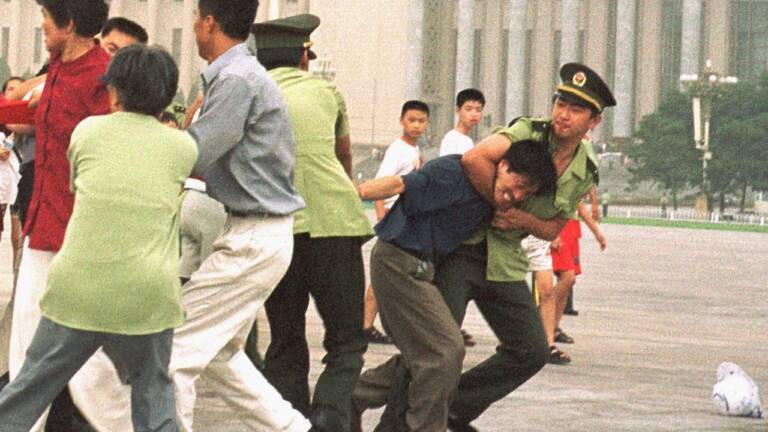
On April 23 and 24, 1999, the Public Security Bureau of Tianjin dispatched
riot police to beat up the Falun Gong practitioners who had come to appeal,
resulting in injuries to the practitioners. The police arrested 45 people. When
Falun Gong practitioners requested the release of the detained practitioners,
they were told at Tianjin City Hall that the Public Security Bureau had become
involved in this matter, so the arrested Falun Gong practitioners would not
be released without authorisation from Beijing. The Tianjin police suggested
to Falun Gong practitioners, “Go to Beijing. Only going to Beijing can
resolve the problem.”
From using attacks in the media in previous years to this incidence whereby
police actually used violence against Falun Gong practitioners in Tianjin, the
escalation of the persecution shocked Falun Gong practitioners. Word of the
“Tianjin Incident” spread rapidly among Falun Gong practitioners all
across the country.
4. Going to appeal at the State Council Appeals Office on April 25
As news of the police brutality and arrests in Tianjin and the need for Beijing’s
authorisation to release the incarcerated practitioners spread throughout the
country, Falun Gong practitioners, trusting the central government, started
heading to the Appeals Office of the State Council of their own accord, one
after another, beginning on the evening of April 24. They were hopeful that
they would find a just resolution of the “Tianjin Incident.” On April
25, Premier Zhu Rongji personally met with the Falun Gong practitioners who
had gone to appeal.
As Ms. C who lives in the Haidian District of Beijing recalls: “At 7:00PM
on April 24, some practitioners told me how the practitioners in Tianjin had
been beaten and arrested. They said that some practitioners wanted to go to
the Appeals Office of the State Council to report the on situation, and those
individuals who wanted to go could go. So, four or five practitioners and I
took the bus and arrived at the North entrance of the State Council at 8:00PM
on the same day. We were probably the first group of practitioners who went
to appeal for the ‘Tianjin Incident’ and the guard at the entrance
asked us what it was about.”
Mr. and Mrs. P from Beijing’s Chaoyang District recall: “By the morning
of April 25th, the West side of Fuyou Street was full of people; there was no
one on the other side of the street (where the State Council is located). Young
practitioners stood in a row at the very front, leaving open the sidewalk and
the special sidewalk for the blind. Behind the front row of practitioners all
the way to the corner of the wall were seated practitioners. Everyone was very
quiet. The traffic was not obstructed.”
Ms. M living in Haidian District recalls: “At about 8:15AM on April 25,
I saw a group of people including Premier Zhu Rongji come out of the main entrance
(west entrance) of the State Council and cross the street to stand in front
of the practitioners who had come to appeal. The practitioners started to applaud.
Premier Zhu asked, ‘What are you here for? Who told you to come here?’
Some practitioners said, ‘We’ve come here to report the situation
regarding the Falun Gong issue; no one organised us.’ Premier Zhu said,
‘Why don’t you write letters to appeal? How come so many people are
here?’ A lot of practitioners were answering him. I heard some practitioners
say: ‘We’ve written letters until we’re numb and yet we still
haven’t gotten a response.’ Premier Zhu said, ‘I have issued
an official directive regarding your issue.’ Practitioners said, ‘We
haven’t received it.’ Premier asked practitioners to select several
representatives to go into the State Council to explain the situation further.
Several people raised their hands. Premier Zhu pointed to a few people and they
entered the State Council.”
5. The Premier of the government properly resolved the “Tianjin Incident”
and the “4.25 Incident”
At noon on April 25, Li Chang and Wang Zhiwen of the Falun Dafa Research Society
and three other Beijing practitioners, acting as representatives of Falun Gong,
entered the State Council to have talks with the government officials. They
presented three requests from Falun Gong practitioners:
1) Release the Falun Gong practitioners who were arrested in Tianjin;
2) Give Falun Gong practitioners a loose and relaxed cultivation environment;
3) Allow Falun Gong books to be published.
The government officials who took turns participating in the talks included
officials from the Appeals Office of the State Council, officials from the city
of Beijing, and officials from the city of Tianjin. At dusk, Tianjin released
all of the detained Falun Gong practitioners in accordance with instructions
from the central government.
6. Jiang Zemin used secret documents to overturn the Premier’s conclusions
and decided to crack down
In the evening of April 25, Jiang Zemin, in the name of the General Secretary
of the Communist Party, wrote a letter to the members of the Standing Committee
of the Politburo and other relevant leaders. In the letter, Jiang Zemin charged
that there were masterminds “behind the scenes” of the April 25th
Incident who were “planning and issuing commands.” (This letter was
marked “Highly Confidential,” distributed as the central government
office’s issuance [1999] No. 14 entitled “Notice of the Communist Party
Central Office regarding the printing and distribution of ‘Comrade Jiang
Zemin’s Letter to the Standing Committee of the Politburo and other Concerned
Leading Comrades’”).
On June 7, Jiang Zemin gave a speech at the meeting of the central government’s
Politburo and stated, “The issue of ‘Falun Gong’ has very deep
political and social background and even a complicated international background…
It is the most serious incident since the political turbulence in 1989.”
On June 13, this document was secretly transmitted inside the Communist Party.
(This document was categorised as highly confidential and issued by the central
government office as [1999] No. 30 entitled “Notice of the Communist Party
Central Office regarding the printing and distribution of ‘The Speech of
Comrade Jiang Zemin in the Meeting of the Politburo of the Central Government
Regarding Handling and Resolving the ‘Falun Gong Issue’ Without Delay”).
Certain high-ranking officials within the Communist Party have revealed that
in the above two classified documents, Jiang clearly raised the issue of “whether
there were overseas and Western connections to the April 25 incident and whether
there were ‘masterminds’ behind the scenes who were planning and issuing
commands.” They have revealed Jiang’s mentality of being overly protective
of his personal power and interests, and how, without any concrete evidence,
he made the erroneous policy decision to persecute Falun Gong.
From late May 1999, the daily practice activities of Falun Gong practitioners
in many areas were subject to forced dispersal by the city administrative agencies
and the Public Security Bureau. The public security officers in some areas used
high pressure hoses to drive practitioners away and high volume loudspeakers
to disturb their practice. The persons in charge of the Falun Gong assistance
centres were called in by their workplaces and by public security officers for
discussion and interrogation, they were put under surveillance and followed,
their phones were tapped, and they were not allowed to leave the local area.
During a high level meeting on July 19, Jiang Zemin officially announced confirmation
of a total ban on Falun Gong. July 20th saw the beginning of a wave of arrests
of Falun Gong practitioners all across the nation.
According to the Falun Dafa Information Centre, from July 1999 to March 2001,
188 people had been tortured to death in China, several hundred had been sentenced
to up to 18 years in prison, and more than 50,000 had been detained in detention
centres, labour camps, and mental hospitals. Jiang Zemin’s insistence on suppressing
Falun Gong has caused China to face increasing criticism from the international
community for the deterioration of human rights and moral values.
Article source: Clearharmony.net
—————————————————————————————-
Commeration event in Sydney:
Falun Gong Commemorates at Bondi Beach
Hundreds of Lives Lost to the Persecution in China
When: Saturday April 26, 6:00 – 8:00am.
What: Dawn Candle Vigil
Where: Bondi Beach
Commemotary event in Melbourne:
When: Friday April 25, 6:00pm – 8:00pm
What: Candlelight Vigil
Where: Melbourne Chinese Consulate, 75-77 Irving Road, Toorak