Apart from its ten-meter wall, the Women’s Re-education Through Labor Camp
in Beijing looks more like one of the modern housing complexes favored by
the capital’s nouveaux riches than a correctional facility. Its pink-colored
buildings, Grecian columns, expansive lawns, rose beds and plane trees welcomed
the first inmates in March. "It feels inviting," enthuses the warden,
Zhu Xiaoli. One of her underlings chimes in, "We don’t want to make it
like a fortress. It should be lively and human."
Little, however, is human about China’s re-education through labour (RTL)
system. The 900-odd prisoners at Miss Zhu’s $6.7m camp are serving sentences
of up to three years, entirely at the recommendation of the police without
having had a chance to defend themselves in court. Most of the inmates are
drug addicts (about 40%), followers of the Falun Gong spiritual movement (28%)
and prostitutes (about 10%). Their offences are considered too minor for punishment
in the regular prison system, whose inmates are tried in court. Yet instead
of being fined, put on probation or sentenced to community service, they are
incarcerated like convicted criminals with little difference between their
institution and a normal jail, except in this case for the architecture and
color scheme. The Beijing RTL camp happens to be a showcase for foreign visitors.
Most of the other 300-odd RTL facilities in China are indistinguishable from
prisons. The justice ministry says there are some 260,000 people now serving
in the RTL system, compared with more than 1.3m in prisons (which are often
confusingly referred to as "reform through labor" camps). The true
numbers are probably greater. [Note: Experts on this subject at the Laogai
Research Foundation (http://www.laogai.org/)
have documented the existence of over 1, 000 forced labor camps, which are
believed to house between 4 and 6 million prisoners.] Bizarrely, a minor offender
could end up with more time inside than a violent criminal. The maximum RTL
sentence is three years, extendable to four for those who behave badly. In
the regular prison system, a rapist or robber could be out after three years.
China’s courts, unencumbered by juries, are hardly impartial. Yet the secretive
process whereby police-dominated committees hand out RTL sentences is especially
open to abuse. Even officials admit that there is a problem. A book of guidelines
for handling RTL cases, published in China in July, acknowledged that the
sentencing procedure was not in accord with the International Covenant on
Civil and Political Rights, which China signed in 1998 but has yet to ratify.
Nor, it said, was it compatible with China’s own judicial system. Some RTL
committees send to labor camps even those involved simply in immoral behavior
or civil disputes.
Lorne Craner, a senior American diplomat who was in China this week for talks
about human rights, said his hosts had for the first time agreed unconditionally
to invite United Nations’ investigators to look into abuses, including the
jailing of citizens without due procedure. But while this was an unusual gesture
by China to a country it normally resents for pontificating on human rights,
there is little likelihood that the RTL system will be scrapped or significantly
modified any time soon.
Western diplomats involved in human-rights talks with China say that a couple
of years ago indications of possible reform were somewhat more encouraging.
The Chinese have now gone quiet on reform, says one envoy. One reason, he
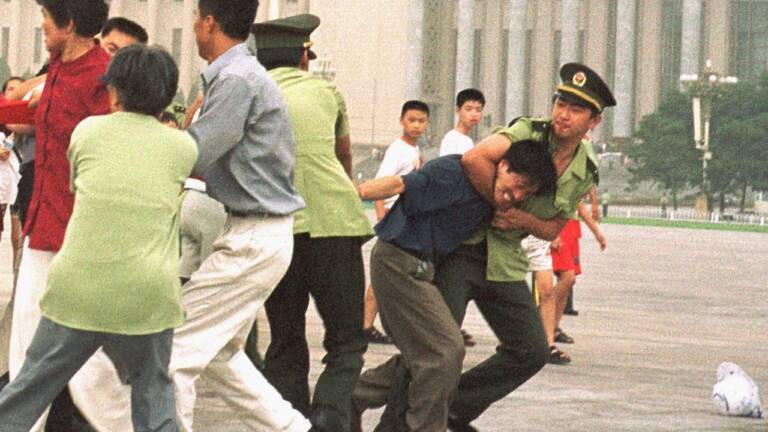
suggests, is the campaign against Falun Gong, which has resulted in thousands
of its followers being sent to RTL camps since 1999. This has played into
the hands of the police, who regard RTL as a useful tool for suppressing dissent
without the encumbrance of judicial bureaucracy. The courts, too, oppose any
reform that would give them a lot more cases to handle.
Even abolishing RTL would leave the police with considerable power to detain
people at whim. They can send people to centers where drug rehabilitation
is carried out forcibly, and send migrants back to their registered homes.
This latter procedure often involves being detained for weeks or months and
has been increasingly abused in recent years to extract payments from rural
laborers working in the cities. Shanghai police detained 10,000 such people
in 1988 (1% of the city’s migrant population). By 1997 the figure had risen
to 100,000, or 3.6% of those registered as living outside the city. Of those
detained, some 80% had committed no offence, according to a government study.
Writing in November 2001 in the Peking University Law Journal, Chen Ruihua,
a lecturer at the university law school, said the police should be deprived
of all their powers to impose custodial sentences. This was the only way to
progress from a police state into a state ruled by law. The police, not surprisingly,
see matters differently.
Posting date: 24/Dec/2002
Original article date: 21/Dec/2002
Category: World News