Catherine Armitage
November 15, 2004
CHINA’S disdain for foreign interference
in its human rights broke through the mask of soft diplomacy one recent Thursday
evening in Canberra.
As a result, 13 members of the Australian media appeared
to have been handed the China scoop of the year.
At a press conference
on annual human rights talks between Australia and China, Chinese assistant foreign
minister Shen Guofang was asked about the 15-year-long house arrest of former
premier of China Zhao Ziyang. He
replied: “There is no problem of so-call
. . . of house arrest. He is free.”
It was an incendiary statement.
Freedom for the 85-year old Zhao could spark the kind of mass uprising which led
to his incarceration in the first place.
Zhao has not been seen in public
since he famously, tearfully, visited the students in Tiananmen Square in May
1989. He was jettisoned soon afterwards by Deng Xiaoping for his soft line on
the protests.
But Shen’s assertion was not true. Life at courtyard No.
6 Fuqiang Hutong where Zhao lives continues as it has for the past 15 years. Armed
police in green uniforms patrol the high grey wall, plain-clothes police hang
around the alley, a bronze banner on the red gate warns: “Closed unit. No
visitors allowed.” The old man needs permission from the highest reaches
of government to step out the gate.
The kindest explanation is
that Shen’s understanding of the word “free” is very different to that
of ordinary Australians. But just maybe, Shen’s assertion was an insult to all
those present, including the Department of Foreign Affairs bureaucrats with whom
he had just spent the day pow-wowing on human rights.
Australia does China
a big favour by corralling its official expressions of concern over China’s horrific
human rights abuses into an annual day-long meeting between bureaucrats behind
closed doors. Since 1997, as a condition of the dialogue, Australia has effectively
agreed not to publicly tackle China on human rights. Especially, Australia no
longer backs resolutions in the UN Human Rights Commission that might lead to
China being “named and shamed”.
Australia won’t openly state,
let alone deplore, the fact that more than 10,000 people a year are executed in
China, often within hours of sentencing, often for economic crimes like stealing
or tax fraud, often after confessions extracted by torture.
Australia
won’t say in public that Chinese citizens are regularly beaten to death by police
or that more than 100,000 Falun Gong practitioners have been sent to forced labour
camps since 1999, of whom well over 1600 have died of torture or abuse.
Nor
will Australia publicly decry the system of re-education through labour which
imprisoned more than 310,000 people without trial or judicial oversight in 2003
alone, a 50 per cent increase on 2001.
There are 25 billion reasons for
Australia’s circumspection on China’s human rights question. Bilateral trade is
now worth $25 billion a year and growing at an annual rate of 12 per cent.
Australian
ambassador to China Alan Thomas spelled it out at a business dinner in Beijing
last month. He noted how “we are very, very fortunate” to have the raw
materials, agriculture and food products “China wants at the moment”.
He said Australia’s political relationship with China has “no major difficulties
at the moment”. On human rights, “We can raise what are very sensitive,
very prickly issues which China doesn’t like us raising, but we do it in a managed
way,” ambassador Thomas said. “We don’t scream it from the rooftops.
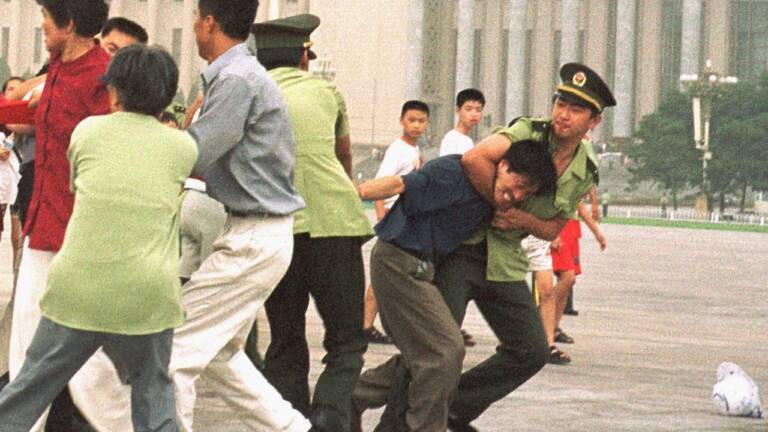
I don’t get up with a microphone in Tiananmen Square, and that is appreciated
[by the Chinese],” he said.
Human rights issues are always raised
when Australian leaders meet the Chinese, diplomats say. Others see this is an
empty gesture. The dialogue isolates and marginalises human rights as a safe arena
that doesn’t extend to other bilateral relations, says Hong Kong-based Nicolas
Becquelin of Human Rights in China.
Privately, diplomats believe that’s
a big part of the reason for “no major difficulties” in the bilateral
relationship. But things could quickly change.
Australians who dread the
prospect of a free trade agreement with China, almost certainly to be negotiated
next year, will no doubt be screaming from the rooftops about human rights –
a prospect in turn dreaded by the Chinese.
And as human rights activists gear
up for an all-out assault on China before the Beijing 2008 Olympics, Australia’s
stance is likely to come under greater international scrutiny.
About a
dozen countries are now signed up for bilateral talks on human rights with China,
including the US, Britain, Canada, Switzerland and Denmark. But even the participating
countries feel a growing sense that they are ineffective, according to a Beijing-based
Western diplomat who is involved.
China is showing its disdain by refusing
to engage in planning the talks, sending along more junior officials, or changing
the days at short notice, as happened with Australia in October, the diplomat
said. The talks are not so much a dialogue as a ritualised reading of set pieces
in which one side lists its concerns and China lists the reasons it won’t act,
according to the diplomat.
Says Becquelin: “I don’t think the dialogues
have ever broken new ground. I have never seen anything useful published as a
result of the dialogues.”
He argues the UN system of binding international
treaties and covenants, some of which are legally binding and many of which China
has signed, is “much much more effective than just bilateral talk shops”.
China sends its best and brightest diplomats to human rights sessions at
the UN, but makes clear its distaste. The UN Human Rights Commission has “low
credibility and efficiency” and is stuck in a Cold War mindset, China’s representative
told a UN session in New York in late October.
In an obvious stab at the
US, China said the commission allows countries which “ignore such large-scale
violations against human rights as foreign military occupation” to “wilfully
name and shame those developing countries they don’t like”.
China
appears to be moving towards cutting down on executions. It has reformed the system
of arbitrary detention of people living or working outside their city of household
registration. Of the 41 cases of incarcerated individuals raised by Australia
in the dialogues since 2001, 15 have been released, including seven out of 25
last year, according to the Department of Foreign Affairs and Trade. “I think
we are making some incremental progress,” said ambassador Thomas.
But
how much improvement can be attributed to the talks is just as debatable as the
assertion that sticking with the UN route would have yielded better results.
John
Kamm is a former head of the American Chamber of Commerce in China who has spent
the past 15 years pursuing individual cases of 900 prisoners in China, of whom
350 have been freed, believes the dialogues are worth pursuing on the basis that
all avenues are worth pursuing. But he, along with Becquelin, believes they are
not used to maximum advantage, not least because dialogue countries don’t co-ordinate
adequately with each other.
Kamm singles out Australia for being overly
secretive and failing to share any lessons or advice, with him or other dialogue
countries. “I can’t recall a single instance in the years I have been doing
this where the Australian government has provided any information to me of any
value, and that is too bad,” he says.
Yet the Australian talks are
seen as among the most useful. They occur with higher-level Chinese officials
than other countries’ talks, and, in a recent breakthrough, the Chinese have invited
non-government organisations to join.
The cynical explanation for this
relative success is that the Australian talks have money tied to them, in the
form of an ongoing aid program on human rights, administered by the Human Rights
and Equal Opportunity Commission, under which Australian experts have provided
training on issues including prison reform, rules of evidence for the judiciary
and domestic violence.
The Senate Standing Committee on Foreign Affairs,
Defence and Trade launched an inquiry into bilateral human rights dialogues after
an article in The Australian questioned the value of the Chinese talks last year.
The 12 submissions so far are almost uniformly critical of the China dialogue
for its secrecy, lack of accountability and lack of outcomes.
Ann Kent
of the Australian National University Centre for International and Public Law,
a world authority on human rights mechanisms, blasted the annual dialogues for
actively undermining both well-established UN monitoring mechanisms and Australian
values.
“Every year Australia approaches the bilateral dialogue with
its hands already tied behind its back. It has no bargaining power. It is able
neither to invoke the possibility of international disapproval nor to apply sufficient
Australian pressure, for fear of destabilising the relationship,”
according
to Kent. The sole virtue of the dialogue, the aid program, should be detached
from the talks because it lends legitimacy to an essentially empty process, Kent
argues.
© The Australian
http://www.theaustralian.news.com.au/common/story_page/0,5744,11385213%255E28737,00.html
1. Jiang Regime’s slanderous words omitted.
Posting date: 15/Nov/2004
Original article date: 15/Nov/2004
Category:
Media Report