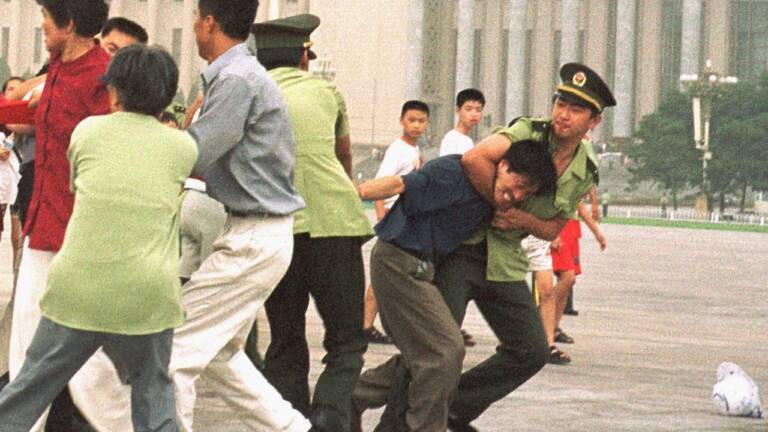
Rosemary Neill meets Jennifer Zeng, AUTHOR
SHE can talk about
the brainwashing and torture she endured, and maintain her composure. She can
tell you, without breaking down, about her husband being arrested and detained.
But the tears spill out, unbidden and bitter, when Jennifer Zeng discusses how
the Chinese Government tried to turn her only child against her because she practises
Falun Gong. This is the meditation-based spiritual movement banned by the Communist
Party in one of its harshest crackdowns since the Cultural Revolution. The party
maintains Falun Gong is an evil cult.
“There was a stage when my daughter
become so confused,” Zeng says. “She was so scared and confused. She
was only six or seven. She had to make a choice between her own mother and what
the party told her.”
Today, 12-year-old Shitan lives in Sydney with
her mother, a soft-skinned, soft-spoken woman of 38. Zeng fled China and came
to Australia as a refugee in 2001, and her daughter followed. “I’m very happy
now that she is in Australia,” says Zeng, adding that Shitan would love to
see her father, grandfather and friends in Beijing.
But the schoolgirl
knows she can’t visit, as it is likely her mother would be arrested. For while
she leads an ostensibly quiet life in the suburbs, working for a lifestyle magazine
and meditating, Zeng continues her struggle against China’s persecution of those
who practise Falun Gong.
Next week, Zeng’s account of her ordeal, Witnessing
History: One Woman’s Fight for Freedom and Falun Gong (Allen & Unwin, $29.95),
will be released in Australia. It is the first book by a Falun Gong follower who
has suffered imprisonment and torture — and it has been black-listed in China.
In it, Zeng explains how her life was “thoroughly transformed” after
she discovered Falun Gong. A scientist by training, she had suffered two haemorrhages
after giving birth. She contracted hepatitis C from blood transfusions and was
unable to work or care for Shitan. “I was only 30 years old; I had a wonderful
husband and a precious daughter but I felt so wretched that life hardly seemed
worth living,” she writes. But once she started practising Falun Gong, which
combines meditative exercises with Taoist and Buddhist precepts, she regained
her health, career and optimism. Indeed, she felt she was leading a “different
existence”. But her happiness was short-lived. In 1999, the Communist Party
banned Falun Gong after 10,000 followers protested in Beijing against the mistreatment
of Falun Gong members in another city. This was the boldest challenge to the party’s
power since the Tiananmen Square student demonstrations of 1989.
Zeng refused
to give up practising, even after she was arrested three times. In 2000, she was
sent to a labour camp. There, she had to squat in the sun all day and was subjected
to electric shocks and brainwashing sessions. The aim was to have her renounce
her spiritual beliefs. To add to the humiliation, “reformed” inmates
were forced to help re-educate or beat up other Falun Gong followers. Zeng couldn’t
bring herself to do this.
She spent 10 months in the labour camp before
“reforming”; at times she says she felt on the verge of total collapse.
“I witnessed somebody else become totally insane and I couldn’t guarantee
I wouldn’t end up in the same situation. That was really, really frightening,”
she says, her voice fading to a whisper.
Her commitment to her faith can
seem extraordinarily courageous and zealous. To get out of the labour camp, she
gave interrogators the false impression she had recanted. She castigates herself
for this, writing that she failed “the standards required of a Falun Gong
student”. But what was the alternative? Going mad or dying behind high wire
fences? “Possibly,” she concedes reluctantly.
Not all of her
family supported her single-minded pursuit of her beliefs. Her terrified mother-in-law
tried to stop her leaving the family’s Beijing flat to meditate outdoors.
In
2002, Zeng was one of seven followers who filed charges with the UN against former
Chinese president Jiang Zemin for persecuting Falun Gong practitioners. Then living
here, she received threatening international phone calls from distant relatives.
“I understood their reaction,” she says. “In their eyes
it’s so shocking an action to take and so dangerous, to put my husband in this
kind of situation. I understand their anger. I always felt for people who live
under terror.” Four days after the charges were filed, Zeng’s husband was
arrested and her daughter spent her 10th birthday alone. “[I was] thrown
into greater torment than when I was thrown into prison myself,” she says.
Her husband, who hopes to join her in Australia, was held for a month and is still
under surveillance. Soon after, his mother contracted cancer and died. Zeng believes
she became sick “from the shock”.
Will her book put her husband
at further risk? She thinks that, paradoxically, the more her story is exposed,
the safer her husband will be. “They [the Chinese authorities] wouldn’t want
to advertise my book by arresting him,” she explains. To this day, it’s unsafe
for her to talk freely to her family in China. The communist authorities know
everything she’s doing here, she says.
“My main concern is not to
bring trouble to others. Maybe some little action of mine could result in big,
big trouble for someone inside China,” she says. Aware of this risk, her
mother has forbidden contact between Zeng and her sister, who has spent 18 months
in a labour camp because of her Falun Gong beliefs.
Has the toll on her
family been worth it? Zeng says her family is innocent and that she blames their
suffering on her persecutors rather than her faith: “I don’t believe that
persecution is right … the law should deal with people’s actions and deeds only
but in China it is used to deal with your thoughts.”
She is dismayed
that many in Australia’s Chinese community have bought the Communist Party line
that Falun Gong is an evil cult. (The local Falun Gong branch is officially excluded
from Sydney’s Chinese New Year parade.) And Western experts seem unsure whether
Falun Gong is a benign faith or a more sinister sect. But they don’t doubt that
its practitioners are persecuted in China — largely because the movement has
spread at an astonishing speed since it was founded in 1992. Today, it claims
tens of millions of followers in and outside China.
Falun Gong’s leader, Li
Hongzhi, is a former grains clerk and trumpet player from northeast China who
moved to New York in 1998. The Chinese Government says he is a charlatan who changed
his birthday to May 13 — the same as Buddhism’s founder. Li denies this.
Nevertheless,
some followers refer to him as Living Buddha. Li believes in aliens and has told
Time magazine he exists at “a higher level”. According to the BBC, the
communists blame him for the deaths of thousands of devotees, claiming he has
stopped them seeking medical help. Li says this is untrue.
Zeng says Falun
Gong has spread so quickly simply “because it is so good”; the positive
effects on followers’ physical and mental health are “so obvious”. She
says she wrote her book to “expose the evil” of China’s labour camps
and to highlight the plight of other Falun Gong inmates: “What we ask is
for an end to the persecution and for the freedom to practise our own beliefs.
I regard that as basic human rights — it’s not political at all.”

Posting
date: 3/Mar/2005
Original article date: 27/Feb/2005
Category: Media Report