ONCE a month, Alexander Downer signs a certificate banning adherents of Falun
Gong from displaying banners and making excessive noise outside the Chinese embassy
in Canberra.
The Foreign Minister has been doing so for the past two years
because, as his department explains it, he has determined that in accordance with
the provisions of the Vienna Convention, fixed banners or signs, including those
on vehicles, together with amplified noise, "impair the dignity" of
the Chinese embassy.
The real reason is that the Chinese, who call Falun
Gong an "xxcult", complained about signs that read "Truthfulness,
Compassion, Tolerance" and "Stop the Killing", as well as the playing
of exercise music with a Chinese voice-over.
According to the group, Australia
is the only democratic country to impose such restrictions on its members, or
practitioners, as they prefer to call themselves – an assertion the Department
of Foreign Affairs and Trade did not challenge when it was put to it this week.
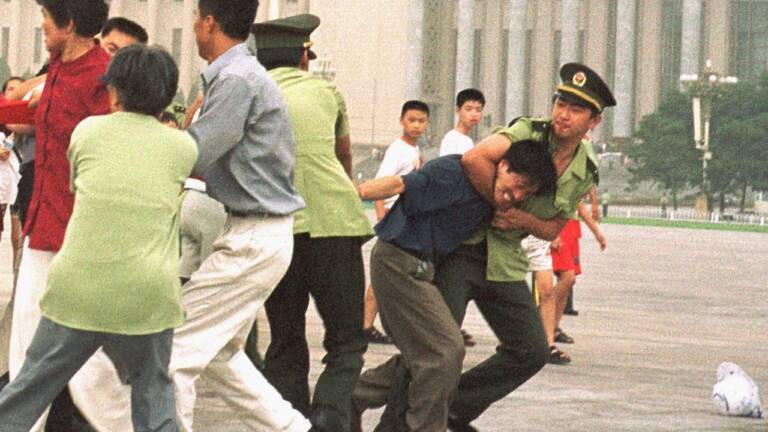
Unfortunately, the Chinese do everything to impair the dignity of Falun
Gong practitioners. Amnesty International says tens of thousands are being detained
in China, mostly in "re-education through labour" centres but also in
prisons and mental hospitals. It reports that total alleged deaths in custody
had reached about 500 by the end of 2002.
that several hundred reportedly have died due to torture, abuse and neglect. Falun
Gong claims to have verified 1423 deaths and that the total could be as high as
10,000. Whatever the figure, it is one of the worst examples of repression of
Chinese citizens since the Cultural Revolution.
China cracked down on Falun
Gong in 1999, after more than 10,000 people held a silent protest outside the
main Chinese leaders’ compound in Beijing. It was the biggest challenge to Chinese
authority since the mass demonstrations in Tiananmen Square in 1989.
The
practice of Falun Gong is similar to tai chi and aims to improve the body and
mind through special exercises and meditation. The Chinese Government regards
it as a threat because it has spiritual elements and Chinese history is replete
with political rebellions fuelled by religious movements. Falun Gong has some
of the qualities of a sect, including its founder Li Hongzhi, now living in the
US, and his teachings, which include that human intelligence and civilisation
were brought to Earth by aliens from outer space.
Its literature includes
criticism of the Chinese Communist Party’s attack on traditional culture and references
such as the "communist evil spectre" and that "the only way of
saving oneself is to thoroughly discard the CCP".
But there is nothing
to support the Chinese Government’s characterisation of Falun Gong as akin to
dangerous cults such as the Branch Davidians, who committed mass suicide when
raided by the police in the US in 1993, or Japan’s Aum Shinrikyo, responsible
for the sarin gas attack on the Tokyo subway in 1995.
Many Australians
driving past the Chinese embassy and consulates in other cities have seen the
Falun Gong in action, if that is the word. It is the epitome of passive protest.
They are often sitting cross-legged, meditating.
Australian spokeswoman
Kay Rubacek concedes there was one incident that broke from the group’s insistence
on peaceful demonstration and was "a bit of a black mark used against us".
Several years ago, some practitioners entered the grounds of the Chinese consulate
in Melbourne and started holding a news conference. Most left when asked, but
one person was removed by the police. Rubacek says it is the only incident of
its kind in Australia.
You can draw your own conclusions why Australia
finds it necessary, unlike other countries, to impose a statutory restriction
on a group just because the Chinese say they are offended, as opposed to the police
simply keeping an eye on members or responding to specific complaints about breaches
of the law. This week the Government went further to please the Chinese by excluding
Falun Gong from talks it convened in Canberra with non-government organisations
on human rights in China.
These discussions are held as part of the input
for the annual human rights dialogue Australia has with China. Haven’t heard much
about those? That is because they are held behind closed doors. Even the NGOs
participate in the preliminary talks only on the condition that they do not speak
about them publicly.
Falun Gong was prepared to abide by these conditions
but this week it was dis-invited to the talks. Why? Because it held a protest
outside the foreign affairs department to coincide with the meeting. This included
displays of information about Falun Gong and a demonstration of Chinese torture
methods.
A foreign affairs department spokesman said Falun Gong members
had been told their attendance might have to be reconsidered but they decided
to go ahead with the demonstration anyway.
"We advised them formally
on Tuesday, the day before the consultations, that their invitation had been withdrawn
because the protest was not consistent with the co-operative spirit of the consultations,"
he added.
That certainly sorts out Australian priorities. Punishing people
for engaging in peaceful protest is not consistent with democratic values. These
are the kinds of values we hold so dear that we are prepared to go to war for
them to see them blossom in Iraq and other countries in the Middle East — at
least, that is our rationalisation after failing to find the weapons of mass destruction
that were the original reason for falling in behind our other great and powerful
friends, the Americans.
But these values apparently are not as important
as kowtowing to the Chinese. The foreign affairs spokesman said the restrictions
on Falun Gong activities outside the Chinese embassy should not be interpreted
"as indicating any lessening of the Government’s concern for the rights of
Falun Gong practitioners" and that these concerns had been raised at the
last dialogue in October.
The annual dialogue is a means of quarantining
human rights issues to a private meeting and is a substitute for public criticisms
of China’s appalling human rights record, including in the UN Human Rights Commission.
As Australian ambassador to China Alan Thomas put it last year: "I don’t
get up with a microphone in Tiananmen Square and that is appreciated [by the Chinese
Government]."
Australia argues that this approach is more effective,
but the results are hard to find. Australia has raised a series of individual
Falun Gong cases in the annual dialogues, including, in two consecutive years,
that of the brother of an Australian citizen arrested in China for being a Falun
Gong practitioner. "He still died in a labour camp," says Rubacek.
Yes,
it is important to have good relations with China and not only because they buy
lots of our goods. And no, we should not pretend that a country of our size is
ever going to have a big influence on Chinese behaviour. But that does not mean
we always have to bend over backwards further than any other country to find favour.
That just means they don’t respect us in the morning.
12 March
Link:
http://www.theaustralian.news.com.au/common/story_page/0,5744,12515306%255E7583,00.html
Posting date: 12/Mar/2005
Original article date: 12/Mar/2005
Category:
Media Report