
The 2004 International Future Science and Culture Symposium was held at National
Taiwan University on May 15 and 16. Professors and scholars from the U.S., Japan,
Australia and Taiwan attended this symposium. More than ten Falun Gong practitioners
were invited to the symposium to present lectures and papers. People from all
circles and many scholars attended the symposium. On the second day of the symposium,
a large number of people attended out of admiration for the content, and there
wasn't even one vacant seat left. Many people were sitting on the steps.
|
| 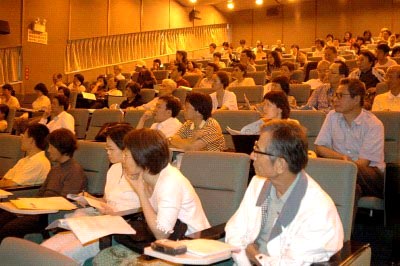 Symposium attendees listening intently to the presentations |
|  Traditional Chinese painting and calligraphy exhibit held at National Taiwan University on May 15 and 16 during the symposium |
During
the symposium, a short documentary film was shown to introduce ancient artworks
that incorporate many of the principles of ancient culture and cultivation. The
documentary was presented by a middle school art teacher, Ms. Zhou Yixiu, who
is also a Falun Dafa practitioner.
Angelika Lehnert is a physician assistant
in Germany. She read a news announcement about this symposium on the Internet
and flew from Germany to Taiwan to attend this event. Despite the language difficulty,
she participated in the whole symposium.
A middle-aged gentleman was planning
on attending another seminar in the same building. He came to this symposium to
see what was going on after he saw a poster about the symposium. After listening
to Falun Gong practitioner Daniel A Monti's presentation entitled, “Nero–Affection,”
he decided to continue on and listen to other presentations. Dr. Monti is a professor
at Thomas Jefferson University, a renowned U.S. medical center. The gentleman
found that this symposium initiated profound reflection on the natural sciences,
and the reports touched on many aspects such as medicine, music, art and even
the economy. Unlike the typical obscurity of many academic papers, the reports
were very attractive and well presented and helped attendees to widen their vision.
A
teacher was listening to the presentations. The more he listened, the more he
became interested. During a break, he called his students to attend this unique
symposium.
Some media reporters were delighted to attend such an interesting
symposium, and many of them said that they would come for interviews on the next
day. One reporter said that she was very happy to see that one of the themes of
the symposium was an emphasis on the importance of morality. Because the symposium
included topics from different disciplines, she felt that the presentations were
very attractive and interesting. Furthermore, the reporter was surprised to learn
that some of the scholars who gave speeches were Falun Dafa practitioners. She
said that these practitioners were so different from what her Mainland Chinese
friends had described, views based on the lies they had heard from the Chinese
authorities. This reporter was studying abroad, where she met a lot of friends
from Mainland China.
On May 16, Hu Enhui, a reporter from Mun Sang,
published an article entitled, “Falun Gong is Effective in Healing and Fitness.”
The article introduced the research findings of Hu Yuhui, an assistant professor
at Donghua University. In the symposium, Professor Hu presented research conducted
on Falun Gong practitioners. Her research showed that those practitioners on average
went to see doctors 12 times a year before they practiced Falun Gong, and that
this number decreased to 6 times per year after they started to practice. Moreover,
70% of them successfully abstained from smoking and drinking. The study clearly
showed that Falun Gong has a very positive effect on people's health.
At
the end of 2002, Professor Hu sampled more than 1,000 Taiwanese Falun Gong practitioners,
who were asked to fill out a citizens health survey designed by the Health Ministry.
Comparing these results with the published 2001 Citizens Health Survey conducted
by the Heath Ministry, she found that the public in general scored 70-80 while
practitioners scored on average more than 90 (higher scores indicate better overall
health).
After the symposium, many attendees took the opportunity to ask
these scholars and professors questions and were very happy to have such a precious
opportunity. A female banker said that she had read several Buddhist books before
and she knew some basic principles of life philosophy. However, she was deeply
touched when she listened to presentations in which scholars validated the Cause
and Effect Principle using a scientific approach.
Posting
date: 27/May/2004
Original article date: 25/May/2004
Category: Insight