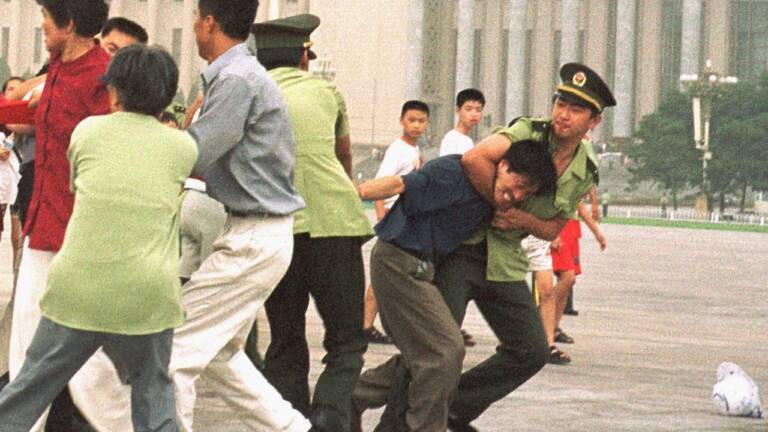
One
Man’s Decision to “Eradicate” the Traditional Chinese Belief of 100 Million People
By
Dr. Michael Pearson-Smith
|

OVER
THE LAST four years, China watchers have proposed a variety of socio-political
reasons for why the Chinese regime moved to crush Falun Gong – a benign exercise
and meditation practice with ancient Chinese roots. The answer, however, has proved
to be simpler and far more disturbing than most initially guessed.
When
the nationwide persecution campaign against Falun Gong began in China in July
1999, many believed the campaign to be another mass movement orchestrated and
backed by the Communist Party leadership as a whole. Since that time, however,
facts have emerged to cast light on the maneuvers of then-Communist Party head
Jiang Zemin. An abundance of evidence has emerged showing Jiang not only formulated
the policy of eradicating Falun Gong himself, but also overrode the will of the
Premier and the rest of the Politburo Standing Committee – who initially disagreed
with Jiang’s stance on Falun Gong – to enact the campaign. Additionally, since
1999 Jiang has been the driving force behind the campaign and its rising intensity.
Falun
Gong Flourishes in China
From
its introduction to the public in May 1992 to the beginning of the persecution
in July 1999, the number of practitioners grew into the tens of millions. In 1999,
Chinese Government officials told the Associated Press and the New York
Times their estimate was “at least 70 million.” (AP: “Growing group poses
a dilemma for China,” 4/26/1999; NYT: “In Beijing: A Roar of Silent Protestors,”
4/27/1999)
Many
attributed the rapid growth of Falun Gong to its effectiveness in improving the
physical health of millions of Chinese citizens, while also uplifting mental and
spiritual well-being. By early 1999, one could see Falun Gong practitioners everywhere
among the morning exercisers in all the major cities of China. In a strictly controlled
society such as China it would have been impossible for such a large mass organization
and social phenomenon to exist, let alone thrive for seven years, without consent
and support from all levels of government.
At
the time, not only were the masses learning Falun Gong, but also all seven of
the Politburo Standing Committee members had read Zhuan Falun, the main
text Falun Gong. Many of their relatives and friends were also practicing Falun
Gong. Many high-ranking officials in the Communist Party, government and military
had taken up the practice themselves after attending Mr. Li Hongzhi’s lectures
personally or hearing about it by word-of-mouth.
The
Offensive Against Falun Gong Begins
In
the latter half of 1996 Falun Gong practitioners first began to report incidents
of harassment by police. Luo Gan was already a high-ranking official. As the Chair
of the Communist Party’s Political Legal Committee, Luo was in charge of the Public
Security Bureau, the national intelligence agencies, and the judiciary. But Luo
Gan saw in Falun Gong an opportunity for further political gain and put in motion
a plan to put Falun Gong and the government at odds with each other.
|
As
part of this plan, Luo, looking for a pretext to ban the practice, ordered the
police in China to conduct a secret investigation of Falun Gong across the country.
In July 1998, through the Chinese Ministry of Public Security Bureau #1 (a.k.a.
Political Security Bureau), Luo Gan issued Public Authority [1998] #555 “Notification
about conducting investigation of Falun Gong.” This document first labeled Falun
Gong a “cult,” then asked the police departments across the country to systematically
plant agents to investigate and collect “evidence.”
The
investigation by the police, however, found no evidence of crimes related to Falun
Gong.
At
the end of the summer a letter was written in response to Luo’s police investigation
by 135 very highly respected members of society, including famous professors,
actors, and high level government officials. The chief author of the letter was
a famous law professor at Beijing University. In it he explained that the basis
of Luo Gan’s investigation of Falun Gong in July, the above-mentioned “notification”
from the Chinese Ministry of Public Security Bureau #1, violated the Chinese Constitution
and was against the law.
Premier
Zhu Rongji quickly responded, saying that the Public Security Bureau should not
harass Falun Gong practitioners, but should concentrate on security issues. Zhu’s
response also mentioned that Falun Gong had helped to save large amounts of medical
costs for the country.
The
response from Premier Zhu, however, was intercepted by Luo, and never forwarded
to Falun Gong practitioners. It was not until April 25, 1999, that Premier Zhu
learned his response had been withheld by someone. It was also not until that
time that Falun Gong practitioners first learned there had been such a positive
response from Premier Zhu.
Following
the police investigation in July, a few retired Communist Party members of the
National People’s Congress led by Qiao Shi, who had been in his own time been
a very high-ranking official, conducted their own investigation of Falun Gong.
They received a great deal of feedback from the population, and concluded that
Falun Gong brought much benefit to China with no negative impact. They ended their
report by saying “Winning the hearts of the people you gain the world. Losing
the hearts of the people, you lose everything.” The report was submitted in October
to the Permanent Standing Committee (the group of seven Communist Party members
who run the country), which Jiang Zemin headed.
Insiders
at Zhongnanhai (the government compound in Beijing) reported that Jiang was very
displeased with this report, and wrote a note to Luo Gang expressing his displeasure,
a note that excited Luo’s desire to advance himself by opposing Falun Gong.
April
25th: Jiang Zemin’s Excuse to Declare War
The
acts of harassment against Falun Gong came to a head in the city of Tianjin, not
far from Beijing. Luo Gan’s brother-in-law, a man with a Ph.D. in physics named
He Zuoxiu, who has regularly written propaganda articles for the Communist Party,
had written a magazine article attacking Falun Gong. That article included a previously
discredited story about an individual said to have committed suicide due to practicing
Falun Gong (in fact that young man had neither practiced Falun Gong nor committed
suicide). When the magazine refused to retract the article, practitioners held
a peaceful appeal outside its office.
Police
arrested and beat them. When local practitioners appealed to the police in Tianjin
for the release of those arrested, they were told all appeals on this issue must
go to Beijing. In all previous incidents in which practitioners had been harassed,
this had never been said before. The stakes had risen.
In
Mainland China, Appeal Bureaus are set up by the government to receive grievances
from the people. All levels of the Party and administrative departments have Appeal
Offices. For example, the Appeal Bureau for the State Council is located about
two to three hundred meters down Fuyou Street from Zhongnanhai, the central government’s
compound in Beijing.
On
the morning of April 25, 1999, over 10,000 Falun Gong practitioners – following
the instructions they were given by officials in Tianjin – came to the Appeal
Bureau for the State Council from different areas. They had heard of the situation
through word of mouth, and came to appeal of their own individual will, hoping
to appeal directly to the officials in the central government. Police were waiting
for them in force. Rather than directing them away from the sensitive government
compound of Zhongnanhai toward the Appeals Office, police did the opposite. They
refused to let practitioners approach the Appeals Office, and instead directed
them opposite Zhongnanhai until the group wound entirely around the complex in
neat, orderly rows.
On
that day, then-Premier Zhu Rongji came out of the Zhongnanhai government compound
and talked to the Falun Gong practitioners. According to witnesses, Premier Zhu
asked why the practitioners had come, saying “Didn’t I already issue comments
on your practice?” The Falun Gong practitioners responded that they never received
Zhu’s correspondence. They proceeded to explain that police in Tianjin had beaten
and illegally arrested over 30 Falun Gong practitioners. “We were told this could
not be resolved locally, and that we should appeal to the central government,”
the practitioners told Premier Zhu.
After
listening to the report of the situation, Zhu issued an order to release the arrested
practitioners that same day. After confirming that the practitioners in Tianjin
would be released, the 10,000 then quietly dispersed.
Not
knowing practitioners were instructed to go to Beijing and then arranged around
Zhongnanhai by the police awaiting them, many observers understood the appearance
of practitioners there to be a direct challenge to the Communist Party’s authority,
and, when the persecution began, assumed the events of April 25th to be the cause.
Jiang
Overrides Government Leaders and Orders Persecution
Eyewitnesses
report that when the news of the Falun Gong appeal was brought to Jiang during
the day, he responded with a vehemence that shocked all present, “Crush Falun
Gong! Crush it! Crush it completely!”
That
evening, Jiang wrote a letter to the other members of the Permanent Standing Committee
and other top Party officials, calling for an emergency meeting regarding this
incident. “The Communist Party must vanquish Falun Gong,” Jiang stated in the
letter. “How could it be possible that the Marxist theory we endorse and the materialism
and atheism that we believe in can’t vanquish what Falun Gong propagates? If it
were true, wouldn’t we become laughing stocks?”
During
the meeting, Jiang openly reprimanded Zhu calling him “Muddle-headed! Muddle-headed!”
He repudiated the Premier’s decision that was in the process of being implemented,
and forced the Party to accept his personal goal to “eradicate” Falun Gong.
At
the end of the meeting, Zhu Rongji, who had been accused under Mao of being a
“rightist,” stopped and shook hands with every staff member present, saying his
goodbyes. He is not known to have uttered a word about Falun Gong since.
Acting
on Jiang’s instructions the General Office of the CCP Central Committee and the
State Council then issued a circular to the Party Committees of all provinces,
autonomous regions and municipalities. This demanded that all departments ascertain
whether any of their personnel were Falun Gong practitioners and whether they
had been to Zhongnanhai on April 25th. Jiang also ensured that the General Political
Department of the People’s Liberation Army issue a directive demanding that all
military personnel, including support workers and even retirees, cease participation
in Falun Gong exercises. The order stated: “The people’s armed forces must never
allow any qigong organizations of a religious nature; and must firmly and decisively
dismiss those servicemen and dependents who are Falun Gong exercisers. Whoever
disobeys this shall be strictly disciplined.”
Yet,
Jiang still faced considerable opposition within the Communist Party. His policy
was viewed by most of the top Party members as irrational, unnecessary, and one
that violated China’s own Constitution. Jiang, however, was the head of the Communist
Party, the government, and the military. Thus, in the face of Jiang’s intimidation,
over the next few months all high-ranking officials of the Chinese government
gradually grew silent on the Falun Gong issue.
Between
April 25 and July 20, 1999, Jiang and Luo began to make use of all meetings and
public occasions to force everyone to express their attitudes and pledge their
allegiance. Chinese government sources say the situation during this time was
also very chaotic as Jiang’s followers attempted to find incriminating details
that they could use to justify the persecution and silence any objections.
The
State Appeals offices still held policies that announced a “freedom to practice”
qigong, and “no ban on spiritual practices.” These announcements were on the walls
of the Appeals offices directly alongside the new policies posted by Jiang, making
the discord about Falun Gong at the highest levels of the Party visible for all
to see.
At
a Politburo meeting on June 7 Jiang announced the decision to form a leadership
team “to deal with the Falun Gong problem.” The Director of that team would be
former vice-premier Li Lanqing, and his assistant directors would be Luo Gan and
the Propaganda Minister Ding Guangen.
On
June 10, the Central Committee obediently formed the “Leadership Team to Deal
with the Falun Gong Problem,” headed by Li, with Luo and Ding as assistants. This
team in turn formed an office they called the “6-10 Office,” named after the date
of its institution. The 6-10 Office would carry out the policies of Jiang and
his “Leadership Team” in eradicating Falun Gong. (see The
6-10 Office)
In
the early morning hours of July 20, 1999, Falun Gong practice site volunteers
around the country were pulled from their beds and detained by police. On the
same day, Jiang ordered the Central Civil Affairs Department, which is responsible
for the registration of groups and organizations, to issue a notice banning Falun
Gong.
An
estimated 35,000 practitioners were detained over the next several weeks. Within
a few months, the first reports of severe abuse, torture and killings began to
emerge from inside China.
Four
Years of Jiang-sponsored Terror
According
to sources in China and thousands of testimonies from victims over the last four
years, Jiang implemented the persecution through a three-pronged directive to
all levels of government: Destroy [Falun Gong] practitioners physically; destroy
their reputations; destroy them financially.
Numerous
edicts handed down by Jiang, which the security and propaganda machines had no
choice but to obey, were illegal and unconstitutional. In July 1999, Jiang, through
the Bureau of Civil Affairs (an Administrative branch), declared Falun Gong to
be an “illegal organization.” According to Articles 2, 80, and 81 of the Constitution
of the People’s Republic of China, only the National People’s Congress has the
ability to declare an organization illegal. The President does not possess such
power. Yet, this executive order initiated the persecution campaign.
In
October 1999, the National People’s Congress passed a series of laws basically
targeting Falun Gong. Regarding these laws, a November 2, 1999, article from the
Washington Post stated: “When [China’s Communist leaders] found themselves without
the laws they need to rigorously persecute a peaceful meditation society, the
Party simply ordered up some new laws. Now these will be applied – retroactively.”
These laws were dictated by Jiang, using the National People’s Congress merely
as a rubber stamp. Doing so oversteps the authority granted to the President by
the Chinese constitution. Applying these laws retroactively to prosecute Falun
Gong practitioners and sentence them to prison terms was likewise an illegal action.
Although
many provinces were quick to enact Jiang’s policy on Falun Gong, some southern
provinces, such as Guandong, were not pursuing the persecution with the vigor
Jiang demanded. Thus, in February 2000, Jiang went on a tour of those southern
provinces to spur them on and ensure that they toed the line. In particular, he
criticized Guandong for not “doing its best in the persecution of Falun Gong,”
and for being “too soft” on Falun Gong. He also asked Guandong Province Governor,
Li Changchun, to make a statement at the conference of the Political Bureau to
“express regret” with respect to his lack of efforts in this area.
Under
pressure from Jiang, Guandong Province as well as other southern provinces eventually
began to incarcerate Falun Gong practitioners and send them to labor camps en
masse. Among the first from Guandong to be sent to a labor camp was a university
classmate of Hu Jintao, the vice-president of China (and the man who would succeed
Jiang as President and Chair of the Communist Party). Hu had been very passive
in carrying out Jiang’s campaign against Falun Gong. In forcing Hu to accept this,
Jiang sent a powerful double message: no one may be granted exception from the
persecution, and none of China’s leadership may try to avoid the responsibility
for enforcing it.
By
the end of 2003, details of 852 deaths have been verified by the Falun Dafa InfoCenter
(FDI), with informed sources putting the true death toll well in the thousands.
Hundreds of thousands have been detained, with more than 100,000 being sentenced
to forced labor camps, typically without trial, according to the InfoCenter.
Jiang’s
Motives
CNN’s
China expert Willy Wo-Lap Lam has reported that the persecution of Falun Gong
was in fact an attempt by Jiang to secure his own power. Lam quoted a Party insider
on February 6, 2001 as saying “by unleashing a Mao-style movement, Jiang is forcing
senior cadres to pledge allegiance to his line. This will boost Jiang’s authority
— and may give him enough momentum to enable him to dictate events at the pivotal
16th Communist Party Congress next year.”
Others
who have been investigating the human rights abuses against Falun Gong in China,
however, put forth a more mundane cause: Jealousy. Consider events in the spring
of 1998. The Yangtze River was flooding. Jiang visited the city of Wuhan on an
inspection tour of the endangered areas. According to eyewitnesses, a particular
group working on the dikes caught his eye. They worked very well together and
with great enthusiasm. Their section of the dike had stayed ahead of the flood.
Jiang was very pleased. He asked who these workers were. When told they were local
Falun Gong practitioners who had volunteered for this duty, he flew into a rage,
turned on his heel, and stalked off.
“Jiang
was jealous of Falun Gong’s wide-spread popularity among the people,” says Dr.
Shiyu Zhou, a Falun Dafa InfoCenter (FDI) spokesman. “Falun Gong had captured
the nation’s attention and seemed to truly bring about changes in the communities.
After so many years of turmoil, people in China were returning to a more traditional
Chinese way of life, working together, thinking of others before themselves and
putting an emphasis on kindness. It may sound petty at first, but the admiration
people held for Falun Gong made him furious. That’s the main reason he did this.”
Dr.
Michael Pearson-Smith lives in Melbourne, Australia, and works in educational
publishing and sales.
Posting date: 22/Mar/2004
Original article date: 16/Mar/2004
Category: Media Report