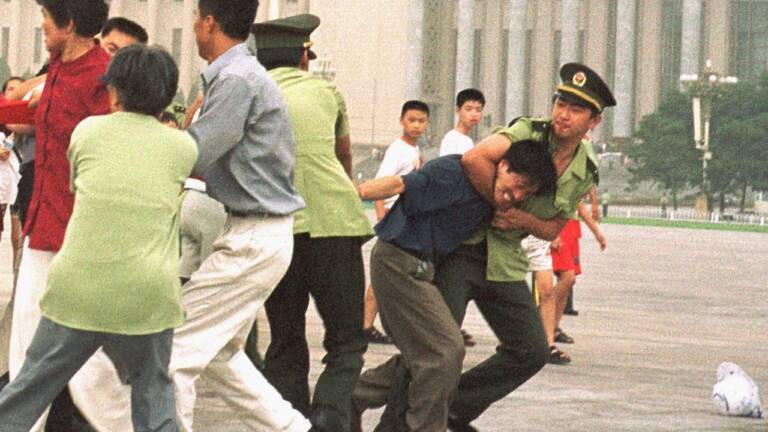
The
Government continued its crackdown against the Falun Gong (FLG)
spiritual movement. Thousands of practitioners were incarcerated
in prisons, extrajudicial reeducation-through-labor camps, psychiatric
facilities or special deprogramming centers. FLG adherents conducted
far fewer public demonstrations than in past years, which some observers
attributed to the effectiveness of the Government’s crackdown
[although fewer practitioners have been going to Tiananmen Square,
more and more Falun Gong practitioners have been stepping forward
to clarify the facts of the persecution in different ways. Please
refer to www.faluninfo.net].
Several hundred Falun Gong adherents reportedly have died in detention
due to torture, abuse and neglect since the crackdown on Falun Gong
began in 1999.
Section 1 Respect for the Integrity of the Person, Including Freedom
From:
a. Arbitrary or Unlawful Deprivation of Life
The official press reported a number of extrajudicial killings,
but no nationwide statistics were available. During the year, deaths
in custody due to police use of torture to coerce confessions from
criminal suspects continued to be a problem. Several hundred Falun
Gong adherents reportedly have died in detention due to torture,
abuse and neglect since the crackdown on Falun Gong began in 1999.
For example, Zheng Fangying of Weifang, Shandong Province, was arrested
in December 2001 after she tried to unfurl a pro-FLG banner in Beijing’s
Tiananmen Square. Zheng was taken to a detention center where she
was punched and shocked with electric batons. Police released her
after she staged an 18-day hunger strike. Three days later, she
reportedly died from her injuries at her home.
d. Arbitrary Arrest, Detention, or Exile
Arbitrary arrest and detention remained serious problems. The law
permits authorities, in some circumstances, to detain persons without
arresting or charging them, and persons may be sentenced administratively
to up to 3 years in reeducation-through-labor camps and other similar
facilities without a trial. Because the Government tightly controlled
information, it was impossible to determine accurately the total
number of persons subjected to new or continued arbitrary arrest
or detention. Official government statistics indicated that there
were 230,000 persons in reeducation-through-labor camps. According
to a 2001 article by the official news agency, 300 reeducation-through-labor
facilities have held more than 3.5 million prisoners since 1957.
In addition, it was estimated that before 1996 as many as 1.7 million
persons per year were detained in a form of administrative detention
known as custody and repatriation; the number of persons subject
to this form of detention reportedly has grown since 1996 to approximately
2 million per year. The Government also confined some Falun Gong
adherents and labor activists to psychiatric hospitals. Although
the crime of being a “counterrevolutionary” was removed from the
criminal code in 1997, western NGOs estimated that as many as 1,300
persons remained in prison for the crime. Another 600 were serving
sentences under the State Security Law, which covers the same crimes
as the repealed law on “counterrevolution.”
According to researchers, the country had 20 “ankang” institutions,
high-security psychiatric hospitals for the criminally insane, directly
administered by the Ministry of Public Security (MPS). Dissidents
and other targeted individuals were housed with mentally ill patients
in these institutions. The regulations for committing a person into
an ankang psychiatric facility were not clear. Credible reports
indicated that a number of political and trade union dissidents,
“underground” religious believers, persons who petitioned the Government
for redress of grievances, and hundreds of Falun Gong adherents
were incarcerated in such facilities during the year. For example,
political activist Wang Wanxing, originally held for trying to unfurl
a banner on Tiananmen Square to commemorate the third anniversary
of the June 4, 1989 massacre, was confined in a Beijing ankang facility.
Huang Jinchun, a judge in Beihai, fired from his job and admitted
to a psychiatric hospital in November 1999 for refusing to renounce
his belief in Falun Gong, also remained in an ankang facility at
year’s end. He reportedly displayed no signs of mental illness
but was given daily injections of narcotics. According to NGO reports,
more than 30 persons were committed during the year to the Harbin
Psychiatric Hospital against their will after petitioning authorities
for redress of various personal grievances. In August The Royal
College of Psychiatrists sponsored a motion to expel China from
the World Psychiatric Association (WPA) for using psychiatric facilities
to incarcerate political prisoners; a decision was pending at year’s
end.
Section
2 Respect for Civil Liberties, Including:
a. Freedom of Speech and Press
The Constitution states that freedom of speech and freedom of
the press are fundamental rights to be enjoyed by all citizens;
however, the Government tightly restricted these rights in practice.
The Government interpreted the Party’s “leading role,” as
mandated in the preamble to the Constitution, as circumscribing
these rights. The Government strictly regulated the establishment
and management of publications. The Government did not permit
citizens to publish or broadcast criticisms of senior leaders
or opinions that directly challenge Communist Party rule. The
Party and Government continued to control many and, on occasion,
all print and broadcast media tightly and used them to propagate
the current ideological line. All media employees were under explicit,
public orders to follow CCP directives and “guide public opinion,”
as directed by political authorities. Both formal and informal
guidelines continued to require journalists to avoid coverage
of many politically sensitive topics. The State Security Law forbids
journalists from divulging state secrets. These public orders,
guidelines, and statutes greatly restricted the freedom of broadcast
journalists and newspapers to report the news and led to a high
degree of self-censorship. The Government continued an intense
propaganda campaign against the Falun Gong.
Government restrictions on the press and the free flow of information
continued to prevent accurate reporting on the spread of HIV/AIDS
and the role of blood collection procedures in the spread of the
disease in rural areas.
For several years, journalists openly have called for legislation
granting press freedom protection. In May 2000, the legal affairs
bureau of Anhui Province issued a regulation banning government
departments from refusing press interviews.
The Government kept tight control over the foreign press during
the year and continued efforts to prevent foreign media “interference”
in internal affairs. The June 15 edition of the Economist was banned
due to an editorial it ran entitled “Set China’s Politics Free.”
Time Magazine was temporarily banned after an article appeared on
the Falun Gong. In July BBC World Television was blocked for several
weeks after it ran a report about the banned Falun Gong spiritual
movement.
During the year, Falun Gong followers overrode television broadcasts
several times to broadcast pro-FLG statements during regular programming.
In September 15 persons were given sentences ranging from 4 to 20
years in prison for interfering with a cable television system in
the northeastern city of Changchun in March. On December 30, the
Intermediate People’s Court in Xining sentenced four FLG adherents
to up to 20 years in prison for tapping into cable television signals.
The Government also reported several instances of individuals interfering
with domestic broadcasts transmitted via satellite, replacing regular
programming with pro-FLG material.
b. Freedom of Peaceful Assembly and Association
The Constitution provides for freedom of peaceful assembly; however,
the Government severely restricted this right in practice. The Constitution
stipulates that such activities may not challenge “Party leadership”
or infringe upon the “interests of the State.” Protests against
the political system or national leaders were prohibited. Authorities
denied permits and quickly moved to suppress demonstrations involving
expression of dissenting political views.
At times police used excessive force against demonstrators. Demonstrations
with political or social themes were often broken up quickly and
violently. The most widely publicized demonstrations in recent years
were those of the Falun Gong spiritual movement. The Government
continued to wage a severe political, propaganda, and police campaign
against the FLG movement during the year. Since the Government banned
the FLG in 1999, mere belief in the discipline, without any outward
manifestation of its tenets, has been sufficient grounds for practitioners
to receive punishments ranging from loss of employment to imprisonment,
and in many cases, to suffer torture and death…However, the great
majority of practitioners were punished without a trial, primarily
in the reeducation-through-labor system. Many thousands of persons
have been detained in reeducation-through-labor and custody and
repatriation camps; others have been confined to psychiatric hospitals.
In 2001 facilities were established specifically to “rehabilitate”
practitioners who refused to recant their belief voluntarily (see
Section 2.c.).
c. Freedom of Religion
The Constitution provides for freedom of religious belief and the
freedom not to believe; however, the Government sought to restrict
religious practice to government-sanctioned organizations and registered
places of worship and to control the growth and scope of the activity
of religious groups. There are five officially recognized religions–Buddhism,
Taoism, Islam, Protestantism, and Catholicism. A government-affiliated
association monitored and supervised the activities of each of the
five faiths. Membership in religions was growing rapidly; however,
while the Government generally did not seek to suppress this growth
outright, it tried to control and regulate religious groups to prevent
the rise of groups or sources of authority outside the control of
the Government and the Communist Party.
Overall, government respect for religious freedom remained poor,
and crackdowns against unregistered groups, including underground
Protestant and Catholic groups, Muslim Uighurs, and Tibetan Buddhists
continued…Various sources reported that thousands of FLG adherents
have been arrested, detained, and imprisoned, and that several hundred
or more FLG adherents have died in detention since 1999; many of
their bodies reportedly bore signs of severe beatings or torture
or were cremated before relatives could examine them [please
note that Falun Gong is not a religion. For more information on
the nature of Falun Gong, please click here].
The atmosphere created by the nationwide campaign against the FLG
reportedly had a spillover effect on unregistered churches, temples,
and mosques in many parts of the country…Party and PLA personnel
have been expelled for adhering to Falun Gong beliefs.
Full
text available at http://www.state.gov/g/drl/rls/hrrpt/18239.htm
Posting date: 3/Apr/2003
Original article date: 2/Apr/2003
Category: World News