Reuters English News Service
by John Ruwitch
BEIJING(Reuters) – If knowledge is power, then Luo Gan has the
potential to be the mightiest man in China.
He is neither president nor premier, nor does he have a spot yet in China’s
top decision-making body, the seven-man Politburo Standing Committee.
But as chief of China’s vast and secretive security machine, Luo, 67,
controls the keys to the dossiers of 1.3 billion people – including those in
the ruling Communist Party’s leadership.
“He knows where the skeletons lie,” said a senior foreign diplomat who has
met the mechanical engineer-turned-politician.
“People who come in with that background have some huge advantages behind
closed doors with the things they know and the ways they can use them,” he
said.
Luo is a long-time associate and friend of top legislator Li Peng, the
number two in the party hierarchy, and presides over a portfolio that has
set the tone for crime and punishment in the world’s most populous country
since the late-1990s.
As head of the party’s political and legislative affairs committee, Luo has
overseen reforms to professionalise the country’s judicial system and make
China a more secure place for foreign investment and economic development.
Under Luo, who is a state councillor – a notch below vice-premier – gavels
and robes were introduced in courtrooms. Luo himself has advocated tougher
laws to comply with China’s obligations as a new member of the World Trade
Organisation.
And the bodies under his control have had a hand in efforts to stamp out
rampant official corruption, loathed by ordinary Chinese and seen from
within as a threat to party rule.
MR STABILITY, NOT MR REFORM
But there has been a dark side to his work that foreign governments and
rights groups have criticised for worsening China’s already dismal human
rights record.
“He’s the big boss, but at the same time he’s not directly in charge. And he
doesn’t seem to be very interested in the legal reforms,” said Jean-Pierre
Cabestan, head of the French Centre for Research on Contemporary China in
Hong Kong.
“He’s much more Mister Stability than Mister Legal Reforms.”
Successive “strike hard” campaigns against crime under Luo have scooped up
offenders, but critics argue they tend to spiral into indiscriminate
dragnets based on quotas and misdirected incentives for police and don’t
have lasting effects.
Under Luo’s watch executions have soared. In 2001, China put to death 2,468
people, nearly seven a day, more than all other countries in the world
combined, says the London-based rights group, Amnesty International.
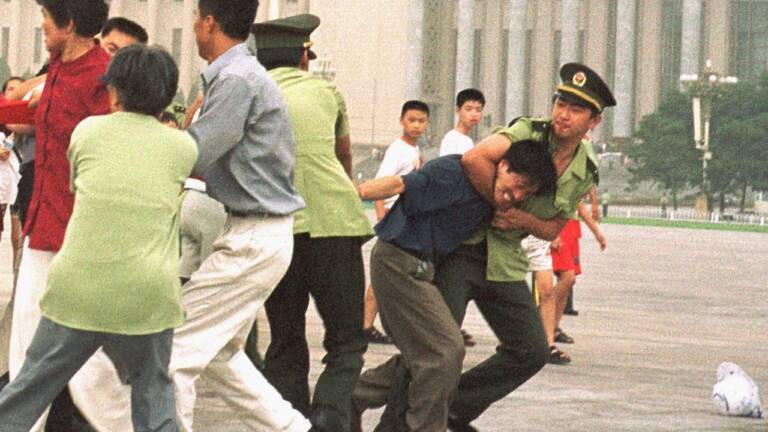
And one of Luo’s crowning achievements has been the almost total smothering
of the Falun Gong peaceful meditation practice in China since it was outlawed in 1999.
The leadership has heralded the campaign as a huge success which, no doubt,
has brought Luo closer to the man who ordered the crackdown, President Jiang
Zemin.
But the effort, which Falun Gong’s U.S.-based information centre says has
seen more than 1,600 members killed at the hands of the police – which China
denies – has drawn criticism from the European Union, the United States and
other countries and rights groups.
Luo also oversees China’s secret police and is chairman of the murky Central
Committee of Secrecy.
REGULAR VISITOR OF LI’S
The winds have blown favourably for Luo, expected to get a seat on the
Standing Committee at the pivotal 16th Party Congress starting on November 8
and a promotion to vice-premier.
Analysts say the East German-trained metals engineer was shepherded towards
the promotion by his friend and associate Li Peng, 74, who is set to retire
from his party post.
The bond between Luo and Li goes back to 1989 when Luo ferried information
to and from Li during the student protests for democracy centred on
Tiananmen Square that were eventually smashed by the army.
“His involvement in the Tiananmen repression and his personal loyalty to Li
Peng guarantee that he would resist any reversal of the party’s position
justifying its violence on June 4,” Columbia University professor Andrew
Nathan and Princeton University doctoral candidate Bruce Gilley said in a
recent article.
And with allegations of corruption swirling around the Li family, Li Peng
will no doubt feel safer in retirement with the loyal Luo in such a high
post, analysts said.
Luo is said to have visited Li at home in the Zhongnanhai leadership
compound regularly during 1989, a habit he is reported to maintain and may
continue even after Li retires.
“He seemed very much at home there,” said the foreign diplomat, who met Luo
there. “That always tells you something about a cadre.”
Copyright 2000 Dow Jones & Company, Inc. All Rights Reserved.
Posting date: 17/Nov/2002
Original article date: 5/Nov/2002
Category: Media Reports