HONG KONG — The government here toned down controversial elements of a proposed antisubversion law in the face of broad opposition.
Changes announced Tuesday by Chief Executive Tung Chee Hwa address some, though not all, key concerns that the controversial law would curtail civil liberties and press freedoms that have so far remained largely intact since Hong Kong’s 1997 handover to Chinese rule.
A provision of the law that would have outlawed the mere possession of materials deemed seditious has been scrapped, Mr. Tung said. To press charges, prosecutors will now have to prove an intent to use such materials to incite others to commit treason, secession or subversion against China.
The government also narrowed the offense of obtaining state secrets — vague definitions of which have aroused fears that the law could become a pretext for arbitrarily jailing journalists or academic researchers, as has occurred in China. It will now only be illegal to obtain classified information by illicit means, such as burglary, hacking into computers or by bribing officials.
In a community reaction that Mr. Tung called “overwhelming,” private citizens and organizations submitted some 100,000 formal responses to the government’s plan. “We have listened closely to their views and fully grasped the views of the public on this issue,” he said.
Critics of the original legislation welcomed the government’s willingness to bend to public pressure. But a continuing source of unease remains the government’s unwillingness so far to make the full text of the bill available for public inspection before sending it to the city’s legislature, which is dominated by representatives allied with the Tung administration.
“[The changes] are appropriate and reflect the force of the submissions made to them,” said Philip Dykes, a spokesman for the Hong Kong Bar Association. “They don’t go far enough, but we’re handicapped in the usefulness of our comments by the absence of a text.”
Another concern centers around the vagueness of the government’s terms. When the authorities have broad discretion, for example, to find any political discussion to be subversive or treasonous, the difference between possessing a seditious publication versus disseminating it means little, said Cyd Ho, an opposition lawmaker. The government, ducking a big question, chose a revision that “tackles only sideline issues,” she said.
Still, representatives of the business community were “pleasantly relieved” after a briefing by Secretary for Security Regina Ip and other officials, said James Thompson, the chairman of the American Chamber of Commerce. Of the worrisome areas that his chamber singled out in its submission, Mr. Thompson said, “We came away feeling that every single one of them had been addressed, and addressed in a way that was thorough enough to give us comfort.”
He and others present quoted Ms. Ip as telling the gathering that the government would begin drafting the legislation immediately and aimed to complete work before the end of February. She provided no assurances on how it would then present the legislation to the public, saying a decision had yet to be taken.
The proposed antisedition law has provoked one of the most heated debates since Hong Kong came under Chinese rule, with thousands of people on both sides turning out to demonstrate. Terms of the handover called for Hong Kong to maintain its economic and political system for 50 years but required new legislation against subversion, sedition and other crimes against the state.
The government’s initial proposals — released only in outline form — prompted concerns that the legislation might erode Hong Kong’s Western-style freedoms, substituting policies more like those in China, where information and dissent are tightly controlled.
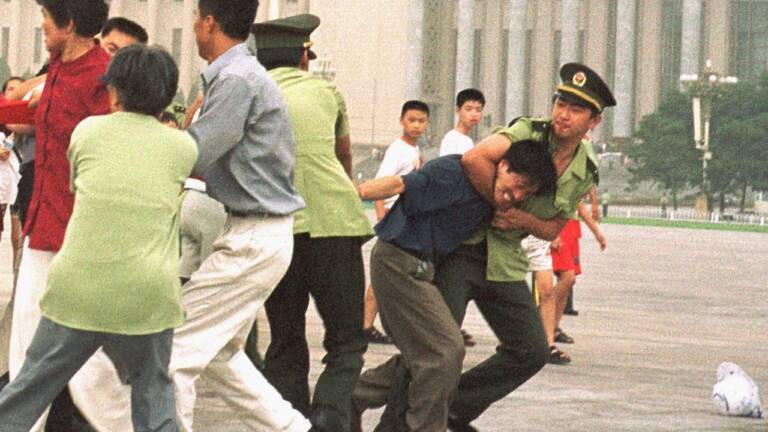
One concern has been potential use of the new law to crack down on local adherents of Falun Gong, a religious movement also known as Falun Dafa that Beijing has banned as an xxx. The new proposals bar the Security Secretary from banning a local group for merely being linked to mainland groups blacklisted by Beijing. The secretary can only move against local groups directly controlled by a mainland body that Beijing has publicly decreed as a national security threat.
This change would give immunity to pro-democracy or human-rights groups linked to political opposition groups that Beijing covertly suppresses. However, it leaves unclear whether Falun Gong members could continue to freely practice in Hong Kong.
Posting date: 01/Feb/2003
Original article date: 30/Jan/2003
Category: Media Reports