By Wu Ming
In May 1992, Mr. Li Hongzhi held the first Falun Gong
class in China. In September 1992, Falun Gong was officially accepted as a direct
branch of the China Qigong Research Association and received a nationwide permit
to teach Falun Dafa in China. Later, the China TV Broadcasting Agency Publishing
Company and some other official publishing companies published Mr. Li’s works,
Falun Gong and Zhuan Falun.
Because of its tremendous power to improve health,
Falun Gong stood out from the thousands of other qigongs of that time and spread
quickly. Before July 1999, by early dawn, almost every Chinese park would be brimming
with people practicing Falun Gong. The number of Falun Gong practitioners reached
100 million within seven years. The practitioners live in different geographic
regions and are of all ages, social strata and walks of life. Even the seven members
of the Politburo Standing Committee had read Zhuan Falun. Some of their family
members practiced Falun Gong and so did many highly ranking Party officials. Many
government agencies and mainstream media acknowledged and supported Falun Gong.
In
December 1992, Mr. Li Hongzhi and some of his students attended the 1993 Oriental
Health Expo in Beijing. Mr. Li Rusong, Chief Executive Officer of the Expo, and
Professor Jiang Xuegui, Chief Consultant of the Expo, commented objectively on
Mr. Li’s cultivation power and the miraculous healing effects of Falun Gong. Mr.
Li Rusong mentioned, "Falun Gong received the most praise during the Exposition
and its healing effects are good." Professor Jiang Xuegui commented, "It
can be said that Mr. Li Hongzhi was a shining star at the Exposition. I witnessed
many of Master Li’s miracles at the Exposition. I have seen patients who were
dependant on walking-sticks and wheelchairs, those who were bothered by various
conditions that prevented them from walking normally, miraculously stand up and
walk after having been adjusted or treated by Master Li. It’s just as it has been
stated: Falun Gong is a miraculous cultivation system. As the Chief Consultant
of the Expo and with corresponding responsibility, I recommend Falun Gong to you
all. I believe that this cultivation system will genuinely bring people physical
health and a fresh spirit and mind."
On August 25, 1993, the Ministry
of Public Security and the Ministry Propaganda cosponsored the Third Conference
of the National Foundation for Heroes in Beijing. The Qigong Research Society
and the Foundation invited Mr. Li Hongzhi to give free treatments to those who
were injured or disabled in the line of duty. On August 31, the Valor Foundation
wrote a letter to the China Qigong Research Association and to Mr. Li Hongzhi
to express their gratitude, in which it stated, "On August 24, upon our invitation,
Mr. Li Hongzhi made a special trip to the Public Security Ministry and offered
treatment to Chairman Wang Fang. On August 30, Mr. Li, Hongzhi, leading a group
of students, offered treatment to up to 100 representatives at the Conference
venue. Because of the remarkable effectiveness, the treatment received wide acclaim.
Prior to the treatment, some people were suffering from ailments left over from
knife and gunshot injuries. After the treatment, they were relieved of symptoms
such as pain, numbness and chronic weakness. Those suffering from brain illnesses
recovered and became sober minded after the treatment. They were relieved of symptoms
such as headache and dizziness. Some people were relieved of tumors right on the
spot. Some excreted gallstones in 24 hours after receiving the treatment. Some
people suffered from stomach diseases, heart diseases or arthritis. After the
treatment, all of them were relieved of symptoms right on the site. Among almost
100 people who received the treatment, only one person claimed no obvious effects.
All others felt obvious improvements to various degrees. The representatives treated
by Falun Gong were very grateful for this event arranged by the Valor Foundation
and credited it as a tangible help offered during the Conference with the following
statement: "Whereas the leaders of CQSRS and Mr. Li, Hongzhi directly offered
that help, and the activity would help promote the general public’s sense of voluntarily
combating criminal activities, we hereby express our sincere thanks to you, other
CQSRS leaders and Mr. Li, Hongzhi!" The People’s Public Security News, published
by the Ministry of Public Security of the People’s Republic of China, carried
a report on September 21, 1993 about this event.
The Chinese government
has always been known for its efforts to strictly control the minds of the population.
After the Communist Party took power, waves of political movements threw the country
into constant turmoil. Today, elderly Chinese people can still vividly recall
the series of framing, fabrications and persecution cases during the "Anti-rightist"
movement and the Cultural Revolution. After the economic reform and "opening-up"
policies took effect, China’s economy developed quickly and the financial environment
loosened up, but the same cannot be said about the government’s iron-fisted control
on diversity of thought. The Party did not lighten its suppression of nonconforming
opinions and civil groups. Those in power have deeply rooted in their minds the
notion of regarding those with differing ideas as their enemy; it’s a form of
"political hypersensitivity" formed during various upheavals during
the Party’s rule. The rulers’ mindset provides an excellent opportunity for those
who hope to seize power through starting a movement, or people who are always
on the lookout for the path to promotion. Such was the unique social environment
confronting Falun Gong in Mainland China, which had great impact on its development.
Falun
Gong brought tremendous benefits to its practitioners as it helped them improve
their moral level as well as their physical health. However, because Falun Gong
principles are different from the atheism advocated by the Party and the number
of Falun Gong practitioners quickly exceeded the number of Party members, gradually
some official media developed misunderstandings about Falun Gong. In addition,
some Party leaders and political opportunists’ hypersensitivity took charge, and
they thought they had to defend their power by going on the offensive and stirring
up trouble. The conspiracy to persecute Falun Gong gradually took form in secret
while the public and the Falun Gong practitioners were completely unaware of it.
Luo Gan, who played an important role in the June 4 Massacre of students on Tiananmen
Square, and his brother-in-law He Zuoxiu, a sham scientist and political hack,
actively took part in the conspiracy.
On June 17, 1996, Guangming Daily,
a government-run newspaper, published an editorial article entitled, "A Loud
and Long Alarm Must Be Sounded Against Pseudo-Science," which claimed that
Falun Gong promoted superstition, and was "Pseudo-Science." It called
Falun Gong practitioners fools for their belief. One month later, the Chinese
News Publishing Bureau, under the Propaganda Ministry at the Central Committee
of the Chinese Communist Party, issued an order to all cities and provinces, prohibiting
the publishing of Zhuan Falun and China Falun Gong, and other Falun Gong books
with the excuse that the books were "promoting superstition." Soon,
a dozen major official newspapers such as Qilu Evening News and China Youth Daily
published articles attacking Falun Gong.
In 1997, Luo Gan, the secretary
of the Political and Judiciary Committee of the CCP Central Committee ordered
the police to secretly investigate Falun Gong throughout China and look for evidence
to ban Falun Gong. Although they could not find anything wrong with Falun Gong,
the police in certain regions started to monitor and fine Falun Gong practitioners
and interfere with their daily lives.
When confronted with attack and slander,
Falun Gong practitioners went to the media and government officials time and time
again to peacefully clarify the facts about Falun Gong. Their sincerity and openness
moved many people who had misunderstandings; they won support from open-minded
Party officials. Some media published corrective reports after they learned the
truth. In order to prevent the Ministry of Public Security from continuing its
secret attack against Falun Gong, on May 15, 1998, Mr. Wu Shaozu, director of
China’s National Sports Commission (NSC) went to Changchun City, where Falun Gong
had originated, to do research about Falun Gong. After a thorough study, the NSC
determined the overall efficiency of healing and keeping fit by practicing Falun
Gong to be 97.9%. On October 20, the NSC sent a team of medical experts to Changchun
to conduct more research. After the study, the head of the research team said,
"We feel that both the Falun Gong exercises and their effectiveness are quite
good. The impact on the stability of society and the strengthening of the spiritual
culture are all quite evident. This deserves to be fully recognized."
In
1998, 135 well-known figures in society, also Falun Gong practitioners, jointly
submitted a letter to the then-president Jiang Zemin and Premier Zhu Rongji. The
letter stated that the Ministry of Public Security violated the Chinese Constitution
and the law by interfering with Falun Gong practitioners’ normal activities and
practice. It also said that the Ministry of Public Security should spend more
time controlling criminals instead of creating trouble for Falun Gong practitioners.
Premier Zhu Rongji wrote a note to the Ministry of Public Security, in which he
said that Falun Gong had saved the government tremendous medical expenses, and
that the police should focus on maintaining the people’s security instead of harassing
Falun Gong.
The political group of villains headed by Jiang Zemin, Luo Gan
and He Zuoxiu ignored the openness and honesty of Falun Gong practitioners. They
regarded the practitioners’ peaceful appeal to the media and the government as
a threat and challenge to their power, and they were intent on destroying Falun
Gong. According to a Party member who wishes to remain anonymous, in the latter
half of 1998, a group of retired National People’s Congress officials led by Qiao
Shi [the former Chair of the Standing Committee of the National People’s Congress]
conducted a detailed investigation and study over a certain period of time on
Falun Gong, because so many members of the public had sent letters mentioning
the Public Security Bureau’s illegal treatment of Falun Gong practitioners. The
conclusion of the study was that "Falun Gong only benefits and does no harm
to the nation and the people." They ended their report by saying "Winning
the hearts of the people you gain the world. Losing the hearts of the people,
you lose everything." The report was submitted in October to the Political
Bureau (the directing body of the Communist Party ), which Jiang Zemin headed.
Insiders at Zhongnanhai (the government compound in Beijing) reported that Jiang
was very displeased with this report, and wrote a note to Luo Gan expressing his
displeasure, a note that incited Luo’s desire to advance himself by opposing Falun
Gong. Luo Gan fully comprehended Jiang’s intentions. Soon, even premier Zhu Rongji’s
notes and comments on Falun Gong to be passed down to local government agencies
were withheld by Luo Gan. By early 1999, overwhelming pressure was mounted against
Falun Gong, and the interference that had lasted three years escalated.
On
April 11, 1999, He Zuoxiu published an article to attack and slander Falun Gong
in a nationwide journal issued by the Tianjin Educational Institute. In the article
he claimed practicing Falun Gong would make one go insane.
The article had
a very bad influence in society and it was not based on facts. Worried that if
they didn’t clarify the truth, Falun Gong’s reputation would be damaged and their
right to practice would be taken away, during the period from April 18 to 24,
some practitioners from Tianjin went to the Tianjin Educational Institute and
related organizations to explain the true situation of Falun Gong. At first, the
officials of the Institute met with the practitioners and said they would correct
the article. The next day, they changed their mind and refused to correct it.
More
and more practitioners went to the institute hoping to clarify the facts with
their firsthand experience. On April 23 and 24, the Tianjin Municipal Bureau of
Public Security dispatched about 300 riot police to beat the practitioners participating
in the peaceful and lawful appeal. The authorities arrested 45 practitioners and
the police injured some practitioners. The Tianjin City government officials told
the practitioners that the arrests made were not within their control and if the
practitioners wanted to appeal, they must go to the central government in Beijing.
The
news spread quickly. People sensed pressure from the central government from the
unusual violence of the Tianjin City government and police. The practitioners
firmly believed there was nothing wrong with being good people according to Truth-Compassion-Tolerance,
and also their own experience had proved Falun Gong to be good. With their trust
in government and the hope of dispelling prejudice, about 10,000 practitioners
went to State Council’s Appeals Bureau near Zhongnanhai on April 25.
On
the same day, Premier Zhu Rongji met with representative practitioners.
According
to what practitioner Shi Caidong, a Ph. D. student at the Chinese Academy of Sciences
recalled, "It was around 7 a.m. when I arrived at the north end of Fuyou
Street on April 25. Practitioners had already filled up the two sides of Fuyou
Street and nearby streets. Some stood there and some sat down, but they did not
talk to passers-by. Some were holding books and reading. Even though there were
a lot of people, they did not create a traffic jam, nor did they make any noise.
Bikers on their way to work were pedaling by as usual. I crossed Xianmen Boulevard
and entered the south side of the district. It was my first time there and I didn’t
even know where the gate was. I thought I would first circle around to see if
I’d run into any practitioners I knew. So I walked south along the west side of
Fuyou Street. Practitioners lined up neatly on both sides of the streets. Practitioners
on the outside were standing and practitioners on the inside sat down. They were
all reading the book Zhuan Falun. Judging from their clothing, I could tell that
some were from the countryside and they looked sincere and kind. I didn’t meet
any acquaintances along my way, although I did see many young men reporting on
the situation through walkie-talkies. They were probably plainclothes policemen.
"As
I walked further down the street, I heard a low but enthusiastic applause. I turned
to take a look and saw Mr. Zhu Rongji a few dozen meters away walking from the
gate across the street. (I had just passed the west gate of Zhongnanhai). Several
of his staff members were following him. They walked towards practitioners who
were across the gate. Practitioners who were sitting down stood up and applauded.
Everyone was very happy and surprised to see Zhu Rongji come out to meet practitioners
as soon as he arrived at his office. Everyone wanted to approach him to explain
the situation. I walked back quickly and also tried to approach him from inside
the crowd. At that moment, a practitioner reminded everyone to stay put and maintain
good order.
"Zhu Rongji probably had already learned about Falun Gong
practitioners’ coming to appeal. He asked us loudly, ‘What are you here for? Who
told you to come here?’
‘You have freedom of religion and beliefs!’ He added.
‘We
are Falun Gong practitioners and we are here to explain the situation,’ Some practitioners
in the crowd replied.
‘If you have any problem, you can send some representatives
up here and I’ll take you inside for a discussion.’ Zhu Rongji paused, then said,
‘I can’t possibly talk to so many of you!’
"Zhu Rongji encouraged us
to designate representatives to talk to him. However, we had all come spontaneously
and most of us did not even know each other and had never thought about designating
representatives. Since our practice is entirely voluntary, we just come to practice
whenever we feel like it and if we don’t have the time we just go about our own
business. Nobody signs up for anything and nobody ever checks headcounts, let
alone elect representatives.
‘Do you have any representatives? Who among
you are the spokespersons?’ He again asked.
"At that moment I walked
up towards him and ended up about two meters from him. ‘Premier Zhu, I can go
with you.’ I was the first one from the crowd who volunteered to walk to his side.
‘Who
else?’ Zhu Rongji asked.
‘Me!’
‘Me!’
‘Me too!’
All of
a sudden, everyone raised their hands.
Every practitioner wanted to go in
to convey his or her message.
‘We cannot have too many people.’ Zhu Rongji
pointed at the first three persons. In fact, we were not elected or designated
representatives, but spontaneous volunteers.
"Zhu Rongji turned and
led us toward the west gate of Zhongnanhai. As he walked he raised his voice and
asked us, ‘Didn’t I already comment on the situation you guys reported?’
‘We
did not see it!’ We replied in surprise.
"He probably realized something
and changed the subject, ‘I’ll get the director of the Appeals Bureau to talk
to you. I’ll get the Deputy Secretary to talk to you.’ He turned to his staff
members and asked them to find the people he mentioned. At that time we arrived
at the Security Guards Post on the west gate of Zhongnanhai. The staff members
signaled us to stop and took us to the left into a reception room while Zhu Rongji
went into Zhongnanhai to work."
"Falun Gong practitioners made
three requests: 1) Release the Falun Gong practitioners who were arrested in Tianjin;
2) Give Falun Gong practitioners a legitimate and relaxed practice environment;
3) Allow Falun Gong books to be published.
"Later in the day, Premier
Zhu Rongji ordered the Tianjin Police Department to release the practitioners
and repeated the government’s policy of not interfering with people’s freedom
to practice.
"At 10 p.m., the practitioners left quietly. They were
so peaceful and orderly that they didn’t even leave a piece of paper behind."
The
April 25 incident was the first time the Chinese government solved a crisis through
peaceful dialogue with ordinary citizens. International media highly praised the
incident and thought it was a milestone marking the Chinese government’s progress
toward democracy. Many people held new hopes for the Chinese government. Unfortunately,
what ensued was a drastic and unexpected turn. The Party leader Jiang Zemin’s
reaction toward the appeal was completely opposite from that of Premier Zhu Rongji.
As revealed by an insider, "on the day of the "Zhongnanhai incident"
on April 25th, those in charge of the top-level offices of appeal, along with
Luo Gan and others, reported on the legal course of appeal taken by Falun Gong
practitioners. Upon hearing this, Jiang Zemin waved both hands and shouted, "Crush
Falun Gong! Crush it! Crush it completely!" This forceful outburst shocked
everyone who witnessed it, including Luo Gan.
"On April 25th, as a
Prime Minister should do, Zhu Rongji had offered an open-minded and peaceful resolution
to the appeal of Falun Gong practitioners. Upon realizing that the world would
praise Zhu Rongji for solving the Falun Gong issue, President Jiang became mad
with envy. At the first meeting of the Standing Committee on the ‘Zhongnanhai
Incident,’ Zhu spoke out, suggesting, ‘Just let them practice.’ Jiang pointed
his finger at Zhu, and said, ‘You’re wrong! You’re being a fool! Falun Gong will
destroy the Party and the nation!’ Premier Zhu Rongji went silent and from then
on he no longer commented on Falun Gong. When the meeting ended, he shook hands
and said goodbye to all the staff members present. Other politburo standing committee
members were also silent.
"Failing to gain full support from the Standing
Committee of the Political Bureau, Jiang Zemin undertook a method likened to that
of Mao Zedong’s (former Chairman of China during the Cultural Revolution) writing
big posters, by writing to all the politburo members, and repeatedly issuing ‘instructions’
in his own name, defining the Falun Gong issue as ‘very serious,’ ‘competing with
the [Communist] Party for the masses,’ and ‘threatening the nation and the Party.’"
Jiang
exerted pressure on the politburo, the Secretariat and the Central Military Commission
to cooperate with him on the persecution. He also ordered his speech on Falun
Gong to be circulated within the Party. Under Jiang’s direct order, on June 10,
1999, the Central Party Committee officially set up an office for the "leadership
group" and named it "the Head Office for Handling the Falun Gong Issue,"
also called the "610 Office." Later they changed the name to "Anti-evil
Cult Organization Office."
By this time, the preparations for a persecution
individually started by Jiang with the goal of completely wiping out Falun Gong
was in full force. To thoroughly persecute Falun Gong was a political task assigned
to all levels of government.
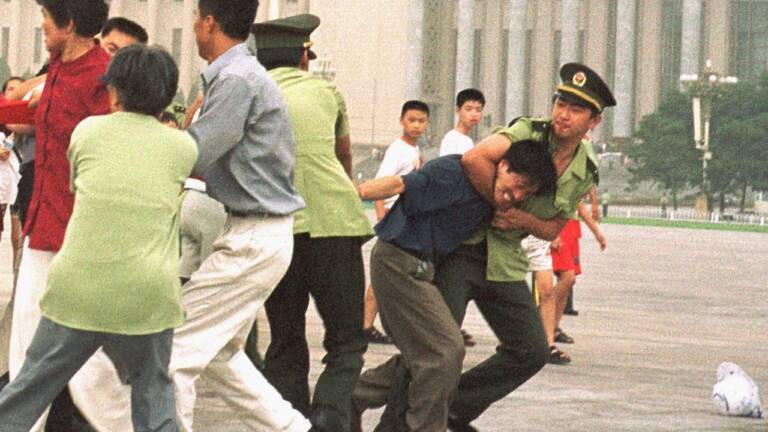
On July 20, 1999, Jiang launched the full-blown
persecution with mass arrests, beatings, and unlawful detentions of thousands
of Falun Gong practitioners. The police burned Falun Gong books and ransacked
the practitioners’ homes, and the media saturated the country with propaganda
to defame Falun Gong.
If we look at the complete process from Falun Gong’s
introduction to the public to its being banned, we can see that there have always
been different voices within the Chinese government. Many open-minded Party officials
including Premier Zhu Rongji acknowledged and supported Falun Gong, while those
who antagonized and suppressed Falun Gong were only a small minority, namely the
dictator Jiang and the political opportunists represented by, Luo Gan and He Zuoxiu.
In
early September 2000, Jiang had a special interview with Mike Wallace of the Columbia
Broadcasting System (CBS). In order to shirk responsibility, Jiang claimed that
all the members of the Politburo Standing Committee raised their hands to support
the persecution of Falun Gong. The truth is that the persecution was solely Jiang’s
idea. He bypassed the law and willfully overthrew premier Zhu Rongji’s decision
on April 25 appeal. He was the behind-the-scenes director of the whole persecution.
Why
did Jiang Zemin persecute Falun Gong? What was his motive?
All dictators
suffer from insecurity about loss of power. As a result, they exhaust all means
to solidify their grasp on power and to strengthen their rule. Anyone who has
the courage to persist in their opinions and uphold their rights would be regarded
as a threat to the dictator’s rule, and he would do everything to ruthlessly silence
those brave voices. If the dictator is not merely cold-blooded, but also incapable
and unintelligent, and he obtained power through underhanded means, then the public
would only regard him with disdain. Unfortunately Jiang Zemin has all of the above
traits.
The Chinese people all know that Jiang became president, not because
of his abilities or longevity in the Party, but because he was one of the first
to side with the central government’s hard line approach during the June 4 Massacre.
Many people inside and outside the Party have criticized Jiang’s lack of credibility
as the president of China and chairman of the Central Military Commission. Therefore,
it is clear that Jiang possesses the dark mentality of most dictators as he suspected,
resented and eventually fanatically persecuted Falun Gong.
To be more specific,
Jiang absolutely could not accept the fact that Falun Gong taught different things
from what he wanted to instill in the people.
Secondly, Falun Gong attracted
100 million people within a few years and the number of practitioners exceeded
the number of Party members, a fact that deeply disturbed Jiang and made him very
envious. He could not tolerate the fact that the size of a civil group was larger
than the Party under his control.
Thirdly, although Mr. Li Hongzhi was only
an ordinary citizen and did not have any title or official rank, he had millions
of disciples who respectfully called him Teacher Li or Master. Many of his disciples
were senior Party members and government officials. As the head of the country,
Jiang had always craved such heart-felt respect for himself, but could not get
it. His jealousy rose to a boiling point because he could not allow an ordinary
citizen to have greater prestige than himself.
He was also jealous of Premier
Zhu Rongji for properly handling the April 25 appeal and winning acknowledgement
from the international community.
Last but not least, he was shocked that
Falun Gong practitioners came time and again to the government to appeal without
hesitation or fear of retaliation, as many ordinary citizens do. He judged the
practitioners’ courage to be a challenge to his power.
His mentality can
be summarized with one word: jealousy. Jealousy towards Falun Gong and Mr. Li
Hongzhi is the root cause that drove Jiang to single-mindedly persecute Falun
Gong.
There are also other analyses on the reason for the persecution.
Someone
said that the moral decline after June 4, 1989 led to rampant corruption and great
social unrest for which Jiang is largely responsible. Falun Gong’s principles,
Truth, Compassion and Tolerance directly contradict Jiang’s own perversity and
malice, and as a result he could not help but persecute Falun Gong.
Some
have said that expanding one’s power by starting a political movement is an often-used
ruse by Chinese dictators. Obviously Jiang is no stranger to such tactic. In the
article "China’s suppression carries a high price" by Willy Wo-Lap Lam,
a CNN senior China analyst points out, "It is no secret that several Politburo
members thought the president had used the wrong tactics." The reporter also
quoted a Party veteran as saying, "By unleashing a Mao-style movement, Jiang
is forcing senior cadres to pledge allegiance to his line… This will boost Jiang’s
authority."
But why did Luo Gan and He Zuoxiu play the roles of point
men in this persecution? The dictator and his minions rely on one another. What
the minions usually do is make some noises to please their master. Falun Gong
has many practitioners and has a great influence in China. If they could destroy
Falun Gong, they could hope for a grand promotion.
Nowadays in China, corruption
is everywhere. Falun Gong teaches people to conduct themselves according to Truth,
Compassion and Tolerance; it benefits the society and causes no harm. By turning
on Falun Gong instead of punishing the corrupt officials, Jiang shows himself
to be irrational, if not clinically insane.
Posting date: 21/Nov/2004
Original
article date: 18/Nov/2004
Category: Open Forum