
On February 15, two House committees jointly held a hearing entitled, “The Internet
in China: A Tool for Freedom or Suppression?” Four major U.S. technology companies,
Google, Yahoo, Microsoft and Cisco received harsh questioning for yielding to
pressure from the Chinese Communist regime. Atlanta practitioner Dr. Yuan Li,
who was recently assaulted by the regime's secret agents, also attended the
hearing.
When California democratic representative Dana
Rohrabacher introduced Yuan Li, the audience responded with a standing ovation.
Rohrabacher called Li “a hero who stood up for principles of freedom.”

Practitioner Yuan Li at the hearing. He received a standing ovation as he was
introduced.
More than 20 representatives of the House attended the
hearing, which lasted more than 7 hours. C-Span broadcast the hearing live. The
hearing received worldwide attention and all major media reported on it.
Li Yuan Received a Standing Ovation
Dr. Li made a special trip to
attend the hearing. The wounds in his face were not completely healed. On February
8, Li, a Falun Gong practitioner, was assaulted by Chinese Communist regime's
secret agents who brutally attacked Li in his own home and took away two laptop
computers.
Looking at the U.S. administrative officials, Rohrabacher said
that you have to make a choice between Dr. Yuan Li, who has stood up for freedom,
and a totalitarian regime.

Practitioner Dr. Yuan Li was referred to as “A hero of freedom” by California
representative Rohrabacher
Dr. Li received a standing ovation as he
was introduced by Rohrabacher. Li stood up several times to thank the representatives
and the general audience for their support. During the process, the live TV broadcast
aired information on the assault and showed Li's injured face which required
15 stitches.
Four Internet Companies Under Fire at the Hearing
During the hearing, “The Internet in China: A Tool for Freedom or Suppression?”,
Google, Yahoo, Microsoft and Cisco testified in front of U.S. lawmakers.
After
Yahoo provided information about Chinese journalist Shi Tao to the Chinese Communist
regime, Shi Tao was sentenced last year to 10 years in prison for sending e-mails
promoting democracy. Yahoo has been widely criticized since then. Yahoo's
Michael Callahan said that Yahoo was regretful for the punishment of dissidents
who wanted to express their opinion. However, he said that Yahoo had to comply
with Chinese laws.
His explanation was questioned by Congressman Christopher
Smith, chairman of the House International Relations Subcommittee on Africa, Global
Human Rights and International Operations.
Smith asked, “If the secret police
a half century ago asked where Anne Frank was hiding, would the correct answer
be to hand over the information in order to comply with local laws? These are
not victimless crimes. We must stand with the oppressed, not the oppressors.”
Google
has been widely criticized for filtering information related to Falun Gong, Tibet
and other topics that are regarded as sensitive by Beijing. Elliot Schrage, Google's
vice president of global communications and global affairs, acknowledged that
the company had compromised to China, filtering some “politically sensitive” information.
Schrage said that Google didn't want to see such a thing happen.
Representative
Tom Lantos, chair of House International Relations, said that these companies
were apparently lacking in social responsibility. “These captains of industry
should have been developing new technologies to bypass the sickening censorship
of government and repugnant barriers to the Internet. Instead, they enthusiastically
volunteered for the Chinese censorship brigade.”
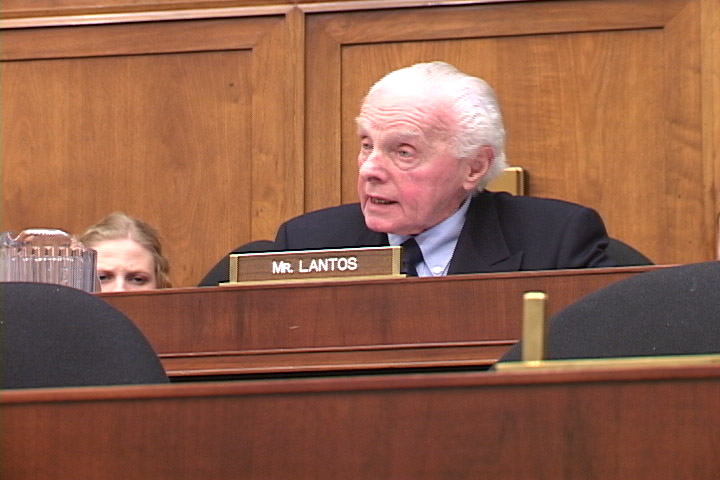
Representative Tom Lantos, chairman of House International Relations
Lantos
questioned representatives of these four companies. “Your abhorrent actions in
China are a disgrace. I simply do not understand how your corporate leadership
sleeps at night.” This comment was widely cited by major U.S. media.
Representative
Smith stated, “I believe that two of the most essential pillars that prop up totalitarian
regimes are the secret police and propaganda. Yet for the sake of market share
and profits, leading U.S. companies like Google, Yahoo, Cisco and Microsoft have
compromised both the integrity of their products and their duties as responsible
corporate citizens. They have aided and abetted the Chinese regime to prop up
both of these pillars, propagating the message of the dictatorship unabated, and
supporting the secret police in a myriad of ways, including surveillance and invasion
of privacy, in order to effectuate the massive crackdown on its citizens. “

Vice-chair of House International Relations, Christopher Smith, sponsored
the hearing
Smith questioned: “Should business enable the continuation of
repressive dictatorships by partnering with a corrupt and cruel secret police
and by cooperating with laws that violate basic human rights?”
Michael Callahan,
a vice president and general counsel at Yahoo, said, “We are very distressed by
the consequences of having to comply with Chinese laws.”
Schrage, representative
for Google, said that the company was not proud of or eager to filter its Chinese
search engine. “We believe it will ultimately benefit our users in China,” Schrage
said.
Representative James Leach, Chairman of the Subcommittee on Asia &
the Pacific, said, “What is interesting is that the censorship practices of American
companies does not represent attempts to uphold the rhetoric of the Chinese Constitution.
Rather, they are undertaken in response to – or in anticipation of – a threat
of commercial or criminal reprisals by the Chinese government which contravene
their own Constitution.”
During the second round of the hearing, under questions
from more than ten lawmakers, representatives of the four companies were often
left speechless and in many occasions they didn't give direct answers to
questions.
Some participants of the hearing were outraged by the despicable
practice of the Chinese Communist regime. Such practice, forcing people and companies
to compromise their dignity and social duties in exchange for commercial interests,
has received wide criticism in the U.S.
Chinese Communist Regime Suppresses
Dissidents
Smith said, “To date, an estimated 49 cyber-dissidents and
32 journalists have been imprisoned by the PRC for merely posting information
on the Internet critical of the regime. And that's likely to be only the
tip of the iceberg.”
Representative Leach of Iowa said, “During the past
year, the Chinese Communist Party has improved its ability to silence and control
political discussion on the Internet.”
Leached said that we must protect
the basic function of the Internet to prevent it from becoming a functionary of
the oppressive regime.
U.S. Government To Take Urgent Action
Representative Smith said, “Not surprisingly, Americans, not just Chinese,
are also the victims of this censorship … I believe our government also has
a major role to play in this critical area, and that a more comprehensive framework
is needed to protect and promote human rights. This is why I intend to introduce
The Global Online Freedom Act of 2006 in the coming week to promote freedom of
expression on the Internet.”
Representative Jeff Fortenberry said that we
should accept this kind of business after the hearing.
To close his opening
remarks, Smith said, “I hope this hearing might be the beginning of a different
sort of dialogue – a discussion on how American high-tech firms can partner with
the U.S. government and human rights activists to bring down the Great Firewall
of China, and on how America's greatest software engineers can use their
intelligence to create innovative new products to protect dissidents and promote
human rights.”
Lantos said that to all unbiased bystanders, it is very clear
that these companies will continue to collude with a totalitarian regime if Congress
doesn't expose their abhorrent collusion. Representative Lantos stated that
these Internet companies need to stand up to resist the pressure from China and
any country where they do business. [paraphrased]
Posting
date: 19/Feb/2006
Original article date: 18/Feb/2006
Category: World
News