Epoch Times Staff
Jan 22, 2006
The author is a dancer in the NTDTV Gala.
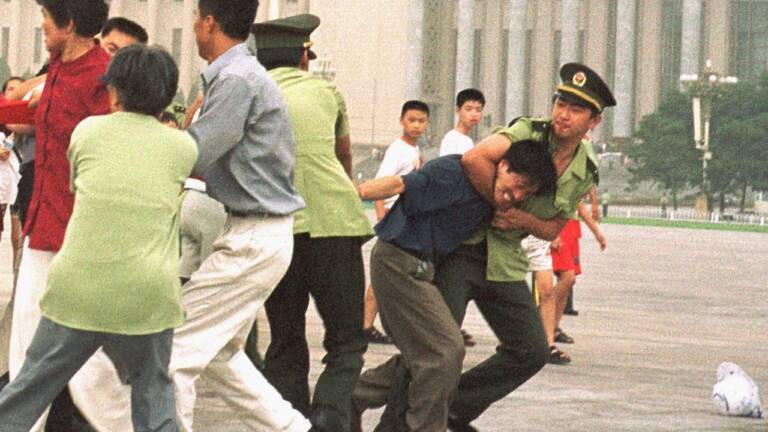
The Epoch Times photo. (The EpochTimes)
Behind "The Same Song"
are streams of blood and countless broken families.
No matter where the true
criminals hide, they cannot escape the call for justice. They will be brought
to trial.
After many hesitations, I decided to write this article before
my performance, especially for the audience at Radio City Music Hall who will
be watching our Gala.
It’s been several years since I left China, a land
under the rule of the terrorist regime of the CCP (Chinese Communist Party). I
have grown up, and have forgotten many things from the past. A few days ago, when
I read in the newspaper that "The Same Song" was to be performed at
Radio City Music Hall on the same stage where I would be performing, I fell silent.
The First Time I Heard the Song, I Was 19 and Imprisoned
My thoughts
went back to several years ago. I still remember vividly the first time I heard
it. After I left China to go to the university, I had read about "The Same
Song" in overseas Chinese newspapers. However, the first time I heard the
song was in a prison cell in China when I was 19 years old.
From a young
age, I had always been the poster child of a good student. I won the title "Honor
Student" five times in my school, in my school district, and once in the
entire country, and I was a member of the Communist Youth League. As a teenager,
I was confident and proud, while shy and innocent. My family was relatively wealthy.
I was the first among my friends to have a computer and the first to ride to school
in a car.
My parents grew up in peasant families and did not suffer much
during the Cultural Revolution. I was born in the 1980s and had not experienced
or even heard of politically motivated persecution, the human rights movement,
or terrorism. During the 1989 Tiananmen Square Massacre, I was too young to understand
what was happening. My parents received a CCP education, joined the military,
went to college, and ended up teaching at their former college. My father is a
high-ranking military official and is well educated.
My mother also works
for the military and conducts chemical research in a lab.
I did not have
any doubts about the CCP’s slogan "Always seek the truth" and felt I
could trust the regime. In my innocent mind, there was nothing wrong with telling
the truth and saying something different from the CCP’s official position. When
I was a student overseas, within the first few years of the persecution against
Falun Gong, I sent many overseas media reports and other materials about the CCP’s
persecution of Falun Gong to China to inform my friends and relatives.
Because
of this, the CCP used the state security bureau, special agents, the Internet,
and phone tapping to illegally arrest me and press charges against me. It took
me a long time to understand why the CCP would use so many resources and manpower
to arrest a 19-year-old girl like me, while leaving rampant government corruption
alone. The CCP does not care about human lives. It only wants power and the status
quo. As the communist governments in the world collapsed one after another, the
CCP was afraid its own people would topple it. Therefore, the CCP tries to fool
the people. It only allows one voice—its own. This strategy is also the subtle
goal of "The Same Song."
As a 19-year-old, I felt it was strange
to be taken to a dark concrete chamber by policemen who I thought were supposed
to be friendly and helpful.
They told me that this was a prison. At first,
I didn’t understand the seriousness and did not feel afraid. After staying there
for a while, I understood what "terror" means. There, every day felt
like a year. I was afraid of the lack of measurement of time, of losing sleep,
of the sound of the shackles, of the light that was on 24 hours a day, the video
monitor that never stopped turning, my parents’ safety, brainwashing, and "The
Same Song."
In the interrogation room, I asked them what law I had
broken that they had to detain me at the airport right away. I had just arrived
in China, yet they would not even allow me to go home. They gave me a piece of
paper and said, "If you sign, you can go home now." I read it, and it
was full of lies. I refused to sign it or appear in front of the media to tell
lies. I also rejected their offer to free me in exchange for my collecting intelligence
information overseas.
I Said, "I Want to Go Home"
They
replied to me with puffs of circling smoke from their mouths and applied cold
handcuffs. I finally understood: I had said what I should not have said—the
truth. They do not jail people for making mistakes; they jail people for having
their own beliefs. The policemen did not care whether I was right or wrong, but
only whether I followed the Party’s voice. I must follow the Communist Party,
have the same voice, and sing the same song. I asked, "What if I say no?
What if I do not want to sing ["The Same Song"] but want to have my
own voice?" They said, "Then there will never be anyone to hear your
voice other than yourself. Do not be so stubborn. Maybe one day you will not be
able to have your voice. Who knows whether you will exist or not."
I
remember that was in early spring, and I had just passed 18 years of age.
The
prison building was very tall, and the rooms were large and high. I remember at
the entrance hung a plate, which seemed to have the words "Male Cell."
There was also Jiang Zemin’s ugly handwriting on a red tablet. I walked into the
cold prison by myself, carrying a washbasin, a pair of plastic slippers, and a
piece of sanitary pad. Behind the thick metal doors and through the small openings
for meal delivery, curious eyes peered at me.
I seemed to hear some whispering,
"How come this small girl is put in this place for death row? What crime
did she commit?" A policewoman by my side immediately closed the small windows
one by one and walked to the end of the hall. She opened the last cell and asked
me to go in. It was a large room, and several surveillance cameras were hanging
high above. Below were a toilet, a shower, and a small bed.
The heavy door
closed with a loud "bang!" I shivered all over and sighed.
Under
the bright light that never went out, a strand of white smoke slowly rose up and
dissipated beyond the three-meter-high wall of the iron cell. I have too many
memories about the prison, which I have been trying to forget these years. For
a time, my family members thought I was suffering from depression and urged me
to seek treatment. A psychologist wanted to treat me with hypnosis, but I refused.
There are some things that can be forgotten, but I do not want to forget.
Some
people and some sounds may fade with time, but "The Same Song" is an
exception. That was the first song I heard in prison, the first and also the most
frequent. I heard it many times, with pain and numbness, even to the point of
wanting to die. That was the first time in my life that I wanted to die.
At
the time, I had no life experience at all and was like a blank piece of paper.
Many things were the first for me, including "The Same Song." That song,
along with the bloodstained memories, grew in my flesh like a thorn. I cannot
pull it out, cannot wash it away. Years have passed, and even though my body is
healthy, I often wake up from dreams at night, though in my own little bed, not
knowing where I am, thinking I am in prison. When I realize where I am, I let
out a heavy sigh of relief. Then, slowly, a burning pain rises up from my chest,
turning into warm streams of tears, wetting my pillow repeatedly.
Forced
to Take off My Clothes in Front of Strangers
My memories of prison include
many first experiences in my life, all accompanied by "The Same Song."
For the first time, I was forced to take off my clothes in front of strangers.
I was searched. At the time, I had my period, and the room temperature was several
degrees below freezing. I had to take off all my underwear. They searched my whole
body. I do not remember feeling shame. I was too scared and stunned. My hair was
disheveled. I could not stop shivering from the cold, and blood flowed down my
thighs to the cold floor.
The TV played "The Same Song," and people
around looked at me without expressions.
For the first time I was handcuffed.
I knew feet could be cuffed too, but they were not called foot-cuffs. In front
of the monitoring camera, I went to the bathroom for the time. When I first woke
up in the middle of the night in the drafty prison cell, I found the prison head
fondling my face.
For the first time I heard that my family’s house had
been searched. For the first time, I knew the feeling of hearing my parents had
been arrested. For the first time, I read the letter from my mother saying that
she wanted to take her own life. For the first time, I heard my mother had had
a heart attack but I could not see her. For the first time, I experienced my parents
kneeling down in front of me begging me to sign the paper to admit guilt.
All
of these are still so vivid in front of my eyes.
They gave me books, but
I tore them apart, refusing to read. They gave me food, but I refused to eat.
They installed a television, but I turned my back to it. They played, "The
Same Song" to me. They did this often, and I could not refuse to listen.
Sometimes I wished I were deaf, but my hearing was good. I went to sleep to that
song at night, and when I woke up in the morning, the song was often still playing.
Sometimes I was not sure whether it was my illusion or the song was indeed coming
from the player. They used the loud yet soft song to confuse me, used the same
sound to wash my mind, and used the image of a shining stage to cause loneliness
and suffering.
I Used Death to Force Them to Stop the Brainwashing
Using
death, I finally forced them to stop the brainwashing. The prison cell resumed
its deadly silence. There was a rotten odor in the air, and sometimes the metal
door was opened to allow fresh air, no matter how cold it was. Behind the door
was a small balcony, secured on all four sides by three-meter-high walls. On top
of it was a metal walkway. Policewomen often walked about up there, kicking off
dirt that would fall in my face.
But my mood was exceptionally good. At
least I could see sunshine. At least I could hear people, bicycle bells, the calling
of small merchants from outside the wall. Sometimes birds would stop at the metal
wire to chirp for me. Doves sang differently from sparrows; small and large sparrows
also sang different songs. The birds of this world, nature, none of them can sing
the same song, not to mention people. Why did they force me to make the same sound?
I would rather listen to bicycle bells and birds’ songs than that brainwashing
song.
Still, I knew my life was weakening bit by bit, and my blood was
running slowly with weak pulses. I was no longer that little girl as innocent
and lively as flowers. I learned what silence is, experienced the feeling of despair
and heart-wrenching pain, and knew what it is to take death as returning home.
My pale face stopped smiling, my frail fingers were not strong enough to play
the piano keys, and my weak voice could not sing.
I used the blood from
my wound to print on the white wall, one after another, making a circle. Each
fingerprint was a flower petal, one, two, three. My balcony was a secret garden,
a window to my heart. There it was, a plum blossom, forever unfading. It was so
beautiful when the sun shone on it. I told myself that my heart was still pure.
They could kill me, soil me, destroy my educational opportunities and family,
but my inner heart was alive, and I would never sell my soul. I often went to
sleep calmly.
The next day, I found my plum drawn the day before had become
brown-colored.
So I used new blood from the wound to draw. I must come out,
or I rather die here than violate my conscience. I would never sing "The
Same Song." I said to them, "You can sing if you want. As for me, I
would rather bite off my tongue and kill myself than sing that song. This is my
right. To live, human beings should have their own voice."
People
in the prison said they had never seen such a stubborn girl. I looked at the plum
blossom that I drew secretly and smiled. When I was overseas, many people said
they had never seen flowers that blossom in the winter. But the plum does not
fear cold. It does not compete for affection with other flowers, but emits its
fragrance alone in the cold winter, giving hope of life amidst decay. Later on,
they discovered my plums and locked up the balcony. They shouted with anger and
ordered the flowers wiped out. I thought to myself, "Even if you can wipe
away my blood, you can never wipe out the guilt on your conscience. Blood debt
will be repaid with blood. Even if I do nothing, you cannot escape your punishment
issued by heaven. As long as I am alive, I am the witness. If I have the opportunity,
I will expose your crime, and one day, I will bring you to trial, letting the
world’s people see the blood you have erased."
With the help of many
people of conscience, I was finally allowed to leave.
Just before I left the
cell, holding a washbasin and a pair of slippers, I looked around. Everything
was the same as when I had arrived. But suddenly, I saw that on the high wall
of the balcony, there was one plum blossom that had not been wiped away. Although
only one, although coffee-colored, it was still very prominent and beautiful.
My fingerprint could clearly be seen on the petal. Loftily, it blossomed in the
corner of the white wall, smiling at me. In silence, I lifted my fingers to press
on the plum flower, saying farewell to her. She responded with warmth from the
wall. We both knew that the luckiest thing was not that we were not dead, but
that our spirits were still alive.
It wasn’t easy to be exiled overseas,
but I didn’t feel bitterness. I wasn’t scared of not going to school and didn’t
despair of being poor. No ordeal is worse than losing freedom or human rights.
The most terrifying time was over. I will survive overseas well, openly and nobly,
carrying out the mission of being a witness. I will live healthily and happily.
I was persecuted but I did nothing wrong. I deserve well-being more than those
who committed crimes for money and fame. Not only will I live happily, but I will
also continue to sue those who persecuted me. They are the most shameful, those
who trample human rights. They are the least respected to the world’s people and
to themselves. The "Same Song" show—just by looking at the title,
many will know that it is the CCP’s show. Most of its staff members are CCP’s
loyal servers and supporters. It doesn’t matter whether they know about the persecution
or not. They serve this propaganda machine made of violence and lies. Aren’t their
hands also stained with blood?
I came to the US in 2003 without a penny
in my pocket. I filled out the application forms for asylum and went to the immigration
office to interview without bringing a translator. I found the immigration office
with a map.
The immigration officer was curious about my being so young and
asked a lot of questions. In the end, he said, "We have a very low quota,
and you need to know that most people won’t pass the interview. Many of them spent
a lot of money to hire lawyers. If you can’t make it, you will become an illegal
immigrant and will be deported. Are you scared?"
"No. I have
been through worse things," I replied.
"Then give me a reason
why I should let you stay in the US?"
"If I had a better place
to go, I wouldn’t be here asking asylum. In China, I had no freedom for democracy
and belief. There is nothing there worth pursuing."
"Then don’t
pursue; just live. Whey did you have to stand up against the government?"
"Sir, I don’t know what you were doing when you were 19. When I was
17, I risked my life just to speak the truth. I lived a life having to choose
between conscience and lies, life and death. I didn’t drink, gamble, do drugs,
and I had all A’s in school. A person like this—what do you think she is
like when she is 19? Can you imagine? The CCP had her locked in the death cell!
Not just her, but her entire family. The CCP ordered her school to expel her,
to arrest her classmates and friends. Even those who talked to her on the plane
and carried her luggage after she got off the plane were seized and interrogated.
Do you think I could live in that country? I think not. I didn’t want to leave
my family, but I lost contact with my parents because I am the only child. I didn’t
want to be expelled from school and be forced to leave my hometown. But you know
people must have certain rights to be alive. Without them, I couldn’t survive.
I know human rights are the most important freedom for a life, more important
than life itself."
I was the only person who passed the oral examination
and received legal residency right at the office that week. The officer smiled
and said, "Congratulations and welcome to the country most particular about
freedom and democracy. I saved you a lot of money."
In 2004, I started
to study Chinese traditional dance at the Tianjiao Arts and Culture Center in
New York. It was a small, unknown art school but gradually expanded. In 2006,
we toured Washington, New Jersey, Connecticut, New York, Boston, Philadelphia,
Harvard University, and Dallas and gave over ten performances as a professional
art group. This year, we participated in the audition for the New Year’s Gala
that will be held at Radio City, hosted by the New York NTDTV. Four performances
from our school were selected. The past few weeks, all the artists in our group
rehearsed intensively for the Gala at the Radio City Music Hall, one of the most
luxurious high-end theaters in the US. You can say it is world class. Many top
artists and dancing groups performed there, and it is one of the symbols of the
theaters in Manhattan.
We were extremely proud of being selected to perform
in the largest Chinese New Year’s Gala in New York City and could perform in this
high class mainstream luxurious theater. But when I saw that the "Same Song"
was going to be in the same theater, I couldn’t believe my eyes.
The "Same
Song" carried blood, tragedy, and tears. It tore open my scars. In a free
and democratic country like the US, how could it serve as the elegant stage for
the performance of a hoodlum dictatorship? I was stunned. Perhaps the road is
narrow for enemies. The "Same Song" and I will perform in the same hall!
Since I know that now, I will not forget my vow. I will bear witness to history.
I will expose the evil "Same Song" and the tyranny behind the song.
I like what a commentator said: "Allowing the CCP to sing for violence
in the land of freedom and democracy, in the United States, is no different than
inviting dictator Saddam Hussein’s music group to NYC to celebrate the
9-11
tragedy. The CCP’s cultural war is against the American people’s will, the nation’s
interests, and its traditional values. The U.S. government has the obligation
to say no to the exportation of CCP culture to the United States and to prohibit
the praise of the CCP’s violence and terror in a civilized society."
Forced
into My Brain During Brainwashing
I gently opened up my diary and my memory.
I wrote, "’The Same Song’ and Zhao Zhizhen’s show are my most painful memories,
for those are the things forced into my brain when I was brainwashed, but they
will never enter my heart."
This song wears a hypocritical mask. If
one day I regain my freedom, I will definitely sue the people who participated
in my brainwashing. I will let the participants of "Same Song," Zhao
Zhizhen’s show, and the world’s media know that a fake celebration of peace will
not conceal the tragedies of tens of thousands of broken families. The "Same
Song" is a lie, and one lie cannot conceal the voices of 1.3 billion people.
Lies written in ink—how can they cover the truth, written in blood?
http://english.epochtimes.com/news/6-1-22/37237.html
Posting date: 23/Jan/2006
Original article date: 22/Jan/2006
Category:
Media Report