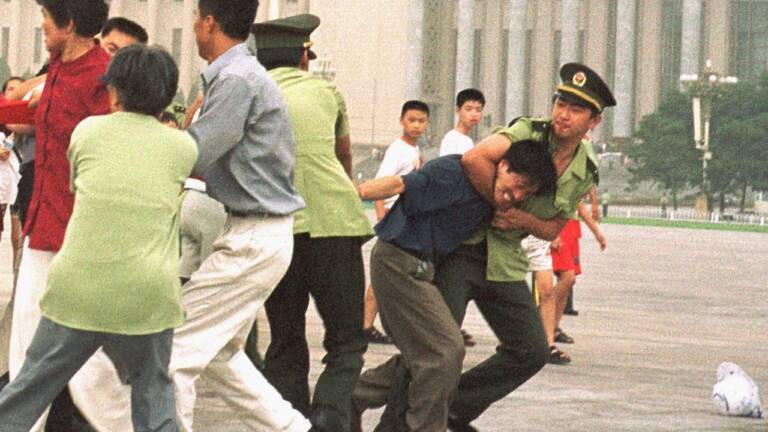
Two truths about Falun Gong: it is not a religion, and the Chinese government
seems to want it crushed at any cost.
A highly spiritual practice that combines
philosophy, meditative aspects and specified body movements, drawing on Buddhism
and Taoism to explain its teachings, Falun Gong, also known as Falun Dafa, has
snowballed over the past few years into a veritable synonym for Chinese state
persecution.
Banned by Beijing as "an xx," "the common
enemy of mankind" and "responsible for many cruel killings and crimes,"
among other epithets, Falun Gong’s supporters say that in China, practitioners
have become targets of systematic incarceration, torture and murder.
Supporters
also warn that Canada is not exempt from a global Chinese campaign of hate propaganda,
spying on and harassing Falun Gong followers.
And they’re using the current
visit to Canada of China’s president, Hu Jintao, to bring the issue to the fore.
Hu was scheduled to visit Ottawa and Toronto between Thursday and tomorrow,
with a side trip to Niagara Falls. His delegation will travel to Vancouver Sept.
16 and 17.
In a letter to Prime Minister Paul Martin urging him to call
on Hu to end the persecution, the Ottawa-based Falun Dafa Association of Canada
claims that more than 2,780 deaths of practitioners while in police or government
custody have been verified, 757 of those between May and July of this year.
The
group accuses Beijing of employing more than 100 methods of torture, including
rape, force-feeding and electric shock.
International human rights groups
say the number of practitioners who remain in illegal custody is in the thousands.
On Wednesday, supporters rallied at Queen’s Park with banners and live
displays of torture. They called for the release of 18 jailed family members of
Canadians, most of whom reside in Toronto, and for officials here to bar the entry
into Canada of Bo Xilai, alleged to be responsible for overseeing the torture
and killing of hundreds of Falun Gong practitioners in China’s Liao Ning province.
Falun Gong advocates are still steamed that the federal government last
month deported a practitioner back to China. They fear that 54-year-old Hu Xiaoping
is now in grave danger.
Ottawa has said it would raise the overall issue
of human rights in China during the visit of the president, who took office in
2002 and has continued his predecessors’ suppression of Falun Gong. The bloody
crackdown began on April 25, 1999, when 10,000 adherents gathered outside the
residential compound of Chinese Communist Party leaders in a daring but illegal
protest against sporadic persecution.
Falun Gong was then banned as "a
threat to social and political stability."
The U.S. Congress has passed
several resolutions criticizing Beijing on Falun Gong. In October 2002, the House
of Commons unanimously passed a motion requesting the release of 13 Falun Gong
practitioners, among them Lizhi He.
An award-winning civil engineer in
China and Falun Gong practitioner since 1995, He was arrested in July 2000 in
Beijing after he mailed several letters to friends in which he extolled the virtues
of the practice and countered the government’s hate campaign.
Following
a show trial in December, 2000, He was sentenced to three-and-a-half years for
"inciting social disturbance," despite the fact he had received a visa
to become a permanent resident in Canada.
For the first seven months of
his detention, He was held in a detention centre in Beijing, where his wife was
not allowed to visit him. He was kept in a 20-square-metre cell with 30 other
prisoners.
"I was forced to sit motionless and I was monitored by
four inmates," He said in an interview. "If I moved even slightly, I
was beaten. Every day, my underwear clung to my bloody skin."
He developed
a fever and chest pains, but was transferred to a prison where, barely able to
stand, he was forced to perform military drills in the freezing wind and rain.
He began to cough and urinate blood, and was finally taken to a hospital. "Even
there, I was pressed for information about my fellow practitioners," he recalls.
After 50 days, He was returned to prison, where he endured shocks with
batons and was forced to write statements of self-criticism every day.
Amnesty
International declared him a Prisoner of Conscience.
"I suffered tremendously,"
He says gently.
Now a 41-year-old engineer living in Scarborough, He harbours
no ill will toward his torturers. "It’s not a personal hatred, but they will
have to pay for what they did. I can forgive them."
Fellow practitioners
will recognize in He’s attitude at least one of the three basic moral principles
on which Falun Gong operates: Zhen, Shan and Ren, or truthfulness, benevolence
(or compassion), and forbearance (or
tolerance) – historically Buddhist, Taoist
and Confucian virtues.
Practitioners are encouraged to conduct themselves
with all three in all situations to develop their xinxing (moral character).
The
goal is to cultivate one’s mind, body and spirit in order to reach higher levels
of consciousness, aided by a set of five exercises.
About 30 practitioners
representing a wide range of ages and backgrounds gathered on a clear Sunday morning
in August in front of Mississauga’s city hall, one of about a dozen "practice
sites" in the GTA, for two hours of consciousness raising.
While a
tape plays soft Chinese music and a voice gently calling instructions, practitioners
begin in a sitting position, either cross-legged, half-lotus or full lotus. Eyes
are closed and hand positions change roughly every five minutes. This lasts an
hour, and requires obvious discipline (in joining the group, this reporter found
he had to shift sitting positions several times).
Then comes another hour
of four standing exercises, also involving various hand positions. Breathing is
normal at all times.
The routine is often confused with Tai Chi, but Falun
Gong’s movements are crisper and said to be easier to learn.
"The
most important aspect of the teaching is to always know that you’re here doing
the exercises, and to help strengthen your main consciousness,"
says
Joel Chipkar, a 37-year-old Toronto real estate broker and spokesperson for the
Falun Dafa Association of Canada. The effort aims to "realign and rebalance
the body’s energy. There’s no trance, no visualization, no meditation. It’s a
very bare awareness."
And, he points out, it’s all free of charge.
There’s no official "membership."
The routine ends with readings
from Zhuan Falun, the movement’s text, which teaches that a Falun, or "A
Wheel of Law," resides in the lower abdomen of practitioners. Said to be
a miniature of the universe, it turns continuously. When the Falun turns clockwise,
it absorbs energy from the universe into the body; when it turns counter-clockwise,
it rids the body of negative influences.
The basic teachings seem to combine
the compassion and mindfulness of Buddhism with the self-improvement techniques
of Dale Carnegie: Don’t fight with others. Reduce your attachments. Treat others
with kindness. Cultivate and live a peaceful life.
Even so, Chipkar made
headlines last year when he successfully sued China’s deputy consul general in
Toronto for libel. In a Star letter to the editor, Pan Xinchun had called Chipkar
a member of a "sinister cult" designed to "instigate hatred."
The court agreed Chipkar had been defamed and awarded him $11,000 in damages,
of which he’s seen not a penny. Pan skipped town, supposedly back to China, and
attempts to seize his bank account failed.
Raised, as he puts it, in a
hot-blooded, short-tempered, southern Italian family, Chipkar says Falun Gong
"taught me to treat others with kindness and compassion and always look inside
to see what you can do better. It changed my life."
Founded in 1992
by Li Hongzhi, a 54-year-old former grain clerk from northeastern China who now
lives in seclusion in Brooklyn, Falun Gong (roughly, "Practice of the Wheel
of Law") spread quickly. Along with other related movements, such as Ch’i
Gong, it was viewed favourably by Beijing, says David Ownby, a China expert at
the University of Montreal who’s finishing a book on Falun Gong.
Chinese
spiritual and cultural traditions, Ownby notes, have historically stressed physical
health and longevity. One outgrowth was Ch’i Gong, a cultivation method that combines
stretching and slow movements.
"Ch’i Gong passed itself off as magic
and physiotherapy," he says. "The (Chinese Communist) party loved it
because (its leaders) are all old, and it seemed to help. Falun Gong followed
right along."
But when the April 1999 demonstration took place, the
Politburo panicked.
"The size and unexpectedness of it made them think
this is not a national treasure anymore. Ten thousand people right outside – that’s
spooky.
Anything that big is really scary to China’s leaders. It brought back
memories of 1989 (the Tiananmen Square massacre), and they were ready to pounce."
Numbers are nearly impossible to assess, Ownby adds. While Li Hongzhi claims
100 million followers worldwide, 80 million of whom are in China (making it larger
than the 60 million members of the Communist Party), Beijing says the group has
just two million practitioners. Both sides have been accused of misestimating
numbers for their own purposes.
And in a nation where only five religions
– Buddhism, Taoism, Islam, Catholicism and Protestantism – are recognized and
strictly controlled by the (officially atheistic) state, senior cadres may have
also feared a spreading spiritual movement that was outside their purview, Ownby
says.
Falun Gong has also acquired a bit of a kooky label due to founder
Li Hongzhi’s theory that corrupt aliens are fixing to replace humans.
Extra-terrestrials
are also responsible for our too-rapid advance in technology.
Chipkar downplays
the supernatural element.
"I believe the universe is boundless. It’s
very egotistical for human beings to think that we’re the only ones in the universe."
Is the alien influence possible? "Yes," he replies. "Have I seen
it? No. Has anyone else seen it?
Maybe. But for me to dwell on that would
be not to follow the principles of Falun Gong. It’s just information. You take
it or leave it."
Beyond Falun Gong’s beliefs, China’s leadership,
still deeply suspicious and paranoid, clearly views the movement as a threat.
As Hu’s predecessor, Jiang Zemin, was reported to have told a 2001 meeting of
the Chinese leadership, "If we can’t exterminate the cult soon, this will
be seen as a major weakness of the Communist Party. The authority and prestige
of the party is at stake."
No one from China’s embassy in Ottawa returned
calls for this story.
Posting date: 17/Sep/2005
Original article date:
10/Sep/2005
Category: Media Report