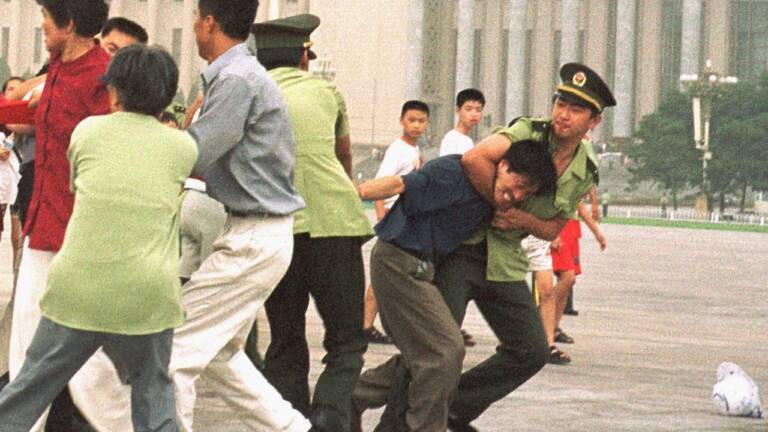
By Hamish McDonald, Herald Correspondent in Beijing October 16, 2004
Tang Yiwen … she claims the state tried to bully her into denouncing
Falun Gong.
A small nameplate beside the high, burnished metal gates announces
the building inside as "Guangzhou City Law School". But this grimy industrial
area on the outskirts of China’s great southern commercial metropolis is an unlikely
place for an academic institution.
No students are visible. The only signs
of life are the black official cars and police vans that come and go through the
forbidding gates. Nearby, across the Pearl River, is a grim set of barracks, called
Chatou, behind high walls and watchtowers.
According to one woman who has
been inside, the school is a front for a state gulag, where police re-educate
followers of Falun Dafa, a quasi-religious movement based on meditation and taichi-like
exercises that was banned by the Government five years ago as a "dangerous
cult".
"It is a brainwashing centre – one of many in China, almost
one in every district," says Tang Yiwen, a slight and soft-spoken 37-year-old
interpreter who was grabbed off the street by police in February and taken to
the Guangzhou institution. "It is said to be one of the most brutal."
She said the inmates are mostly Falun Gong followers who, like her, have
refused to renounce their beliefs even after serving three to four years in brutal
labour camps like the one across the river.
She said the school put inmates
through an intensive program of mental and physical torture that included beatings,
prolonged interrogations, sleep deprivation and continuous exposure to video and
audio propaganda.
The "brainwashing", she said, was a more intensive
form of "re-education" applied to Falun Gong followers in between stints
at places like Chatou and Shanshui, the labour camp in Guangdong province where
Tang spent three years until August last year. She said her visit to the Guangzhou
City Law School has left her partially crippled in one leg.
The methods
she and others describe sound eerily like the "struggle" sessions applied
by Mao Zedong’s Red Guards to extract confessions of "rightist deviation"
during the decade-long Cultural Revolution Mao set off in 1966.
"I
used to hear from my father and old people how people, one a famous writer, had
committed suicide in the camps," Tang said, referring to that era. "I
couldn’t understand. Why couldn’t they just hold out? After brainwashing in labour
camp I understood why – it was really too brutal for human beings to stand. It
was just like hell."
On the face of it, the struggle between state
and Falun Gong is a hopelessly uneven one, like the breaking of a butterfly on
a wheel.
On one side is the 1.7-million strong Ministry of Public Security,
which is directed by Liu Jing, 60, a party central committee member with connections
to the family of the late supreme leader Deng Xiaoping. The police can hold people
without trial or access to lawyers for up to four years.
There is also
the full weight of the state propaganda department, which directs a hostile media
campaign against Falun Gong, claiming the movement encourages suicide and neglect
in adherents and takes their savings.
There is no legal redress for abuses:
after the official ban in July 1999, the Chinese Supreme Court passed down a directive
forbidding lower courts or lawyers to accept cases brought by followers.
On
the Falun Gong side are people like Tang. She is crippled, unable to get a job
in the teaching profession she loves and at risk of being jailed and tortured
at any time. She said her husband was forced to divorce her, and she cannot get
a passport to leave China.
Since receiving a pro-forma letter early in
August from the office of the Australian Prime Minister acknowledging a smuggled-out
account of her ordeals and her request for asylum in Australia, Tang has been
constantly on the move, staying in a succession of temporary accommodations around
China, fearing re-arrest by embarrassed and angry police.
Yet the butterfly
is not broken.
It is not too hard to find people who – even after years
in labour camps – still swear by Falun Gong. In her three-week battle of wills
inside Guangzhou City Law School, which involved a hunger strike that brought
her close to death, Tang came off the moral victor: she was released without signing
any of the letters of renun-ciation waved in front of her. WHEN more than 10,000
Falun Gong followers arrived without warning early on April 25, 1999, outside
Zhongnanhai, the walled precinct next to the Forbidden City where China’s ruling
elite live and meet, and sat down in silent protest, it was an enormous shock
to China’s then party chief and president, Jiang Zemin.
Falun Gong had
grown exponentially since it was formally registered in 1992 by Li Hongzhi, a
former army trumpet-player and minor clerical worker in China’s bleak north-east,
formerly known as Manchuria, where millions were suddenly losing their jobs and
social welfare benefits with closure of obsolete factories owned by state enterprises.
Partly out of legal necessity – Beijing does not allow new religions outside
the streams of Buddhism, Taoism, Islam, Catholicism and Protestantism – Li positioned
Falun Gong among many groups reviving the ancient form of bodily and mental cultivation
known as "qigong" whereby the life forces (qi) can be channelled into
beneficial harmony by meditation, diet and slow-motion exercises (gong).
But
in contrast to more secular, often pseudo-scientific groups, Li claimed to have
rediscovered the basic law (fa) of the universe, as well as gaining supernatural
powers through the teaching of a score of qigong masters since the age of four.
"Master Li" could see through objects, or transmute himself through
closed doors. He was a "Living Buddha".
For ordinary practitioners,
Falun Gong’s routine of daily exercise provided an immediate sense of well-being,
as well as a fall in the medical bills that had become so expensive under China’s
market reforms. Many reported that chronic ailments, even serious illnesses, simply
faded away. The movement’s simple moral code – truth, benevolence and forbearance
– also gave a psychological lift to anxious people living in crowded tenements.
Li’s two widely-circulated books, which practitioners were told to read and
absorb daily, gave them the goal of self-purification.
By the late 1990s
some Chinese media claimed it had 100 million adherents.
The Government later
amended that figure to 3 million, but the reality was probably in the tens of
millions, concentrated in northern China.
Master Li, who by 1998 had moved
to the United States, had shown no interest in exerting any political power. Falun
Gong’s methods were entirely peaceful, and the organisation showed no concern
with social ills – beyond telling followers to rise above them through self-cultivation
and superior morality.
But the evidence of the movement’s ability to organise
was alarming to the Communist Party. Falun Gong’s membership included many state
employees, party members, and armed forces personnel. When the state media made
a slighting reference to Li, hundreds of followers had protested outside a state
TV station in Tianjin, and then, unsatisfied, marched on Zhongnanhai.
It was
the biggest challenge to the state since the Tiananmen Square massacre a decade
earlier.
Jiang unleashed a suppression campaign, with a ferocity that intensified
as Falun Gong followers streamed into Beijing for continuing protests. The skill
with which Falun Gong has fought the propaganda war since the ban, noted the French
scholar Benoit Vermander, reinforced the impression the communists had met their
toughest adversary since taking power – "an adversary that knows all there
is to know about the party".
http://www.smh.com.au/articles/2004/10/15/1097784050386.html?oneclick=true
Posting date: 16/Oct/2004
Original article date: 16/Oct/2004
Category:
Media Report