Gao Hao
The Epoch Times
In China, what you see is not always
what you get. In the markets, fake products abound, including tainted food and
medicines. I have come to understand that a general lack of integrity and appreciation
for life, coupled with decaying leadership is the root cause of these fake products.
Although
in recent years there has been no shortage of reports on fake products, I used
to pay them heed, thinking they were something far away. My naiveté became
apparent to me when a notable report came out on a disposable-chopstick “factory:”
a forced labor prison camp that had a work force of inmates with untreated diseases
working under completely unsanitary conditions. Since then, I always opt for the
washable chopsticks when I go out for sushi.
Shortly after that report,
I read that the United States will promote the export of apple orchards to China
in exchange for a bid at China’s genetic market. I realized that having more
China-produced foods is an inevitability and that China’s tendency toward
fake products is something that can affect us all.
A fake product coming
from China is not news, for it is too common. Only when health is threatened or
harmed is the story newsworthy. Following are some examples of stories published
in the last several months in Chinese news.
In May 2003: a Guangzhou City
business man mixed urea into milk; an estimated one half of a particular soybean
product is poisoned; Huiyang City produced roughly 6 tons of toxic cooking oil;
a chicken roasting factory in Dezhou City collected dead chickens for meat; and
more than 70 percent of foreign liquor labels sold in hotels and restaurants are
knockoffs.
In October 2003: a Shenzhen company produced cooking oil from
rotten pig skins and guts; a spot check showed that only 58.4 percent of white
gold jewelry met the industry standard for white gold; a Sichuan cigarette manufacturer
seasoned its product with addictive opium; and 39 people in Liaoyang City fell
ill from tainted pork.
In February 2004: a steamboat coming from Chongqing
City put passengers in danger when olefin, a cheap plastic, was used in place
of tallow, a natural plant-based fuel to power the boat up the Yangzi River; a
man from Dongwan City died after ingesting methanol that was sold as grain alcohol;
a Guangzhou City company made tofu with pig fodder; sausage made from tainted
Tianjin pork was sold in Beijing; and blankets used for covering cadavers in a
funeral house were sold in department stores as brand new.
In April 2004:
more than 1 billion yuan in fake money was found; poisoned celery from Hebei Province
dominated the Beijing market; and poisoned longan fruit was found in Guangxi Province.
And
finally the most important news about fake products surfacing in April was reported
by Oriental Morning in Shanghai. A tragic exposé on a low quality infant
formula that killed dozens of infants and harmed hundreds since 2003 was the first
of several similar stories that followed. 30 percent of Guangzhou City-produced
baby formula does not meet nutritional standards; Xian City found baby formula
with small amounts of lethal toxins; 19 different baby formula brands from Tangshan
City that supplied 11 provinces in China did not meet nutritional standards; Beijing
shut down four dehydrated-milk factories; three underground baby formula factories
in Buyang City were discovered and shut down after more than 1.35 million units
of bad product had been sold and distributed.
This fake product phenomenon
in China is of great concern, not only because of the obvious health and safety
hazards, but because of the increasing ethical vacuum that is at its root. Society
leaders are paying more and more heed to this problem, as reflected in a university
entrance exam question in 2001. It asked students to write a composition about
an allegory in which a young man traveling by boat is forced to lighten his load
when a storm brews. In his luggage he carries health, good looks, cleverness,
money, honor and integrity. He chose to throw his “integrity” away.
The
essay drew a lot of interest from the public, including from several famous writers
such as Wang Xiaoshan.
Although Chinese people are deeply worried about
the current moral standards, the Chinese government does not capitalize on their
concern and steer people toward goodness. On the contrary, the government exacerbates
the problem through its many arms and campaigns of control, including, perhaps
most notably, the media.
Here is an example. In June 2003, a drug-addicted
mother from Chengdu City, Sichuan Province, locked her 3-year-old daughter in
her home alone so she could go out to steal money. Police arrested her the same
day and threw her into a drug detox center. The mother repeatedly asked the police
and the detox center to allow her to make a phone call to relatives so that they
could help her daughter. All of her requests were denied. Seventeen days later,
the little girl was found dead at home, starved to death. A journalist from Chengdu
Economic Daily investigated the story and wrote an article that never went to
print, due to government intervention. Desperate to make the story known, she
posted the article on the Internet and generated enormous public concern. In return
for her desire to publicize the event in the hopes of preventing a repeated occurrence,
she lost her job as a journalist.
The little girl’s story is one incident
of government control undermining the stability of society and exacerbating the
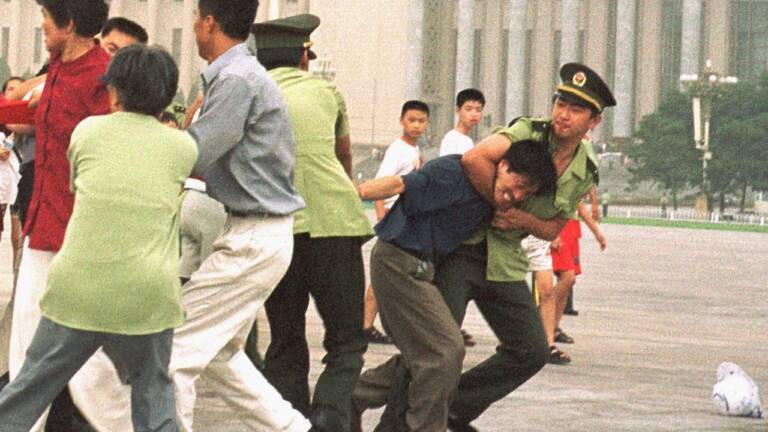
morality vacuum. China’s record of human rights and in particular the persecution
of the spiritual practice Falun Gong is an example of the government systematically
doing the same. In order to persecute large groups of innocent people, police
and local government officials are given absolute power to disregard basic civil
and human rights. Bad people are rewarded with money and promotions for carrying
out systematic torture. The government’s policies have effectively inverted
society’s ethics, wherein bad is rewarded with good and good with bad. Taking
advantage of the policy specifically for Falun Gong, a local leader or policeman
may arbitrarily strike or fine a Chinese citizen and claim that he practices Falun
Gong. There will then be no repercussions.
A system that rewards corruption
is quickly eroding social stability by taking integrity from people. It is dangerous
to the people in such a society and dangerous to the people of the world. Trade
with China is unstoppable but there is a price. In exchange for a Chinese-grown
apple pie, we may have exchanged our peace of mind.
Posting date: 15/Jul/2004
Original
article date: 14/Jul/2004
Category: Media Report