A Falun Dafa Information Center Special Report
Soon
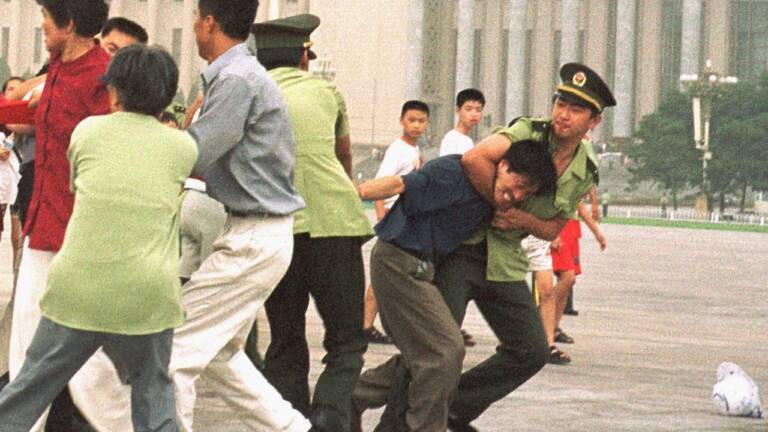
after Jiang Zemin initiated the brutal persecution of Falun Gong in 1999, incidents
appeared of Chinese officials threatening, harassing and assaulting Falun Gong
practitioners, as well as pressuring and threatening officials, businesses, and
free media around the world.
According to reliable sources inside China, as
early as October 2000, Jiang had given the order to implement a policy to “intensify
the campaign [against Falun Gong] overseas, collect more information and prevent
protests. ”
While the Chinese government claims that international
expression of concern over its policies that violate human rights constitute an
imposition on its state sovereignty, the regime has no misgivings about sending
agents around the world not only to apply pressure and interfere in local events,
but also to commit crimes in foreign countries.
Below are sample cases
that have been compiled primarily from testimonies and news reports in over thirty
countries and territories. Complete reports, photos, and documents are available
for many of these cases. Many more similar cases are not included below.
Argentina
After
the Chinese President’s visit to South America in April 2001, Chinese officials
attempted to portray Falun Gong as a dangerous group by giving false information
to the media, government officials, and Chinese communities. They also called
and threatened local Chinese practitioners.
Australia
In October,
2001 three women held a peaceful appeal outside of the Chinese Embassy in Canberra.
A Chinese diplomat came out of the embassy and began to shout at them in a defamatory
manner. As a practitioner began taking photos of the diplomat he grabbed the camera
out of her hands and slapped her across the face.
While practitioners in
Australia held a vigil at Centenary Park, three of their cars were broken into
and one car was stolen. While belongings were not taken from the three cars, Falun
Gong reading materials inside were completely ruined.
The webmaster for
Australia’s Falun Dafa Information Center had his house broken into with
the only things taken being his address book and cellular phone, containing contacts
for practitioners in Australia and China.
Australian practitioners have
long suspected that their phones are tapped. Upon investigation of one practitioner’s
home, professional technicians found that his home junction box had been tampered.
On
October 23, 2003 major media outlets in Australia, as well as numerous Members
of Parliament received an official request by the Chinese Embassy to censor articles
about Falun Gong. Chinese diplomats contacted Sydney officials and pressured them
not to allow Falun Gong practitioners to use community facilities for group gatherings.
Bulgaria
In
October 2003, an exhibition of the works of Zhang Cuiying, a world-famous artist
who practices Falun Gong, was scheduled at the Bulgarian Parliament in Sofia.
It was canceled at the last minute when the Chinese Ambassador arrived with several
other officials and asked the General Secretary of the Parliament to terminate
it.
Cambodia
The workplace of an elderly Chinese couple discovered
they practice Falun Gong when they illegally opened a package of books sent to
them from Taiwan and informed the Chinese Embassy. In August 2002, Chinese Embassy
agents, accompanied by Cambodian police, abducted the couple from their home and
deported them to a labor camp in China, even though the two held “People
of Concern” certificates from the United Nations. The Chinese Embassy then
proceeded to chase after the remaining two elderly Falun Gong practitioners, who
went into hiding after their friends’ arrest. Thanks to the United Nations
High Commissioner for Refugees Office, the two were successfully relocated to
another country.
Canada
In 1999, the server hosting www.falundafa.ca
experienced increasing problems. The same situation occurred to a mirror site
created to maintain availability. The source was traced to an IP address in China
that was sending a flood of invalid requests to use up all system resources. An
AP reporter discovered that the IP belonged to the Public Security Bureau in China.
The attacks stopped after the AP story was widely publicized.
In February
2000, Chinese thugs assaulted Parliament Member Rob Anders inside the House of
Commons because he wore a shirt in support of Falun Gong.
In August 2000,
Montreal practitioners’ application to hold an exhibit was denied, with the reasons
given including involvement from the Chinese Embassy and diplomatic concerns.
In
August 2001, Chinese Appeals Office officials visited Toronto to set up an appeal
office for Chinese Canadians, announcing, "No Falun Gong practitioners are
allowed to appeal." When a practitioner asked for the reason, she was rushed
by two men and dragged to the ground.
In December 2001, the Chinese Embassy
hosted a New Year’s party that was in fact an anti-Falun Gong exhibit, inviting
over 300 Chinese community members. One of the guests, a Falun Gong practitioner,
took a picture of the display. He was then forced into a back room and beaten
by embassy staff.
In December 2001, the Ottawa Chinese Seniors Association
cancelled the membership of a 70-year-old practitioner because she was a Falun
Gong practitioner.
Denmark
In August 2002, the Chinese Embassy
in Denmark sent slanderous material and a letter to the police complaining about
Falun Gong practitioners’ peaceful daily appeals in front of the embassy.
As a result, practitioners were forced to change the site of their appeal. The
Danish Ministry of Justice later reversed the decision.
In August, 2002,
the Chinese National Security Bureau seized and forcibly closed down three companies
in Tianjin involved in trade between Denmark and China because their owner, Xuezhi
Zhu, is a Falun Gong practitioner. As a result, Mr. Zhu’s work permit in
Denmark expired and he now faces possible deportation to China.
Fiji
At the request of the Fiji Chinese Embassy, the Fiji Criminal Investigation
Department (CID) forcibly took three Australian women who practice Falun Gong
into custody from their Fiji hotel in July 2003. They were repeatedly interrogated
in detention, although the Fiji CID advised them that they did not break any law
during their visit to Fiji.
France
In July 2000, several Chinese
Embassy employees, including the Consul General came to the Parisian restaurant
of practitioner Wu Shoumei. They threatened that if he attended a peaceful appeal
in front of the embassy the following day, he would be personally responsible
for anything that would happen to him. Mr. Wu participated in the following day’s
activity. Approximately two weeks later, he found that his restaurant had been
broken into. Two glass doors were broken and the restaurant was in shambles, yet
the cash register remained untouched, indicating that the vandals were not burglars.
In
January 2004 during President Hu Jintao’s visit to Paris, French police detained
over 70 Falun Gong practitioners as the latter were standing on the street or
walking near the Champs Elysées. The policemen told the practitioners that
they were being detained because they wore yellow clothing (a color Chinese officials
associate with Falun Gong) or clothing with "Falun Dafa" written on
it.
On at least one occasion, a Chinese official personally directed French
police to detain the practitioners. All those detained were neither officially
charged with anything nor given any documentation; they were simply held until
the day’s activities, which were partially organized by the Chinese Government,
had come to a conclusion and then they were released.
Germany
During
Jiang’s visit to Germany in April 2002, practitioners were harassed, assaulted,
and evicted from their hotel rooms by both Chinese and German secret service agents.
In some cases, this happened after practitioners exercised their freedom of expression
in protesting against the severe human rights abuses for which Jiang is responsible,
but in many instances they were harassed simply for being of Chinese decent or
for wearing yellow clothing.
On April 11, as Jiang’s car procession
arrived in front of a Dresden hotel Ms. Zhan Linghu, a 40 year-old woman, cried
out “Falun Gong is good!” Before she was able to finish the sentence,
a Chinese secret agent grabbed her by the throat and choked her. Two German security
officers then arrived and immediately removed the woman from the scene.
In
August 2002, the fuel line of practitioner Roland Gottschlag’s car was cut
as it was parked outside his home. That day, a neighbor reportedly observed several
Chinese individuals in dark suits acting suspiciously as they walked up and down
the street. Upon inspection at a local garage, it was discovered that the line
had been clearly severed.
In August 2002, the e-mail addresses of Falun
Gong practitioners in Germany were flooded with e-mails containing slanderous
material about Falun Gong and insulting or threatening messages. The source of
the e-mails could not be traced but the messages had recognizable Chinese/German
grammatical language errors.
Hong Kong and Macao
Technically part
of the P.R.C, these semi-autonomous regions have repeatedly been pressured by
Chinese authorities to persecute Falun Gong. While the authorities have not caved
in and banned Falun Gong, many incidents in these territories have taken place,
including violent arrests of practitioners during their peaceful and legal sit-in
appeals due to direct calls to the police from the Chinese Liaison Office, spying,
and violent deportation of practitioners from other countries.
Hungary In
June 2003, an official emerged from the Chinese Embassy and harassed practitioners
who were holding an appeal there, while another official photographed them. The
embassy then asked the police to cancel the appeal. Upon arrival a policemen pointed
out: “They are just sitting here in meditation. How are these people disturbing
you?”
Iceland
Acting on disinformation and a blacklist supplied
by Chinese agents, the Icelandic government banned Falun Gong practitioners from
entering the country during a visit by Jiang Zeminin June 2002. The blacklist
could have been compiled only by spies operating covertly on foreign soil. About
70 practitioners from various countries were held overnight at the airport or
a nearby makeshift detention center. At several airports in Europe and North America,
more than 150 passengers whose names were on the blacklist were denied boarding
Iceland-bound flights. Hotels were told to cancel reservations of or eject Falun
Gong practitioners.
Thousands of Icelandic citizens marched to the Chinese
Embassy, voicing outrage at both the interference with freedom of expression and
the CCP’s ongoing human rights violations.
Indonesia
The
Chinese Embassy in Indonesia continuously exerts political pressure on Indonesia’s
Ministry of Interior to disavow the legal Indonesian Falun Gong Association and
to prevent Falun Gong practitioners from holding legal activities such as introductory
workshops, gatherings, and parades. For instance, as practitioners were setting
up for their parade in March 2002, Indonesian police cancelled it at the last
minute, and admitted the decision was made due to pressure from the Chinese Embassy
in Jakarta.
Israel
An Israeli-Chinese Falun Gong practitioner
was repeatedly interrogated for multiple hours by the Chinese Embassy, which demanded
that he renounce practicing Falun Gong in order to renew his Chinese passport.
The Embassy also tried to pressure the police to prohibit Falun Gong appeals in
front of it.
Italy
While practitioners were performing the Falun
Gong exercises in Milan in November 2001, officials from the Chinese Consulate
photographed the practitioners and recorded their conversations with passers-by.
In
March 2002, a Chinese Falun Gong practitioner in Italy received two calls from
a male who told him in Chinese: “300,000 Chinese in Italy will never spare
you. Watch out for your life.”
Japan
A Chinese Embassy official
twice visited the Tokyo city government in an attempt to pressure them to prohibit
Falun Gong from registering as a non-profit group in Japan. The embassy continually
pressured government officials to cancel all activities by Falun Gong practitioners
in government buildings.
Practitioners in Japan received telephone calls
from people defaming Falun Gong, who also said they would kill or injure the practitioners’
parents in China if the practitioners did not give up their practice of Falun
Gong.
Malaysia
Due to pressure from the Chinese Embassy on the
Secretary of Foreign Affairs, Falun Gong practitioners were barred from participating
in book fairs or any other activity.
Mexico
During Jiang Zemin’s
visit to Mexico for the Asia-Pacific Economic Cooperation (APEC) summit in October
2002, the Mexican government received a blacklist of Falun Gong practitioners
from the Chinese government. However, they refused to use it and allowed the Falun
Gong practitioners to enter the country and hold activities.
Myanmar
Hong
Kong resident Mr. Chan Wing-Yuen, 71, visited Myanmar in December 2002. When he
found out that Jiang Zemin is also visiting the country he unfurled a small banner
with the words "Truth, Compassion, Forbearance" by a road Jiang’s
motorcade was scheduled to pass. He was arrested and sentenced to 7 years imprisonment
in a secret trial.
Officials from the Chinese Embassy in Rangoon and the
local police tried to force Chan Wing-Yuen to give up his belief in Falun Gong
as an exchange for his freedom, but Chan rejected their attempt. Chan was released
after one year in detention.
New Zealand
In July 2002 New Zealand’s
Auckland Airport removed a Falun Gong poster that was placed according to regulations
at an international gate lounge. The poster featured a woman sitting in meditation
and the words “The world needs truth, compassion and forbearance.” The
country’s Green Party publicly accused the airport of giving in to pressure
from China and adding to the persecution of Falun Gong.
Peru
In
addition to reporting telephone eavesdropping, Falun Gong practitioners in Peru
have reported that the Chinese Embassy has ordered local Chinese newspapers to
withhold articles that introduce Falun Gong, has persuaded a newspaper to publish
articles slandering Falun Gong, and has asked news stands to stop selling Falun
Gong books.
The Chinese Embassy untruthfully told the immigration department
that some Chinese practitioners were committing criminal acts and causing problems.
Chinese agents monitor practitioners during their activities and hose them with
water when they are doing their exercises in the public area in front of the embassy.
Romania
In
March 2003, the painting exhibit of Chinese-Australian artist and Falun Gong practitioner
Ms. Zhang Cuiying was scheduled to take place at a gallery in Bucharest.
Shortly
after an advertisement announcing the exhibit was published in a local newspaper
the organizers received a phone call from a representative of the Chinese Embassy.
He demanded that the event be cancelled, saying that the Chinese government does
not allow such activities. The organizers, nonetheless, decided to hold the exhibit
as scheduled.
During the exhibit’s opening ceremony, three representatives
from the Chinese Embassy arrived and closed it by force. They distributed false
information claiming that the exhibit was illegal and that the Romanian government
was opposed to Falun Gong, and then forced the spectators to leave. They physically
assaulted the organizers, including an Australian citizen who videotaped the incident.
Scotland
In
June 2003, a representative from the Chinese Consulate in Edinburgh wrote to the
organizer of the “Edinburgh One World Festival” complaining that Falun
Gong practitioners had participated in the previous year’s festival and requesting
that Falun Gong be omitted from this year’s program. The organizer ignored
the request, saying: “We can invite whoever we’d like”.
In
October 2003, Zhao Liping, a doctor of Chinese medicine and a Falun Gong practitioner
was forced to resign from her post at the Chinese medical clinic in Edinburgh
after her employer received a letter from the Chinese Consulate complaining that
Ms. Zhao introduced Falun Gong to some of her patients.
Singapore
The
first secretary of the Chinese Embassy tried to prevent a hotel from renting a
conference room to Falun Gong practitioners.
South Africa
An unidentified
gunman shot a Falun Gong practitioner, who traveled to South Africa from Australia
to appeal during the visit of China’s Vice President Zeng Qinghong and Minister
of Commerce Bo Xilai. The gunman fired five shots at a vehicle Mr. David Liang
was driving, and fled the scene without taking anything. Mr. Liang was injured.
Out of the five passengers in the car he was the only one wearing a Falun Dafa
jacket and the only one shot.
South Korea
Due to pressure from
the Chinese Government, hundreds of caps with the words “Falun Dafa is Good”
in Chinese were confiscated during the Soccer World Cup games that were held in
South Korea.
Sweden
In July 2003, Hans Hirschi, a government official
from Gothenburg received an invitation for a meeting from the Chinese Consul General.
During the meeting, the consul pressured Mr. Hirschi to stop the broadcast of
a program about Falun Gong that is aired weekly on a local radio station. The
consul hinted that continuing to air the program could threaten the relationship
between China and Sweden, naming specifically cooperation between Shanghai and
Gothenburg. When Mr. Hirschi refused the request, the Chinese Consulate contacted
the Management Section to which the local station belongs and pressured them to
terminate financial support for the station
Switzerland
Falun
Gong practitioners were denied their application for a stand at the Chinese Spring
Festival celebrations that were held in Switzerland in February 2003. The reason
given by the sponsor of the event was that he feared that granting their request
might upset the Chinese Ambassador who was scheduled to attend the festivities
in person.
Taiwan
During the years 2001-03 at least 182 Falun
Gong practitioners traveling from Taiwan were barred from entering Hong Kong upon
arrival at the airport and were deported. In addition to it being a violation
of Hong Kong’s Basic Law (Article 141), it also raises the question of how
the Hong Kong authorities knew which people practiced Falun Gong when there are
no Falun Gong membership lists. Such a listed could have only been compiled by
illicit means such as spying, tapping phones, or hacking emails.
Thailand
In
2001, the Thai government was pressured by the Chinese Embassy to cancel a Falun
Dafa Experience Sharing Conference in Bangkok.
The Bangkok Marriott Hotel
fitness-center manager personally invited a practitioner to teach the Falun Gong
exercises at the hotel. However, in March 2003, after three weeks of the free
class, the practitioner was contacted by the hotel desk manager who cancelled
the class and admitted it was due to pressure from the Chinese Embassy.
In
April 2003 a Swedish citizen and legal resident of Thailand was detained on the
day of Chinese Premier Wen Jiabao’s visit to Thailand. Having been charged
with no crime, she was nevertheless detained for 37 days and then deported. Thai
officials cited pressure from the Chinese Embassy. Apparently, she became a target
for having spoken out publicly in on behalf of Falun Gong.
In July 2003,
Dr. Zhen, a postgraduate research fellow from Sydney flew to Thailand to discuss
wedding plans with her fiancé. Upon arriving at the airport, however, she
was denied entry and told that her name was on a blacklist and that it out of
consideration for Thailand and China’s diplomatic relationship. She was sent
to a detention center and later deported.
In advance of the APEC summit
in Thailand in October 2003, Thai officials announced that Falun Gong practitioners
will be barred from holding group activities, including group meditation practice,
anywhere near the conference site, because such activities were a major concern
for Beijing. Moreover, they announced that any overseas Falun Gong practitioner
seeking to enter Thailand at the time will be deported. In the months prior to
the summit, Falun Gong practitioners were repeatedly followed, filmed, and interviewed
by Thai police for fear that practitioners might be planning some activities that
would upset Beijing.
Ukraine
On September 2001, Igor Izevlin
and several other Falun Gong practitioners held a peaceful appeal in front of
the Chinese Embassy in Kiev. Shortly after dark, a large number of policemen arrived
at the scene, broke several posters displaying evidence of the human rights violations
suffered by Falun Gong practitioners in China, and arrested Mr. Izevlin. One of
the representatives of the police who arrived at the scene told the practitioners:
“You should put yourself in our position and understand our difficulties.
The Chinese Embassy puts constant pressure on us.”
United States
On
July 21, 1999, a day after the persecution of Falun Gong officially began in China,
the Fairmont Hotel in San Jose, California, received a threatening phone call
that the hotel would be burned down if the scheduled Falun Gong conference were
allowed to be held there.
A few days before September 11, 2001 four Falun
Gong practitioners participated in a peaceful hunger strike in front of Chicago’s
Chinese Consulate, protesting the escalated killing in China. Three Chinese men
pulled up in front of the consulate, verbally abused the practitioners, threatened
to expose themselves to one of the females there and, upon seeing that a practitioner
had pulled out his camera to document the abuse, proceeded to chase him down the
street, smash his camera, and beat him.
When charges were filed against
them, a man known to have close ties with the consulate visited the plaintiff’s
house and offered the plaintiff’s roommate a $15,000 bribe to drop the case.
The plaintiff’s roommate refused. Several days later his car, full of Falun
Gong materials, was set on fire. They attackers were found guilty in court.
At
a Falun Gong group practice session in San Francisco’s Chinatown, several
practitioners were beaten, injured, and chased down the street by Chinese thugs.
According to the lawsuit that was filed against them, the two attackers were seen
regularly going in and out of San Francisco’s Chinese Consulate.
The
Chinese Consul General of Los Angeles asked Pasadena city officials to make the
Pasadena Civic Auditorium off-limits to Falun Gong practitioners, threatening
Pasadena’s Sister City relationship with West Beijing. The consulate also
pressured the Asia Expo Show organizers to cancel a Falun Gong exhibition booth
contract. They threatened that if the Falun Gong booth were not canceled they
would withdraw dozens of booths reserved by China.
A lawsuit has been filed
in federal court in Houston on behalf of Falun Gong practitioners from across
the US. The suit alleges that Falun Gong practitioners were discriminated against
by a US business during the visit of former leader Jiang Zemin in October 2002,
and that a secret police agency of the Chinese Government had conspired with the
US business. The named defendant in the case is Homestead Studio Suites, which
operates a hotel next door to the hotel where Jiang stayed in Houston. Several
dozen plaintiffs who had confirmed reservations to stay in the Homestead during
Jiang’s visit found their reservations cancelled with little or no notice.
In Washington, D.C. photographs show a few unknown Chinese men surreptitiously
filming practitioners during their exercise practice session in a park. Additionally,
two practitioners’ private conversations were recorded and then played back
to them on separate answering machines.
In June 2003 about a half-dozen
practitioners held signs, peacefully demonstrating against the persecution, outside
a restaurant that was hosting a banquet attended by the Chinese UN Ambassador
and the Consul General in New York City. A group of men came out of the restaurant
and, at the direction of a pro-Communist figure, proceeded to attack the practitioners
there. One victim suffered multiple injuries, including a black eye and bloody
nose. A female Falun Gong practitioner reported being sexually harassed by the
attackers. Witnesses report that attackers shouted, “If you are Falun Gong,
I will beat you to death!” The pro-Communist figure was later arrested.
Venezuela
During
Jiang’s visit to South America and Venezuela, Chinese practitioners in Venezuela
were detained due to slander and lies that the Chinese Government passed on to
the Venezuelan Government, claiming that Falun Gong is a terrorist movement. In
the airport, practitioners of Chinese descent were detained and deported for possessing
Falun Gong books.
Posting Date: 5/Jul/2004
Article Date: 3/Jul/2004
Category: Media Report