Transcript
This is a transcript from The World Today. The program is broadcast around
Australia at 12:10pm on ABC Local Radio.
You can also listen to the story in REAL AUDIO and WINDOWS MEDIA formats.
Hong Kong politician speaks out about new security measures
The World Today – Monday, 18 August , 2003 12:14:57
Reporter: Hamish Robertson
HAMISH ROBERTSON: Well, while the Prime Minister, Mr Howard, is holding
talks with Chinese leaders in Beijing, the leading opposition politician in
Hong Kong, Martin Lee, is currently visiting Australia.
Mr Lee has been at the forefront of the campaign against the Government’s
plans to introduce draconian new security measures, which, it’s widely
feared, will severely restrict basic human rights, including freedom of
expression and freedom of belief.
So intense is public opposition to the new security bill, coming in under
Article 23 of the Basic Law, that on July 1st, the sixth anniversary of the
handover of the territory to China, an estimated half a million people came
out onto the streets of Hong Kong to demonstrate.
It was a massive vote of no confidence in the pro-Beijing Hong Kong
administration of Chief Executive, Tung Chee Hwa, also know as CH Tung, and
the new security bill was temporarily shelved.
Well, shortly before we came on air, Martin Lee came into The World Today’s
studio and I asked him whether this setback for the Tung administration
meant the crisis had now receded?
MARTIN LEE: Certainly not. It’s going to come back again, because the
Government will not give up its intentions of legislating under Article 23
of the Basic Law, which is our Constitution, and I don’t think the
Government has actually learnt the lesson, which is that they really should
consult the people. Leave it to us, rather than leaving it to Beijing.
HAMISH ROBERTSON: Where is the pressure coming from? Is it coming from
Beijing, or is it coming from the Hong Kong administration, to tighten the
laws on security?
MARTIN LEE: It could be both. It’s very difficult to tell. Mr Tung of course
has the habit of trying to second-guess Beijing, so one never knows, but
whichever way it is, it is bad for Hong Kong.
HAMISH ROBERTSON: Do you think that the pressure that CH Tung is
experiencing from public opinion in Hong Kong could change the direction of
the government, or is he determined to carry through this agenda?
MARTIN LEE: He certainly has been woken up now, and also the leaders in
Beijing are extremely concerned about what’s happening. They never thought
there would be more than half a million people there. They were given the
figure of 50,000.
But what happens from now? The jury is still out. Hong Kong is at a
crossroad but so is China. So we have to see what happens.
HAMISH ROBERTSON: Do you think in the longer term what happens in China is
absolutely critical here, because you have a government which is determined
to modernise the Chinese economy. It wants a modern, information-based
economy, it wants presumably an efficient form of economic system in China
that, increasingly these days, depends on transparency, on openness and
indeed on greater democracy and yet, China still is an authoritarian State.
MARTIN LEE: Yes, I suppose the Chinese government would say ‘give us more
time’ and that is precisely what the Hong Kong people do not want to do,
because they have never marched in such a way.
Sixty per cent of the people there were from the middle class, professional
people. It was the world’s most orderly demonstration because at an average,
one has to wait for at least three hours before one could start the walk,
because the police did a very stupid thing and they said if you don’t emerge
from Victoria Park, you won’t be counted.
HAMISH ROBERTSON: Well you say that the demonstration was orderly, and it’s
true that Hong Kong is an orderly and generally law-abiding society. Why
should the government in Hong Kong and the government in China want
draconian legislation on security when, on the face of it, there’s nothing
to fear?
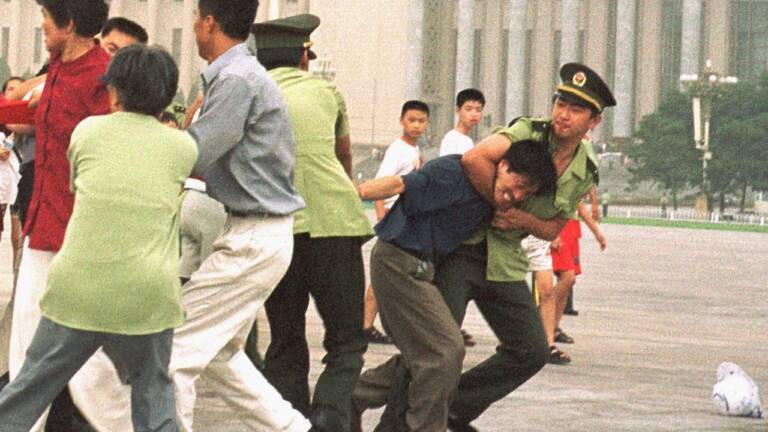
MARTIN LEE: I think it started with Beijing looking at Falun Gong in Hong
Kong and wanted to have the activity stopped, but of course, these people
are not hurting anybody. They are behaving themselves. They are the world’s
quietest protesters because they don’t even speak a word when they protest.
But of course, Jiang Zemin, the former president, didn’t like them and
wanted to have the activity stopped, and hence you have very draconian laws
contemplated and actually brought to the Legislative Council by the
government.
HAMISH ROBERTSON: Does it possibly go further than just concern about
opponents to the government in Beijing? Could the Chinese Government be
concerned that if Hong Kong were allowed to maintain its lively and free
type of society, despite all the rhetoric of one country, two systems, that
this would somehow infect the mainland and result in greater calls by
Chinese citizens in mainland China for the same kind of freedoms that they
take for granted in Hong Kong?
MARTIN LEE: I don’t think they are that much worried about Hong Kong people
enjoying more freedom than the rest of China, but they don’t want to see
democracy being developed in Hong Kong, because they would feel the pressure
in China.
But I think this is the right time for the Beijing leaders to actually think
over the matter and to lay down a timetable for change. It could be gradual.
They could start with elections at the village level, and then towns,
cities, and then finally the rest of China.
HAMISH ROBERTSON: And clearly it’s not in China’s interests for things to go
wrong in Hong Kong.
Do you think there’s a role for Western leaders, like the Australian Prime
Minister John Howard, to put some subtle diplomatic pressure on Beijing to
take a more relaxed view of the position in Hong Kong?
MARTIN LEE: Actually I think there is moral obligation on his part because
his government, back in 1984, warmly supported the signing of British joint
declaration. In other words, that Hong Kong people would be returned with
the land to a Communist regime, but clearly on the understanding and
promises that all our freedoms and the rule of law and way of life will
remain the same for 50 years.
Now, when you see changes already at the end of the sixth year, surely there
is an obligation on the part of the Australian Government as well as the
other governments to speak up when there is a pressing threat to our
freedoms.
HAMISH ROBERTSON: I was speaking to Martin Lee, one of the leading
opposition politicians in Hong Kong, who is a member of LEGCO, the
Legislative Council in Hong Kong.
http://www.abc.net.au/worldtoday/content/2003/s926719.htm
Posting date: 19/Aug/2003
Original article date: 18/Aug/2003
Category: Media Report