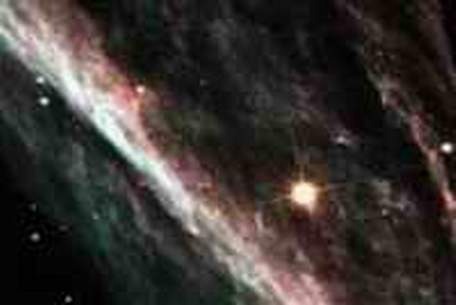
Hubble Captures a Pencil Nebula
June 15, 2003

Remnants from a star that exploded
thousands of years ago created a celestial abstract portrait, as captured
in this NASA Hubble Space Telescope image of the Pencil Nebula.
Officially known as NGC 2736, the Pencil Nebula is part of the huge Vela
supernova remnant, located in the southern constellation Vela. Discovered
by Sir John Herschel in the 1840s, the nebula's linear appearance
triggered its popular name. The nebula's shape suggests that it is
part of the supernova shock wave that recently encountered a region of
dense gas.
The region of the Pencil Nebula captured in this image is about three
fourths of a light-year across. The Vela supernova remnant is 114 light-years
(35 parsecs) across. The remnant is about 815 light-years (250 parsecs)
away from our solar system.
The supernova explosion left a spinning pulsar at the core of the Vela
region. Based on the rate at which the pulsar is slowing down, astronomers
estimate that the explosion may have occurred about 11,000 years ago.
The age of the blast, if correct, would imply that the initial explosion
pushed material from the star at nearly 22 million miles per hour. As
the Vela supernova remnant expands, the speed of its moving filaments,
such as the Pencil Nebula, decreases. The Pencil Nebula, for example,
is moving at roughly 400,000 miles per hour.
One can also see a bright star in this image, but it has nothing to do
with the Pencil Nebula. In fact, astronomers haven't yet measured
the distance between this star and the Pencil Nebula.
Supernova Is Forming in Cassiopeia
February 19, 2003

Through a long period of observation, astronomers from Netherlands found
out that a star in Cassiopeia will soon explode. Since 1993, astronomers
have carried out careful observation on this yellow giant star — one
of the brightest stars in the Milky Way. In 2000, the temperature of this
star was found to suddenly drop from 7,000 degrees to 4,000 degrees and
at the same time, the star emitted substances. The mass of the ejected
material weighs more than 10,000 times that of the earth. This is up to
present the strongest substance emission from a star that has been observed
by astronomers.
Scientists consider that supernova explosion could occur at any moment
and that this explosion might actually have happened and happened a long
time ago. We have to note that Cassiopeia lies about 10,000 light-years
away.
Mysterious Erupting Star Reverberates Through Space
April 1, 2003
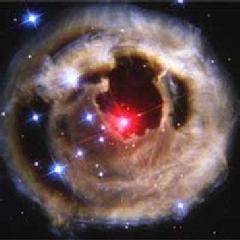
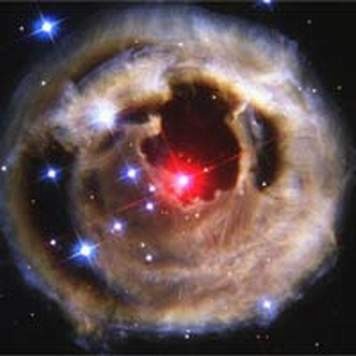
In January 2002, a dull star in an obscure constellation suddenly became
600,000 times more luminous than our Sun, temporarily making it the brightest
star in our Milky Way galaxy. The mysterious star has long since faded
back to obscurity, but observations by NASA's Hubble Space Telescope
of a phenomenon called a “light echo” have uncovered remarkable new features.
This petulant star, called V838 Monocerotis (V838 Mon) is about 20,000
light-years from Earth. The star puts out enough energy in a brief flash
to illuminate surrounding dust, like a spelunker taking a flash picture
of the walls of an undiscovered cavern. The star presumably ejected the
illuminated dust shells in previous outbursts. Light from the latest outburst
travels to the dust and then is reflected to Earth.
V838 Mon did not expel its outer layers. Instead, it grew enormously
in size, with its surface temperature dropping to temperatures not much
hotter than a light bulb. This behavior of ballooning to an immense size,
but not losing its outer layers, is very unusual and completely unlike
an ordinary nova explosion. The star is so unique it may represent a transitory
stage in a star's evolution that is rarely seen. The star has some
similarities to highly unstable aging stars called eruptive variables,
which suddenly and unpredictably increase in brightness.
Hubble Resolves Dying Planetary Nebulae
May 19, 2003

Planetary nebulae like the Helix are sculpted late in a sun-like star's
life by a torrential gush of gases escaping from the dying star. They
have nothing to do with planet formation, but got their name because they
look like planetary disks when viewed through a small telescope. With
higher magnification, the classic “donut-hole” in the middle of a planetary
nebula can be resolved.
The above photo shows a striking example of a planetary nebula, NGC 3132,
which is also known as the “Eight-Burst” or “Southern Ring” Nebula. NGC
3132 viewed by the Hubble telescope views an expanding cloud of gas, surrounding
a dying star. NGC 3132 is nearly half a light year in diameter, and at
a distance of about 2000 light years is one of the nearer known planetary
nebulae. The gases are expanding away from the central star at a speed
of 9 miles per second.
This image of NGC 3132, captured by NASA's Hubble Telescope, clearly
shows two stars near the center of the nebula, a bright white one, and
an adjacent, fainter companion to its upper right. (A third, unrelated
star lies near the edge of the nebula.) The faint partner is actually
the star that was ejected. This star is now smaller than our own Sun,
but extremely hot. The flood of ultraviolet radiation from its surface
makes the surrounding gases glow through fluorescence. The brighter star
is in an earlier stage of stellar evolution, but in the future it will
probably eject its own planetary nebula.
Sleeping Beauty Galaxy
May 30, 2003
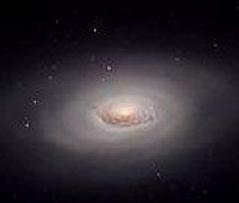
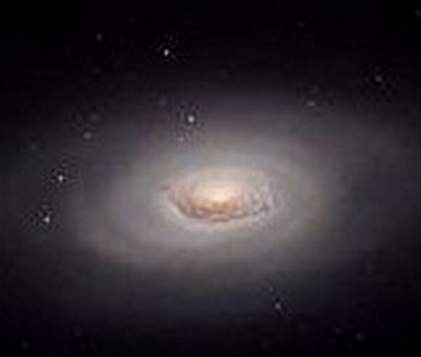
M64 is the famous Black Eye
galaxy, sometimes also called the “Sleeping Beauty galaxy“.
The conspicuous dark structure is a prominent dust feature obscuring the
stars behind.
M64 was recently shown to have two counter-rotating systems of stars
and gas in its disk: The inner part of about 3,000 light years radius
is rubbing along the inner edge of the outer disk, which rotates opposite
and extends up to at least 40,000 light years, at about 300 km/sec. This
rubbing process is probably the reason for the observed vigorous star
formation process, which is currently under way, and can be observed as
the blue knots imbedded in the peculiar dust lane on one side of the nucleus.
It is speculated that this peculiar disk and dust lane may be caused by
material from a former companion which has been accreted but has yet to
settle into the mean orbital plane of the disk.
Strongest Supernova Explosion
April 15, 2003

Gamma-ray bursts (GRBs) pose
one of the greatest mysteries of modern astronomy. Most astrophysicists
think that gamma ray bursts, fantastically energetic flares from deep
space, stream from new black holes that form when the cores of massive
spinning stars collapse to trigger supernovas.
Scientists have pieced together the key elements of a gamma-ray burst,
from star death to dramatic black hole birth, thanks to a March 29, 2003
explosion considered the “Rosetta stone” of such bursts. This telling
March 29 burst in the constellation Leo, one of the brightest and closest
on record, reveals for the first time that a gamma-ray burst and a supernova
— the two most energetic explosions known
in the Universe — occur essentially simultaneously, a quick and powerful
one-two punch. GRB 030329, named after its detection date, occurred relatively
close, approximately 2 billion light years away (at redshift 0.1685).
The burst lasted over 30 seconds. Scientists
say the gamma-ray burst detected on March 29, 2003, was associated with
a hypernova, which is more energetic and expands more rapidly than a supernova
does.
Hubble Captures a Perfect Storm of Turbulent Gases
May 6, 2003

Resembling the fury of a raging
sea, this image actually shows a bubbly ocean of glowing hydrogen gas
and small amounts of other elements such as oxygen and sulfur.
The photograph, taken by NASA's Hubble Space Telescope, captures
a small region within M17, a hotbed of star formation. M17, also known
as the Omega or Swan Nebula, is located about 5,500 light-years away in
the constellation Sagittarius. The image is being released to commemorate
the thirteenth anniversary of Hubble's launch on April 24, 1990.
The image, roughly 3 light-years across, was taken May 29-30, 1999, with
the Wide Field Planetary Camera 2. The colors in the image represent various
gases. Red represents sulfur; green, hydrogen; and blue, oxygen.
Dying Stars in Tarantula Nebula
April 29, 2003

Hodge 301, seen in the lower
right hand corner of this image, lives inside the Tarantula Nebula in
our galactic neighbor, the Large Magellanic Cloud.
This star cluster is not the brightest, or youngest, or most populous
star cluster in the Tarantula Nebula. But age has its advantages; many
of the stars in Hodge 301 are so old that they have exploded as supernovae.
These exploded stars are blasting material out into the surrounding region
at speeds of almost 200 miles per second. This high speed ejects are plowing
into the surrounding Tarantula Nebula, shocking and compressing the gas
into a multitude of sheets and filaments, seen in the upper left portion
of the picture.
Hodge 301 contains three red super-giants, stars that are close to the
end of their evolution and are about to go supernova, exploding and sending
more shocks into the Tarantula Nebula.
Also present near the center of the Hubble telescope image are small,
dense gas globules and dust columns where new stars are being formed today,
as part of the overall ongoing star formation throughout the Tarantula
nebula region.
The Most Beautiful Stars
April 28, 2003
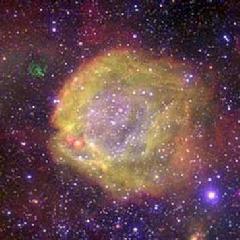
Image 1
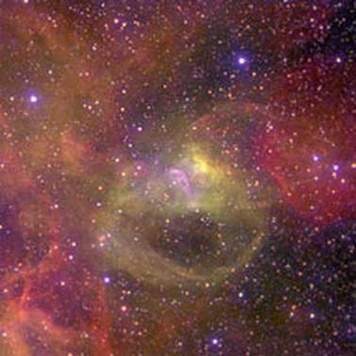
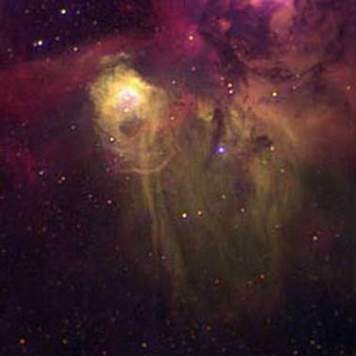
Planetary nebulae — remnants of stellar explosions are splendid celestial
bodies in the cosmos, but they are still mysteries to astronomers. Although
many gas-dust nebulae are rather close to the earth and have been carefully
investigated, they still let astronomers feel puzzled.
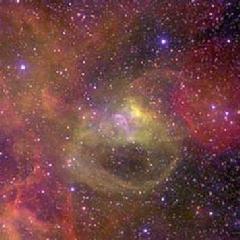
Image 2
First, what we talked about here are handful abnormal nebulae. They are
intensively heated and they contain large amount of ions, that is, charged
atoms. Their radiant intensity depends on the amount of atoms that participate
in this process and the amount of electrons that are lost. The hot “wind”
blew away those special bubbles in the surrounding substances. In the
photos taken, some bubbles show themselves as different colorful arcs.

Image 3
What is the source of this kind of atomic emission? It might be young
hot stars or some bizarre celestial body hiding in a nebula. How to list
these bizarre celestial bodies in the modern picture of the cosmic evolvement?
Recently, astronomers carried out extensive observations and found out
that the nebulae in four photos of Magellanic Cloud are highly ionized.
(The Large Magellanic cloud and the small Magellanic Cloud are two closest
companion galaxies of the Milky Way. They are about a few light years
away from the earth.)

Image 4
In the first three nebula images, Belgian astronomers identified the
origins of the high energy emission including the ultraviolet radiation
are the most heated and most gigantic stars (among which are a few double
stars). This might be WR-Wolf-Rayet stars, whose brightness are more than
1 to 10 million times of that of the Sun. But their burning can only last
a few million years rather than a few billion years. Just like the dead
yellow dwarf stars whose mass is more than 20 times that of similar stars
and the surface temperature is over 90,000 degree. In the fourth image,
the Belgian astronomers were not able to identify the origin of the emission.
Marvelous Spectacle: Hypergiant Erupts
January 9, 2003

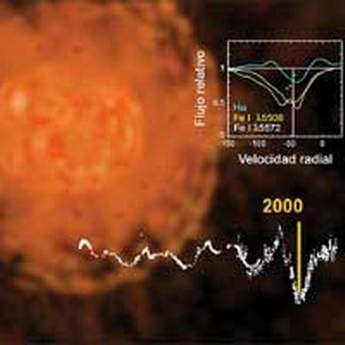
Rho Cas (type semiregular) is a hypergiant star and one of the most luminous
stars in our galaxy. Eruptions on these very rare, very massive stars
produce huge mass ejections evidenced by dramatic spectral changes and
optical dimming (an ejection in 2000 amounted to 10,000 Earths worth of
material and caused a ~1.5-magnitude drop in visual brightness)
Astronomers are anticipating possible major activity in rho Cas over
the next few months and feel that the eruption projected for the coming
months may be stronger that the 2000 one.
A Rose Blooming in the Universe
September 23, 2002
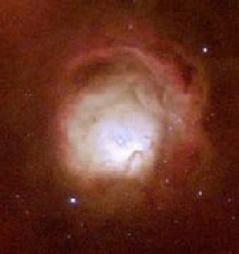
Resembling a delicate rose floating
in space, the nebula N11A is seen in a new light in a true-colour image
taken by the NASA/ESA Hubble Space Telescope. Fierce radiation from massive
stars embedded at the centre of N11A illuminates the surrounding gas with
a soft fluorescent glow.
N11A lies within a spectacular star-forming region in the Large Magellanic
Cloud, a small nearby companion galaxy to our own Milky Way Galaxy, visible
from the Southern Hemisphere. This nebula is particularly interesting
for astronomers since it is the smallest and most compact nebula in that
region and represents the most recent massive star formation event there.
Giant Black Holes Merge
September 4, 2002

Australian and American
astronomers have found convincing evidence that black hole mergers do
take place, as scientists have long suspected. For instance, in the main
view above is the pattern of jet lobes from galaxy NGC326 seen a few years
ago. Jets of energy (inset) from the core of radio galaxy NGC326 appear
to have changed direction suddenly, interpreted as a result of black holes
merging.
Scientists produced a mathematical model showing that a merger between
two black holes would impart a change in spin to the larger black hole,
causing its spin axis to flip suddenly — in the space of just a few minutes.
In effect, it knocks over the larger black hole by merging with it. Galaxies
that produce radio waves in a 'winged' or X-shape may be evidence
of this effect.
Although astronomers have known about X-shaped galaxies for a long time,
but until now, a convincing explanation had never been found for them.
Galaxies in death waltz spied by Hubble
December 18, 2002

NASA's Hubble Space Telescope
is witnessing a grouping of galaxies engaging in a slow dance of destruction
that will last for billions of years. The galaxies are so tightly packed
together that gravitational forces are beginning to rip stars from them
and distort their shapes. Those same gravitational forces eventually could
bring the galaxies together to form one large galaxy.
The galactic group is known as Seyfert's Sextet, suggesting that
six galaxies are taking part in the deadly dance. There are in fact only
four. The small edge-on spiral galaxy in the center of the image is actually
five times farther away than the group. An incidental alignment makes
it seem like it belongs. The sixth “galaxy” in the sextet, below to the
right, is actually a long stream of stars torn from one of the other galaxies.
The main group of galaxies is some 190 million light-years away in the
constellation Serpens. It is only 100,000 light-years across, taking up
less volume than our Milky Way galaxy.
Their distorted shapes suggest that gravitational forces have reshaped
them. The halos around the galaxies indicate that stars have been ripped
away. Such large intergalactic collisions usually spark the formation
of many stars. But Seyfert's Sextet — captured by Hubble's
Wide Field and Planetary Camera in 2000 — lacks such young stellar clusters,
which appear as bright blue regions in space images. The galaxies will
continue to interact. And eventually, billions of years from now, all
four may merge and form a single galaxy.
References: