The Hong Kong Government should rethink proposed harsh new security
laws.
As the Union Jack was lowered for the last time in Hong Kong, the
British
governor, Chris Patten, declared: “Now Hong Kong people are to run Hong
Kong. That is the promise. And that is the unshakeable destiny.” Beijing
was
never going to let that happen fully on the issues that mattered –
security,
sovereignty and political freedom. In his speech on that wet night six
years
ago, then Chinese president Jiang Zemin spoke of the colony’s “return to
the
motherland” while making soothing noises about China’s commitment to the
principle of “one country, two systems”.
Hong Kong has since taken a battering on several fronts. It was hit hard
by
the Asian economic crisis that set in within weeks of the handover.
Rising
unemployment, business collapses, a decline in tourism and, most
recently,
the SARS epidemic have added to its woes. On top of this, Hong Kong’s
administration has moved to introduce anti-subversion laws that could be
used to stifle criticism of both the local and mainland rulers.
The anti-subversion laws, grouped under what is known as Article 23,
would
form part of Hong Kong’s Basic Law, the “mini-constitution” that governs
the
territory under the “one country, two systems” regime.
The law is currently before a local legislature stacked with
pro-Government
and pro-Beijing members. Article 23 covers such activities as treason,
subversion and secession, sedition, theft of state secrets and
prohibitions
on organisations with foreign links from conducting political activities
in
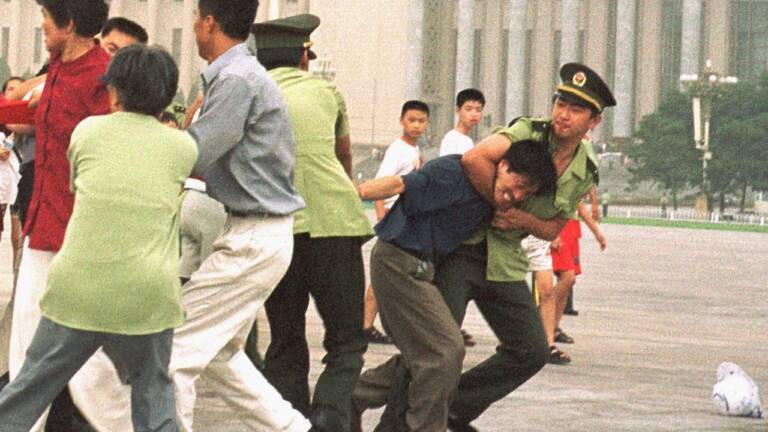
Hong Kong. Critically, it would mean that organisations banned in
mainland
China could not operate lawfully in Hong Kong. This would include groups
such as Falun Gong and could potentially be extended to include
churches,
human rights groups, trade unions and even opposition political parties.
Opponents say there is a direct threat to political, religious and media
freedoms.
The Hong Kong Government contends that Britain, Canada and the United
States
already have legislation similar to Article 23. But it fails to point
out
that these countries also function under a rule of law not apparent in
China, where what constitutes a state secret, for example, is a rubbery
concept.
The US, Britain and the European Union have all criticised the proposed
law.
The Hong Kong Government has also been taken aback by the level of
public
opposition. On Tuesday up to 500,000 black-clad citizens – from a
population
of just 6.8 million – peacefully took to the streets in the largest
protest
in China since the 1989 pro-democracy demonstrations.
The catalyst for the protest was Article 23, but demonstrators also
vented
frustrations over the administration’s handling of the economy and the
SARS
crisis. Hong Kong’s Government should rethink its anti-subversion laws,
but,
under pressure from its mainland puppeteers, probably will not.
http://www.theage.com.au/articles/2003/07/02/1056825454606.html
Posting date: 3/July/2003
Original article date: 3/July/2003
Category: Media Report