Anne Hyland, Hong Kong
The Chinese Premier, Wen Jiabao, arrived in Hong Kong yesterday on a
three-day visit to mark the anniversary of the former British colony’s
return to Chinese sovereignty, but instead of celebrations he found a city
spoiling for a fight.
At least 100,000 citizens are expected to fill Hong Kong’s streets tomorrow,
the sixth anniversary of Hong Kong’s return to China, to protest against
implementation of a controversial national security bill, which many fear
will restrict Hong Kong’s political and civil freedom.
The law, referred to locally as article 23, has drawn international
criticism, with the US House of Representatives on Friday passing a
resolution, 426 votes to one, urging the Hong Kong government to withdraw
the bill. China denounced the US “interference” and foreign ministry
spokesman Kong Quan claimed that the “legislation is a common practice in
all countries, including the United States”.
Hong Kong’s unpopular leader, chief executive Tung Chee-hwa, said the city
had a constitutional duty to pass the laws. “We have to make sure that we
are patriotic,” Mr Tung said last week. “We have to maintain the
fundamental interests of our nation.” Human rights group Amnesty
International has demanded the law be abandoned, claiming it could present a
“potential catastrophe to human rights”.
Hong Kong is required under the basic law, the city’s mini-constitution, to
pass legislation banning treason, sedition, subversion and theft of state
secrets. However, concern exists that the Hong Kong government has gone
beyond the basic requirements of such legislation and may use the new law to
suppress freedoms, including those of the media, speech and religion.
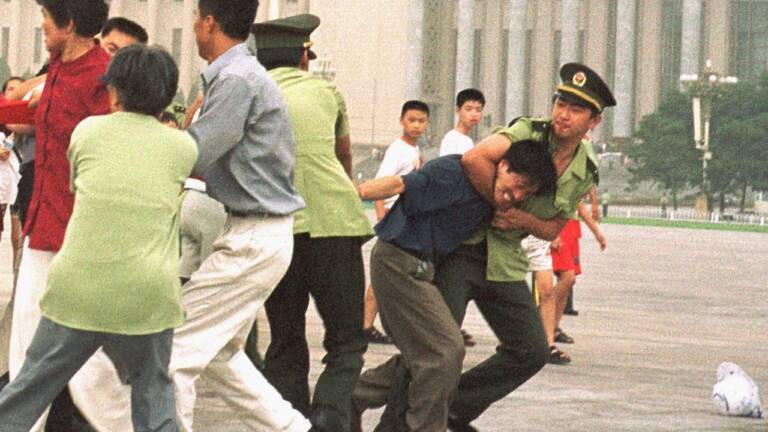
For example, Hong Kong could decide to suddenly ban groups, such as the
Falun Gong, which is allowed to exist in the city but is outlawed on the
mainland.
A University of Hong Kong study found that nearly two-thirds of people
surveyed opposed the government’s July 9 deadline for the passage of the
controversial national security bill.
The strong opposition to the law has not dissuaded the Hong Kong government
from pushing ahead with its implementation and this continued even in the
midst of the 13-week crisis caused by severe acute respiratory syndrome,
which killed 296 and infected 1755.
The disease has taken its toll on the city, with unemployment at a record
high and the economy teetering on the brink of recession, which would be the
third in six years.
A survey by advertising firm TBWA Hong Kong recently found the territory’s
people were the unhappiest of those questioned in an Asia-wide survey, and
the most likely to describe the future as scary and stressful.
Mr Wen would be cognisant of the discontent in Hong Kong, but is unlikely to
witness the protests in the streets as he will depart the city shortly
before they begin. His visit is ostensibly to mark the handover anniversary
as well as the signing of the first bilateral trade agreement between Hong
Kong and China, which Beijing is hoping will help to revive Hong Kong’s
sluggish economy.
Posting date: 30/June/2003
Original article date: 30/June/2003
Category: Media Report