BY: Kris Olsson
 |
| Leisa Griffiths Park, Falun Gong practitioner |
‘The main principles provide ways of looking inside yourself’
LEISA Griffiths Park always knew the pain that racked her body was the
manifestation of something much bigger, and much deeper, than physical
disease.
But it took years of mind-numbing medication and prolonged hospital
stays
before she realised hope lay only in taking back the power from a
condition
that was fast claiming her body, her emotions and a blossoming
international
singing career.
“I realised I had to take responsibility back,” says the articulate
42-year-old, who until five years ago was crippled by a cluster of
diseases
dominated by the rare trigeminal neuralgia, which causes swelling and
excruciating pain through the neck, face and head.
“I had to look at my whole history. I had to see what was going on
deeply
inside me that I hadn’t been in contact with. That was a real turning
point.”
At the time, she was hitting her stride in a musical career that had
already
taken her to London, Europe and China, performing her own compositions
in
hotels and clubs.
Music had always been the centre of her life. Through writing and
singing,
she believed she could slice through cultural barriers to find common
connections between people, the things that linked rather than divided.
“I wanted to reach a place in people’s hearts where they could recognise
themselves, a place in them and in me,” she says. “A place where
language
went out the window.”
This made finding the source of her physical problems all the harder: “I
knew I had to look at my behaviour and thinking to mend whatever damage
had
been done, but I had no idea what I’d done that led me to this. The
penalty
felt a bit high. It felt like a punishment.”
But there seemed to be little choice. Her body was failing her (she was
also
diagnosed with celiac disease, irritable bowel and hypothyroidism),
Western
medicine was failing her, and her family feared the worst.
“I came to realise I may not be able to go on,” Griffiths Park recalls.
“Life was at a near standstill.”
A few years previously, she had lived and worked in China, where she had
intuitively felt her answers might lie. At her lowest ebb, she returned,
in
search of an expert, or master, in the eastern practice of Qi Gong.
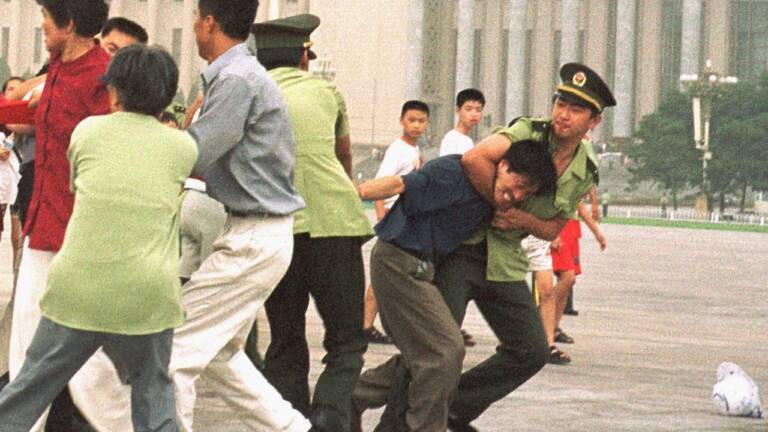
In the West, the best-known form of the practice is Falun Gong, or Falun
Dafa, controversially banned in China, where its proponents have been
persecuted and jailed. Griffiths Park didn’t find her master there, but
on a
return stopover in Bali, she began to read the Falun Dafa books given to
her
previously by a friend.
The change, she says, was as surprising as it was sudden. “From that
point
my life started to change,” she says. “I began to do the exercises and I
could feel things happening immediately, in my nerve endings, right
through
my body. I began to feel better physically and emotionally and I knew
I’d
found it. I knew I wouldn’t need any other healing, medical or
otherwise.”
What Griffiths Park had embarked on was a “cultivation system” based
around
the physical practice of five exercises, meditation, and the principles
of
truth, compassion and tolerance.
“The focus is on being a better person,” she says simply. “I know that
sounds cliched, and I think that’s sad, in this day and age. The main
principles provide ways of looking inside yourself and seeing what you
are
doing. Of looking at a situation and instead of trying to change others,
asking, what is the kindest, most compassionate way to go about this?
What
is my part in this? It’s about putting other people first.”
The several thousand practitioners of Falun Gong in Australia are keen
to
point out the practice is not an organised religion and is not even a
club.
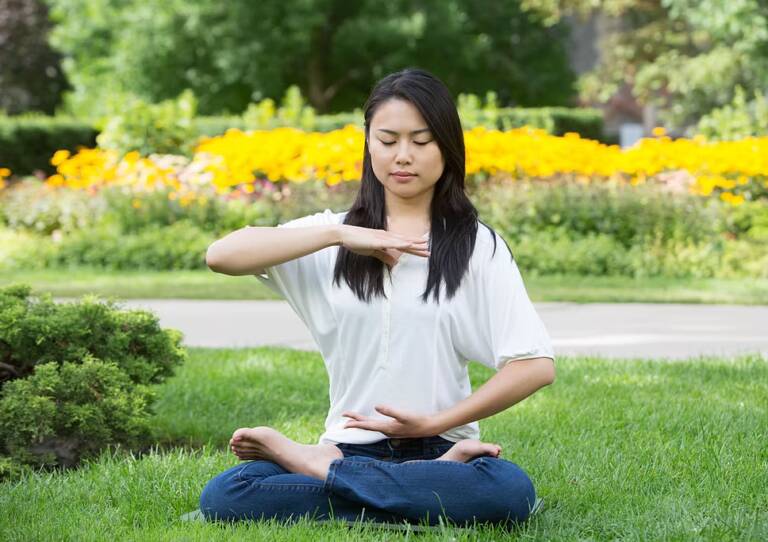
“It’s a way of living, but it’s entirely up to the individual. Sometimes
people practise exercises or meditation in the local park, and they’re
happy
to show others, or talk about it,” she says.
“No one is allowed to take money for this information. We can just show
people how this works. Then it’s up to them. For me, it was about the
tools
being put into my hands. How much I used them was up to me.”
Feeling positive effects immediately, Griffiths Park adopted the system
wholeheartedly. Over the following months, her facial swelling and pain
disappeared, her slurred speech improved and without the numbing effects
of
strong medication, she felt clear-headed and light.
Then the “completely impossible” happened: new blood tests confirmed all
the
abnormalities had gone, and she fell pregnant. At first, her husband and
family were sceptical about the new regime, fearing she could still
regress
and just “fall down”. Now, five years down the track, they’ve been won
over.
“There’s no sign of the pain. I’ve had a complete and utter turnaround
in my
health,” she says. “I feel lighter, calmer, more youthful. And
exhilarated
and a bit shocked — I walked away from it. Now my life seems to become
more
worthwhile every day.”
There are two babies now, and Griffiths Park is back in the recording
studio
putting down her new composition Call to Heart, which will premiere at
next
weekend’s celebrations in Canberra around National Falun Dafa Day on
Monday,
June 23.
For Griffiths Park, the health benefits have become a by-product of
“really
wholeheartedly doing something and being a better person”. She wants
this,
and the Falun Dafa messages about tolerance and compassion, to emerge in
her
music, but she and her fellow practitioners also want to highlight the
ongoing persecution of others in China.
She believes the bans on Falun Dafa there are linked to the way its
principles of truth and tolerance have “exposed corruption among
high-ranking officials and bureaucrats”. She is also concerned that
people
associated with her in Australia have gone missing on their return to
China,
and she fears for their safety.
Posting date: 25/June/2003
Original article date: 21/June/2003
Category: Media Reports