by Wei Jingsheng

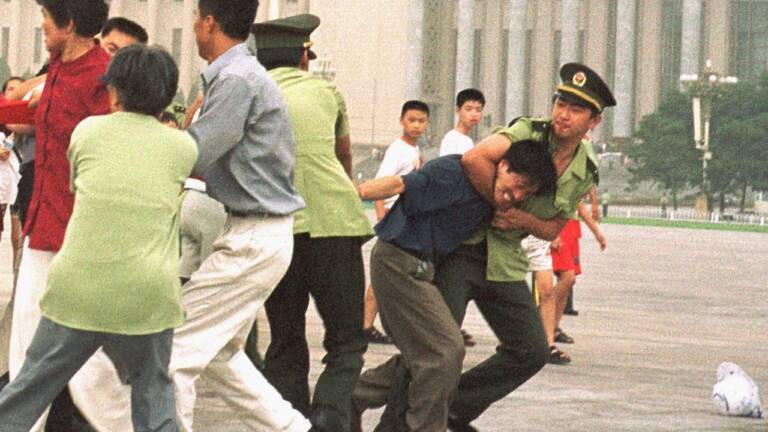
A deserted Tiananmen Square
Because of early official denials and cover-ups over the spread of SARS –
severe acute respiratory syndrome – some analysts have christened this crisis
“China’s Chernobyl.” The initial secrecy of the former Soviet regime
after the Chernobyl nuclear accident, which completely ignored the interests
of public health, is considered by historians to be one of the final blunders
of a closed totalitarian system that ultimately led to its demise. In the wake
of that disaster, Mikhail Gorbachev was compelled to use the policy of “glasnost”
or openness as a means to recover legitimacy for Communist Party rule. But,
as Gorbachev discovered, opening a closed system necessarily spells its demise.
Will the same be true for China?
The fast-spreading SARS virus and the mounting death toll of victims have caused
worldwide attention and anxiety. Neglected by outside observers, however, have
been frantic rumors within China that have aroused public imagination. These
include the notion that SARS emanated from China’s biological weapons research
facilities. Indeed, many Chinese believe the Chinese Communist Party secretly
backed Osama bin Laden as a way to menace the United States. Some suggest China
and Russia were more likely to provide him with these means of terror than Iraq.
True or not, these rumors reveal the fragile legitimacy of regimes, such as
China or the old Soviet Union, that are based upon totalitarian control of information:
When governments cannot be trusted to tell the truth, people will believe anything.
Then, when such a regime admits its lies, it does so at its own peril.
To dampen rumors about biological weapons leakage and to demonstrate that the
government was implementing measures to combat SARS, China’s new paramount leader,
Hu Jintao, recently conducted a highly publicized inspection tour, including
one of the Chinese Military Medical Academy, a bio-military research facility.
No doubt if SARS continues to worsen to epidemic proportions in China, Hu’s
belated glasnost will undermine his credibility, not enhance it. Everyone is
already asking: “Why didn’t he act sooner? How can we live in a system
that values control of information above public health?”
During the Gorbachev era in the Soviet Union, the internal fighting was intense
at the leadership level. Each faction used the others’ failures as an offensive
weapon, causing an even further erosion of confidence in the leadership. The
same thing is happening in today’s China. Hiding information about something
as dangerous as SARS could only have been sanctioned at the highest levels –
the Politburo and Secretariat. No mere minister of health or Beijing mayor would
have the courage or power to hide this kind of information. Their recent dismissal
was the usual story: Lower officials are scapegoats for high-level irresponsibility.
What is unusual this time is that the scapegoats are from different factions.
One is from Hu Jintao’s side; the other is allied with Jiang Zemin, Hu’s predecessor
and continuing competitor. Were they having fierce internal fights and unable
to collaborate with each other, causing paralysis as SARS spread rapidly around
the country? Or, having suddenly realized the stakes, have they decided on a
truce where each side loses one scapegoat in order to save their common skin
– the Communist Party?
We don’t know. We only know this: Most Chinese believe that the Communist regime
is guilty of concealing information about an infectious disease that threatens
the entire country. The Communist government had to admit this fact, and the
implications must be clear.
Finally, there is a big difference between the SARS disaster and Chernobyl.
During the Chernobyl crisis, Western countries heavily criticized the Soviet
Union. That pressure was, in large part, what made Chernobyl a turning point
that led to Soviet collapse.
By contrast, Western leaders today need Beijing’s support in their own internal
dispute over Iraq and in dealing with North Korea. More than a shame, it would
be an historic mistake to pass up this opportunity to make China’s leaders accountable
to their own people and to the world at large. The virus next time is sure to
be more virulent.
* Wei Jingsheng is a China democracy activist in exile who was imprisoned
for years in China before moving to America.
http://www.asianresearch.org/articles/1332.html
Original article date: 30/Apr/2003
Category: Special Report