As SARS rages in China, some cadres
are more intent on saving face than saving lives. TIME investigates a cover-up
that may have killed
BY Hannah Beech/ Shanghai
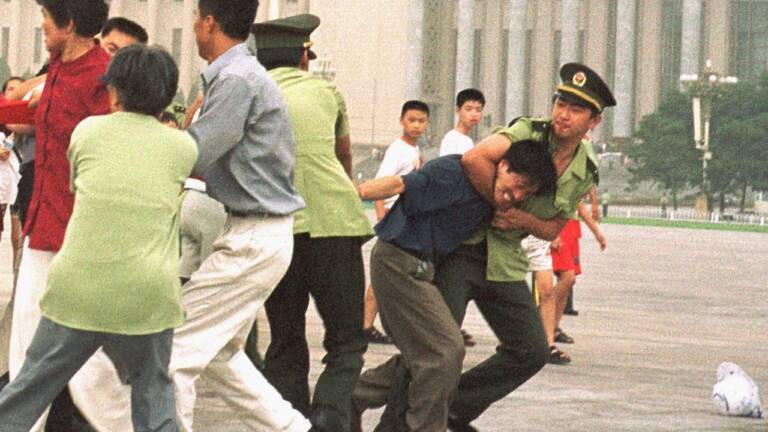
 Photo taken in Shanghai on April 16. AP Photo/Eugene Hoshiko. Because of the government’s deliberate cover-ups, more and more Chinese people’s health is in jeopardy without being aware of it. |
This is the hospital ward China’s Ministry
of Health doesn’t want you to see. There are more than 100 Severe Acute
Respiratory Syndrome (SARS) patients crammed into tiny rooms in the infectious
diseases section of Beijing’s You’an Hospital. “Every single one
of us in this building is a SARS patient,” says a nurse surnamed Zhang who
worked at the People’s Liberation Army Hospital (P.L.A.) No. 301 until
11 days ago, when she was diagnosed with the disease and admitted here.
“There are at least 100 SARS patients here, if not several hundred. The
conditions here are really bad. We’re not allowed out of this room.
We piss in this room, crap in this room and eat in the room. As far as I
know, at least half of the patients here are doctors and nurses from other
hospitals.” As a Time reporter continued through the ward, another nurse
who wouldn’t give her name stopped him and explained, “Look, I’m
not pushing you away. I do this for your own good. It’s too dangerous
here. It’s really a terrible disease, even we who work here don’t
know when we’ll get it. No place is safe in this hospital. All of these
wards are full of SARS patients, there are over 100 at least. Don’t
believe the government–they never tell you the truth. They say it’s
a deadly disease with 4% mortality? Are you kidding me? The death rate is
at least 25%. In this hospital alone, there are over 10 patients dead already.”
According to the Chinese government, most of
these patients–and perhaps hundreds or even thousands of others across
the nation–simply do not exist. Before the reporter is hustled out of You’an’s
teeming isolation ward, nurse Zhang warns, “Never believe what the Health
Ministry tells you.”
China, flush from having won the right to host
both the Beijing 2008 Olympics and the 2010 Shanghai World Expo, may be
presenting a rosy, reformist face to the rest of the world. But the country’s
handling of the deadly SARS epidemic, which is believed to have originated
in the southern province of Guangdong last November, shows that behind closed
doors Beijing can be as inscrutable and secretive as ever. Numerous reports
from local doctors over the past week suggest that the nation’s health-care
system remains hostage to a government that values power and public order
before human lives. “You foreigners value each person’s life more than
we do because you have fewer people in your countries,” says a Shanghai-based
respiratory specialist, who sits on an advisory committee dealing with epidemic
diseases. “Our primary concern is social stability, and if a few people’s
deaths are kept secret, it’s worth it to keep things stable.”
The question is: Just how many deaths can be
kept secret before the health epidemic itself becomes a threat to social
stability? For decades, China’s Ministry of Health has deliberately
kept killer outbreaks hidden, hoping that deadly diseases will burn out
on their own without interference, or scrutiny, from the international medical
community. After all, China is a big country, it says, and it’s natural
for a case or two of plague or rabies to pop up; why worry the populace
unnecessarily? But Beijing’s emergency plan may be backfiring with
SARS, which has burst out of the mainland’s national boundaries to
kill 116 people and infect 2,890 worldwide as of last weekend. Yet even
as the deadly pneumonia proliferates around the world–Africa is the latest
continent afflicted with the bug–China continues to massively underreport
its own SARS epidemic. In the metropolises of Beijing and Shanghai, local
doctors and nurses whisper of hundreds of cases piling up in epidemic wards.
And citizens who have put faith in China’s health-care system for decades
are beginning to wonder whether their long-held trust has been dangerously
abused.
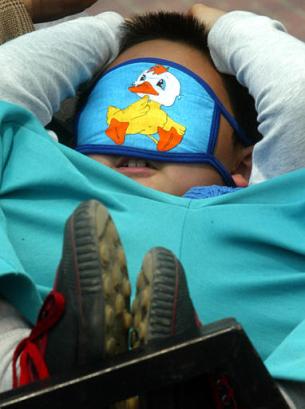 A boy in Beijing covers his eyes with respirator. |
Even as late as last Saturday, China’s health
authorities continued to stick to an accounting of 60 SARS deaths and 1,300
cases–even though China’s Premier Wen Jiabao visited You’an Hospital,
where medical staff say the full caseload there has not been incorporated
into the figures. In an effort to ease an increasingly worried populace,
Beijing’s recently appointed Mayor Meng Xuenong claimed last Thursday
that Chinese health officials have “full control over atypical pneumonia.”
Meanwhile, medical authorities maintained that most SARS cases in China
outside of Guangdong were “imported,” proving that cities such as Beijing
and Shanghai were not themselves breeding grounds for the disease.
But even as the government continued its policy
of denial, a number of whistle-blowers began contesting Beijing’s numbers.
On Tuesday a retired military hospital surgeon alleged that in one Beijing
hospital there were more than 60 SARS patients and seven deaths from the
disease. A local cadre from Shenzhen told Time that during an internal meeting
last week, a city health official spoke of at least six deaths there so
far while still publicly denying any cases. And in Shanghai, local doctors
spoke of 14 cases at one hospital, while Dr. Li Aiwu of the Shanghai Pulmonary
Hospital confirmed that seven foreigners were being treated for the disease–contradicting
the city’s previous claim that no foreigners were suspected of having
SARS. “I guess that means I don’t exist,” jokes a middle-age Englishman
who has been confined to its 14th-floor isolation ward for a week.
The Manchester native connects with the outside
world by cell phone. “The care here is good, but I must admit I’m feeling
a little cut off from the real world.”
China’s continued obfuscation contributed
to the U.S.’s issuing a travel advisory warning against nonessential
trips to China. At about the same time, Malaysia barred all tourists from
mainland China and Hong Kong. In Hong Kong, the government reacted to the
continued increase in local SARS cases and criticism it had been slow in
dealing with the disease by finally ordering household contacts of confirmed
patients to stay in home quarantine. Travelers wishing to fly from Hong
Kong’s Chek Lap Kok airport would also have their temperature taken
before they were allowed to board their flights. In the mainland, luxury-hotel
occupancy in Shanghai has slipped from the usual overbooked 120% this time
of year to 30%. High-level trips by former U.S. President George Bush, Singaporean
Prime Minister Goh Chok Tong and a World Economic Forum event have been
postponed or canceled. “The drop-off in visitors is worse than in 1989,”
grumbles a Shanghai foreign-affairs official, referring to the foreign exodus
after the Tiananmen crackdown.
In a country where mass revolts have regularly
paralyzed empires and regimes, the Communist Party is apprehensive about
panicking the people. And now that China’s booming economy is more
dependent than ever on foreign investment–54% of Shanghai’s industrial
output, for instance, derives from foreign-owned or partially foreign-owned
companies–the Party is doubly concerned about maintaining the appearance
of stability. “Look at what happened in Hong Kong, where everybody’s
scared and wearing a mask,” explains a senior aide to Shanghai’s vice
mayor, blaming the foreign media for stirring up jitters about the killer
virus. “We don’t want everyone to get panicked like that for no reason
and destroy our economy.” Furthermore, with the major May 1 holiday week
rapidly approaching, local tourism officials are worried that the SARS scare
will deter Chinese from traveling and spending their yuan.
China has a long history of not facing up to
its medical problems. Prior to SARS, the country had been notoriously unwilling
to publicly admit to its burgeoning AIDS epidemic. When news trickled out
three years ago of tens of thousands of farmers in central China infected
by HIV after selling blood to traffickers using tainted equipment, the government
delayed more than a year before conceding the truth. Even then, Beijing
insisted the virus contaminated only one tiny village in Henan province.
Finally, in 2002, the Chinese leadership revised its HIV estimate from 30,000
cases to 1 million–in a single day. Similar night-and-fog tactics kept
quiet an outbreak of food poisoning in the northeastern province of Liaoning
last month, when three schoolchildren died and 3,000 were sickened after
drinking tainted soy milk. Even with hundreds of students flocking to hospitals,
local authorities denied for weeks that there was anything amiss.
Most doctors are too frightened of losing their
jobs to tell the truth about such cover-ups. A doctor who told a TIME reporter
that there were dozens of SARS cases being isolated in a tuberculosis ward
at Beijing’s No. 309 People’s Liberation Army Hospital backed
out of continuing the discussion, saying, “I’m embarrassed that I can’t
talk to you. I had really wanted to, but I’m young and I can’t
afford to lose my job.” But other brave souls are finding the courage to
speak out. Last week, in a case first reported by Time, retired military
surgeon Jiang Yanyong alleged that at the same hospital there were 60 SARS
cases and seven deaths, and that at the P.L.A.’s No. 301 Hospital (where
nurse Zhang works) at least 10 doctors and nurses had contracted the disease
from their patients. Jiang, who initially submitted his statement to the
state TV channel CCTV 4 but received no response, says he was spurred to
report more accurate numbers because he was so dismayed that the Ministry
of Health reported only 12 cases and three deaths in the capital in early
April. According to Jiang, another military hospital, No. 302, admitted
two SARS patients first diagnosed at No. 301 in early March just as Beijing
was convening the politically sensitive National People’s Congress.
It was only after both patients had died, says Jiang, that health authorities
called a meeting, but instead of instructing doctors on how to contain the
disease through public-education campaigns, Jiang says medical officials
told physicians they were “forbidden to publicize” the SARS deaths “in order
to ensure stability.”
Doctors in Shanghai have faced similar political
interference. Early last week, physicians at a hospital in the city’s
Huangpu district were called in by their superior to discuss a new policy
initiative straight from the municipal health bureau. For the past couple
of months, doctors had been clandestinely searching the Internet for information
about SARS, and they hoped for solid information from their director. Instead,
he told them not to wear masks in the hospital, save in isolation wards
and a few select diagnostic rooms. The gathered physicians were confused.
One top administrator meekly said, “I thought wearing masks was supposed
to stop SARS from spreading to medical staff.” Their superior responded
curtly, “Wearing a mask will scare the patients. We do not want panic, especially
since SARS has already been controlled.”
Local health authorities can get away with such
reckless policies because there’s little oversight from above. Health
Minister Zhang Wenkang actually ranks lower in the government hierarchy
than the Communist Party secretaries of Shanghai and Guangdong. That gives
the regional Party bosses far more power than the Health Minister to dictate
even medical policies in their fiefdoms. Furthermore, each city’s center
for disease control (CDC), which is responsible for updating China’s
SARS caseload, reports first to the local Party boss, then to the Ministry
of Health. The head of each city’s local health bureau is appointed
by local Party cadres, not by the Ministry of Health. That structure means
local health workers have little incentive to reveal the true magnitude
of the crisis.
Even doctors on the front lines have been left
in the dark, sometimes to their detriment. At Beijing’s You’an
Hospital, for instance, nurse Zhang estimates that about half of those in
the isolation ward are medical staff from other area hospitals. To complicate
matters further, the only people who are officially allowed to diagnose
SARS in China are CDC researchers, not the physicians who are treating the
patients. “I had a patient whose symptoms clearly seemed to be those of
a SARS-positive patient,” says a doctor who consults at a hospital in a
leafy district of Shanghai. “But after I contacted the CDC, the patient
was suddenly transferred without my knowledge and I never found out whether
he had the disease or not.” The physician presumes the patient did indeed
have SARS; otherwise, why would he have been transferred so mysteriously?
“We doctors are all left with a lot of questions,” he says. “I think it’s
shameful to not let us know what’s going on.” That information blackout
has resulted in unnecessary deaths as local doctors have resorted to trial-and-error
treatments rather than using therapies that have proved relatively effective
in other hospitals. Physicians in some Guangdong hospitals, for example,
were told by Beijing to treat SARS patients for mycoplasma pneumonia and
chlamydia pneumonia, which are bacterial infections, even though they had
already found that a combination of antiviral medications and steroids showed
better results.
Part of the confusion might be springing from
China’s accounting methods. Current diagnostic tests for SARS are unreliable
at best, and doctors worldwide have had to diagnose primarily by evaluating
symptoms and proximity to other SARS patients. But with places like Beijing
refusing to acknowledge true numbers of infected patients, it becomes difficult
to prove that a person has been near a SARS patient, because those victims
aren’t supposed to exist in the first place. That, plus a more stringent
set of requirements applied before confirming a case as SARS means that
many patients who would be diagnosed as having the virus elsewhere in the
world are only considered “suspected” cases in China. The English patient
at the Shanghai Pulmonary Hospital, for instance, has been quarantined for
a week, yet the physicians there have told him there’s no way they
can tell whether he has SARS. “I’ve heard that in other countries they’re
able to diagnose within a few days,” he says, between dry coughs. “Why can’t
they diagnose our cases? It’s very strange.” (The Englishman’s
doctor says he is treating the man’s case as SARS, although the CDC
has yet to confirm the case as such.)
Last Thursday it seemed the Ministry of Health
couldn’t even agree on its own SARS count. At a press briefing in Beijing,
Qi Xiaoqiu, director of the Ministry of Health’s Disease Control Department,
said China’s official SARS statistics include “confirmed and suspected
cases.” Just minutes later Vice Minister of Health Ma Xiaowei told reporters
that the numbers he had stated referred only to confirmed cases. Either
way, experts agree that the ministry’s reckoning still seems far too
low. Mainland doctors fret that with continuing ignorance about the disease,
the virus could spread even farther. Misinformation abounds: a Shenzhen-based
health official named Zhang Shunxiang warned last week that people shouldn’t
wear masks because they impede proper breathing and contribute to public
panic–contrary to advice given almost everywhere else in the world. State-run
newspapers in the mainland suggested that a protein-rich potion containing
cicada shells and silkworms could be a SARS panacea. Even more worrisome
is the possibility that the disease is making its way into China’s
estimated 100 million-strong migrant worker community, which has little
access to health care. Already, doctors suspect that the first case of SARS
in Beijing was a migrant who worked in Guangdong. If the virus is indeed
infecting members of China’s vast floating population, experts fear
it could spread quickly into the country’s undeveloped interior. With
much of China still in the dark about the killer bug, the worst may be yet
to come.
—-With reporting by Bu Hua/Shanghai and Huang
Yong
http://www.time.com/time/asia/magazine/article/0,13673,501030421-443226-1,00.html
Posting date: 19/Apr/2003
Original article date: 18/Apr/2003
Category: Media Reports