By JOE McDONALD
BEIJING – Complaining about a lack of Chinese progress, Amnesty
International exhorted American diplomats Friday to set specific goals and
demand the release of political prisoners during a new round of human rights
talks in Beijing next week.
“We remain deeply concerned by the lack of progress,” the London-based
organization said in a letter to U.S. Secretary of State Colin Powell (news
– web sites). “Without progress on these fundamental topics the
effectiveness of the dialogue remains in question.”
The meeting Monday in Beijing is part of a periodic series of human rights
exchanges held by China since the mid-1990s with the United States, the
European Union (news – web sites) and other governments. Activists say such
meetings produce little, while muting official criticism of China. U.S. and
other officials release few details of their talks.
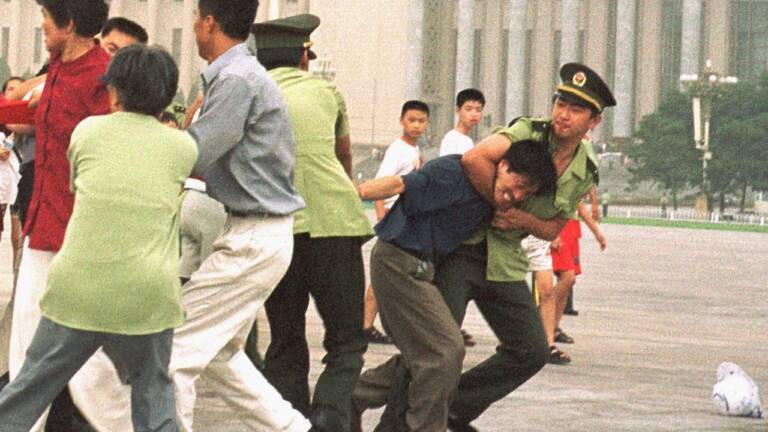
Amnesty cited a wide range of outstanding issues despite past talks with
Washington, including torture in prisons and crackdowns on Internet dissent
and the Falun Gong (news – web sites) spiritual group.
Beijing routinely rejects human rights criticism as interference in its
affairs. But it has carried on such dialogues since the mid-1990s with the
European Union, the United States and other governments, and in recent years
has shifted its public tone to acknowledge progress is under way ýX though
on China’s terms.
Amnesty called on U.S. diplomats to tell Chinese officials that human rights
will be an “integral part of the political dialogue” with Beijing.
“The U.S. government should the specify the overall aims, concrete
objectives and time frame,” its letter said. “Benchmarks for progress should
be identified and complemented with a clear time frame for the achievements
of these objectives.”
The group said it sent a copy to U.S. Assistant Secretary of State Lorne
Craner, who will represent Washington at the Beijing talks. Craner is head
of the State Department’s human rights bureau.
The letter asked U.S. officials to convey a list of specific requests.
They include the release of Rebiya Kadeer, a prominent Muslim businesswoman
imprisoned for sending newspapers to her activist husband abroad, and
dissident Xu Wenli, who is serving a 13-year prison term and is reported to
be suffering from Hepatitis B.
Amnesty said it recognized that engagement with China is a long-term
process, and that “dialogue may not produce major changes in the short
term.”
However, it said that in some cases abuses have worsened, such as a recent
Chinese crackdown on Internet use in which it said at least 30 people have
been arrested on vague subversion or state-secrets charges.
Amnesty also complained of imprisonment, torture and sometimes death in the
government’s crackdown on independent Christian churches, Falun Gong and
Tibetan, Muslim and other ethnic minority activists.
China has been accused recently of misusing the international campaign
against terrorism to crack down on peaceful pro-independence sentiment in
Tibet and among Uighurs, a Muslim minority in the northwestern Xinjiang
region.
“Thousands of Tibetan Buddhist monks and nuns remain in detention, while
ethnic Uighurs, many of them Muslims, are falsely accused of being
`separatists’ or `terrorists,'” Amnesty said. “Many have been executed after
secret trials.”
http://story.news.yahoo.com/news?tmpl=story&u=/ap/20021213/ap_wo_en_po/as_gen_china_human_rights_1
Posting date: 14/Dec/2002
Original article date: 14/Dec/2002
Category: Media Report