Claude Adams, Featurewell.com
HONG KONG – It is said that, not too many years ago in China, you could get
into serious trouble with the authorities for insulting your neighbor’s cat.
The Chinese word for “cat” is “mao,” and it is pronounced almost exactly the
same as “Mao,” the name of the Great Helmsman. A slip of the tongue could
lead to subversion.
Those days are gone. The Chinese are freer in their speech today. Privately,
they can, and do, poke fun at their leaders and even criticize the Party.
But there are lines they cannot cross. The word “subversion” has a chilling
force in China, much like the cry of “witchcraft” in 17th-century Salem. In
the minds of Chinese Communist Party members, it is, along with treason and
sedition, the ultimate crime: an attack on the security of one’s country.
Soon, the Chinese definition of subversion will be a crime in Hong Kong. The
government here recently launched “public consultations” over new
anti-subversion measures dictated by Beijing. The measures are contained in
something called Article 23, an anodyne name for a potentially nasty piece
of legislation. It will take effect next July.
Beijing insisted on a tough law covering treason and sedition as a condition
of Hong Kong’s handover to the mainland in 1997. Beijing is phobic about
Hong Kong being used as a base for what it sees as foreign subversion of the
mainland. But the antidote, say many critics, goes too far. Article 23, they
insist, is a heavy club to beat down dissent and to intimidate Hong Kong’s
free press.
Today, as a Hong Kong resident, I can stand on a soapbox in Victoria Park
and denounce the new Chinese leader, Hu Jintao, as a tyrant. I can call for
the independence of Taiwan and Tibet, speak on behalf of the Falun Gong,
protest the incarceration of dissidents in Chinese psychiatric hospitals.
Then I can go home, waving a banner hailing the democracy movement that
ended in the Tiananmen Square massacre as a great blow against Chinese
totalitarianism. It is unlikely anyone would try to stop me. But under the
terms of Article 23, I would be in serious trouble.
“The honeymoon is over. Beijing’s patience is running out,” said Martin Lee,
chairman of Hong Kong’s Democratic Party, on the day the draft of Article 23
was released.
“The Coming Crackdown in Hong Kong,” howled the Asian Wall Street Journal.
“Slowly they are chipping away at anyone interested in democracy or
dissenters,” said Frank Lu of the Information Centre on Human Rights.
For the first time since the 1997 handover, Hongkongers in large numbers are
worried about a serious incursion into civil liberties by the mainland
government. However you measure the level of public anxiety – radio call-in
shows, letters to the editor, dinner table talk – there’s a foreboding that
“Beijing is finally showing its hand.”
Imagine you are a journalist. You learn that a piece of real estate in
central Hong Kong, occupied by the Chinese People’s Liberation Army, is
about to be sold to the local government so it can be developed as an office
complex. Your information comes from an “unauthorized” source. But you
publish it anyway. Under Article 23, you have committed a crime, publishing
secret state information, and are liable to a prison term of five years.
Or imagine this: In the sea between the Philippines and China, sits
something called the Mischief Reef, part of the disputed Spratly Islands,
claimed by both countries. Say China decides to seize the reef by military
force and Hong Kong’s large Filipino community takes to the streets,
demanding that Manila strike back. Such a demonstration would amount to
sedition. Foreigners in Hong Kong defending their country’s sovereignty
would be branded as traitors.
Quizzed about Article 23, Hong Kong Solicitor-General Robert Allcock
admitted as much. “If someone stands up and incites people to fight against
the People’s Republic, that would be an offense.”
On mainland China, subversion charges are routine. Recently, a Chinese AIDS
activist released a report on health conditions in Henan province, where the
disease is spreading rapidly as a result of a blood-transfusion scandal. The
activist was accused of leaking state secrets and arrested. The message was
clear: Subversion is anything the Party says it is. The “offense” in this
case had less to do with a threat to the state than with the Party’s
stranglehold on information and its own sense of paramountcy.
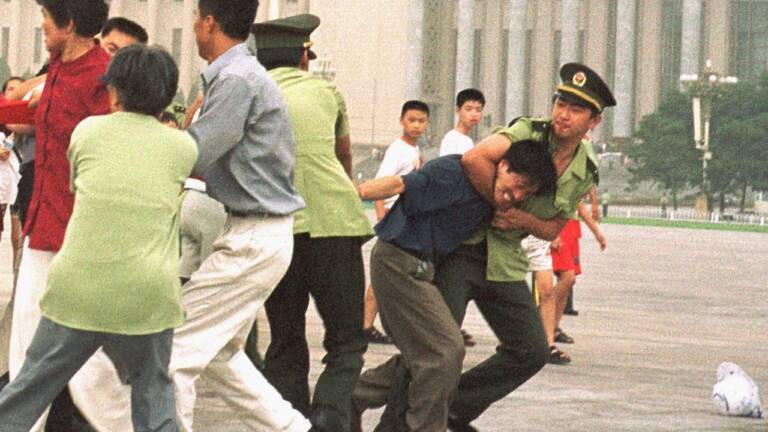
Beijing’s take on the Falun Gong movement is another illustration of how
paranoia drives state policy. Because Falun Gong is able to organize large
rallies to defy the government, and even infiltrate the occasional TV
station to broadcast its message, the Beijing government has included it
among “<...>” intent on “splitting the nation, subverting national
unity or … overthrowing the socialist system.” Never mind that the typical
Falun Gong devotee is a little old lady practising deep breathing. Soon she
will be an enemy of the state in Hong Kong as well.
Because the Hong Kong government is, for the most part, unelected and
subservient to the mainland government, the “consultation” period for
Article 23 is not expected to lead to any real changes. The government is
even refusing to publish the actual wording of the proposed law.
This vagueness is a feature of Beijing’s style of governance: Keep the
masses guessing about exactly what is and is not legal. China scholar Perry
Link calls this “the anaconda in the chandelier” strategy. The snake is
China’s central government.
As Link wrote last April in The New York Review of Books: “Normally the
great snake doesn’t move. It doesn’t have to. It feels no need to be clear
about its prohibitions. Its constant silent message is, ‘You yourself
decide,’ after which, more often than not, everyone in its shadow makes his
or her large and small adjustments – all quite ‘naturally’.”
It’s all part of what Link calls China’s “psychological control system,”
designed to have the masses censor themselves. Now the snake has its eye on
Hong Kong.
http://www.newsmax.com/archives/articles/2002/12/2/214341.shtml
Posting date: 9/Dec/2002
Original article date: 3/Dec/2002
Category: Media Report