BYLINE: Jodie Sinnema, Journal Staff Writer
Zhang Cuiying stands at a table lined with fabric flowers and paints
lipstick-red petals onto a sheet of rice paper stretched out in front of
her.
She is a small, quiet woman from Australia and an internationally acclaimed
artist, whose paintbrush has caressed the face of Buddha and stroked the
hair of the goddess of mercy.
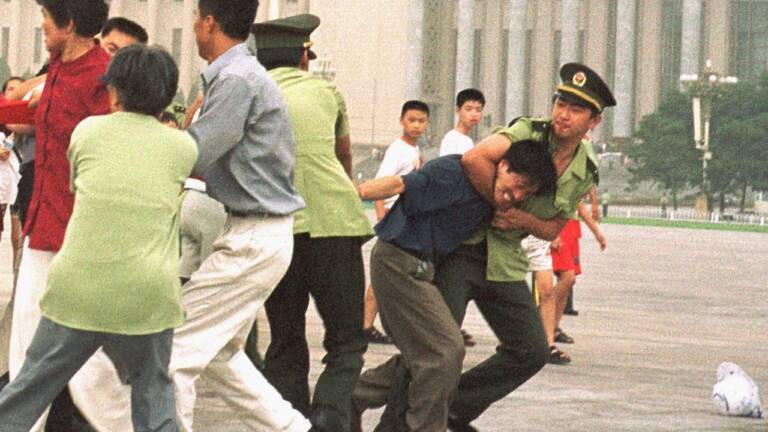
But her life hasn’t been tranquil. It’s been marred by an eight-month
imprisonment in China where she was tortured, beaten, shackled and
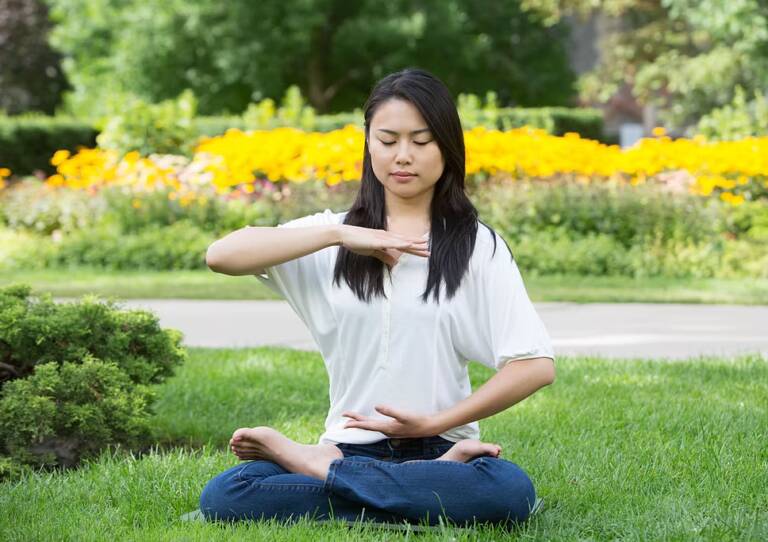
humiliated for practising Falun Gong, a spirituality-through-exercise
movement. “It was painful,” said Zhang of her imprisonment, while she sat in
her art exhibition at the University of Alberta’s Dinwoodie Lounge, her
Mandarin words translated by Chunyan Huang.
During those months in 1999 and 2000, Zhang was forced to sleep beside the
only toilet in her cell, her body oozing with infection. Her legs were
trampled by other inmates, who were instructed to hurt her if she attempted
to meditate. Her head was beaten with rolled-up newspapers. She had to drink
water out of the toilet, shower in front of male inmates and stand barefoot
outside in the middle of winter.
“I felt dizzy all day,” she said. “The police weren’t sympathetic. They
said, if you die, you die like a dog. They beat me. There were bruises all
over my body and leaking blisters. I didn’t see anybody die in the place
where I was, but thousands of Falun Gong practitioners have died.”
The spiritual movement was banned in 1999 as a threat to Communist rule.
Zhang, 40, was a skeptic before she began practising in 1996 in Australia.
She was suffering from arthritis, its pain crippling her hands and joints
and making painting all but impossible. Her husband, a taxi driver who had
moved to Australia in 1989 before the Tiananmen Square massacre, invited her
to a free Falun Gong seminar. Within a month, her arthritis was gone, Zhang
said.
So she travelled to Beijing, where she was soon arrested, to share her story
and fight the persecution of other practitioners.
“In China, we have a saying: If you have benefited, you return in larger
amount,” she said. “I wanted to help my Master Li,” the founder of Falun
Gong.
Since her rescue by the Australian government, she has been banned from her
country of birth and has lost all contact with her parents.
Zhang uses her rice paper paintings, and the poems in calligraphy
accompanying them, to express her faith and tell the world how Falun Gong
practitioners are treated in China.
“When I was at an art exhibition in Italy, someone said my paintings look
like sacred paintings,” Zhang said. “People say, when they see my pictures,
they don’t want to conduct any bad behaviours. My pictures have a kind of
energy which shines full of truthfulness and kindness. It’s like a piece of
music. It can educate people and change people.”
She said her paintings capture the contrast between brutal persecution —
captured in the sad eyes of her characters — and transcendental beauty,
seen in the ink-and-brush mountain sketches.
“By travelling around the world, I want to educate a small group of people,”
Zhang said. “Let’s oppose the terrorism together. Let the Chinese people
have the basic human rights, the right to believe and practise the truth,
compassion and tolerance.”
VIEWING HOURS
You can see Zhang Cuiying’s exhibit, entitled The Golden Brush, today only
at the Dinwoodie Lounge in the Students’ Union Building at the University of
Alberta. It’s open from 9 a.m. to 9 p.m.
You can also visit www.zhangcuiying.org for a sneak peek.
GRAPHIC: Photo: Candace Elliott, The Journal; Zhang Cuiying hopes her
paintings, on display at the University of Alberta, foster compassion and
tolerance.
Posting date: 6/Dec/2002
Original article date: 3/Dec/2002
Category: Media Reports