GEOFFREY YORK from Beijing – The Globe and Mail
Jiang Zemin has never been famous for his modesty. But in his farewell
speech to his party comrades last Friday, when he reviewed his 13 years
at
the helm of China’s ruling Communist Party, his rhetoric was
particularly
florid.
He boasted of leading a “magnificent upsurge” in China’s modernization,
with
a “historic leap” for its people and “tremendous achievements” in rising
wealth and national strength. He bragged that China had nearly tripled
its
GDP during his 13 years in power. He proclaimed that he had written “a
glorious page in the annals of the great rejuvenation of the Chinese
nation.”
Mr. Jiang, the 76-year-old Chinese President and Communist boss, would
prefer to measure his legacy in terms of economic growth and global
prestige
— areas where China has clearly made great gains during his rule. But
a
harsher view of his legacy can be drawn from the latest data on labour
protests, social inequality and unemployment.
Labour disputes have increased by 30 per cent in the past five years.
Discontent over corruption and inequality is growing, with surveys
estimating that 36 million people are “extremely dissatisfied” with
their
life. About 50 million workers have lost their jobs at state-owned
enterprises and municipal work units since 1995. The gap between rich
and
poor is widening. The ranks of the poorest of the poor, with less than
$40
(Canadian) in monthly income, have swollen by at least 10 million since
1996, even as the richest class of people gets richer.
The strange reality of the Jiang epoch is that both of these trends —
the
successes and the dark side, the booming economy and the rising
inequality,
the victories on the world stage and the mounting layoffs at home — are
equally accurate measures of his legacy. They are the yin and yang of
modern
China, the contradictory elements that seem locked inextricably together
as
China races toward an uncertain future.
The era of Jiang Zemin formally ends this Friday, when he retires as
General-Secretary of the Communist Party, the most powerful post in
China,
although he remains President until next March and will continue to
exercise
influence in the party backrooms for years to come.
With his square-rimmed glasses, his nerdy image, his legendary vanity
and
his fondness for crooning Love Me Tender to world leaders during dinners
at
global summits, Mr. Jiang has perhaps never been taken seriously enough.
In
the early years of his rule, most pundits believed he was too weak to
last
more than two or three years, at most.
But instead he became a battle-hardened survivor of China’s backroom
power
struggles. Plucked from obscurity to head the Communist Party in June,
1989,
after his predecessors were judged too soft, he was a former
Soviet-trained
engineer and car-factory manager who had risen to become the Shanghai
party
boss. He consolidated power in the early 1990s as his mentor, Deng
Xiaoping,
slowly succumbed to illness and old age.
After four decades of rule by autocratic strongmen, Mr. Jiang introduced
a
new form of collective leadership. He was not a visionary like Deng or
Mao.
He was a consensus-builder who exercised power by cultivating allies and
manoeuvring shrewdly in the party’s top ranks. His heir apparent,
Vice-President Hu Jintao, has also ascended by avoiding controversy,
forging
alliances, and remaining bland and cautious in his public statements.
After consolidating power, however, Mr. Jiang often behaved like an old
Chinese emperor. He turned apoplectic at the sight of protesters in
Switzerland, berating his hosts and cutting short a ceremony. On
billboards
and posters, he portrayed himself as the equal to Mao and Deng. With his
much-publicized love of poetry and outdoor swimming, he deliberately
sought
to evoke parallels to Mao, who had the same hobbies.
He was the first Communist leader who grew up after the Long March
generation, and the first who lacked any military experience. He was not
involved in planning the military operation that crushed the Tiananmen
Square protests in 1989. Yet his repression of his enemies was as
relentless
as any of his predecessors, with the possible exception that he
preferred to
jail or exile his opponents rather than shoot them dead. He has arrested
Tibetan separatists and dissidents, crushed new political parties, and
tried
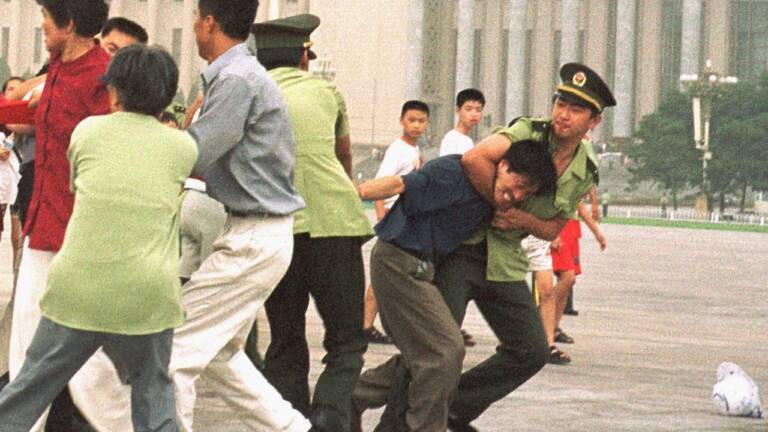
to destroy the Falun Gong religious sect that had challenged his
authority.
While he still recites the slogans of socialism, Mr. Jiang has preferred
to
exploit the much more potent forces of nationalism and patriotism. To
further safeguard his power, he has diligently cultivated the top
officers
of the People’s Liberation Army, giving them higher wages, a bigger
military
budget, and lucrative promotions for his loyalists.
He does deserve credit for keeping China solidly on the path of economic
reform. He has liberated the private sector and helped achieve an
average
9.3-per-cent annual growth rate.
His other triumphs were impressive: getting China into the World Trade
Organization, helping Beijing win the 2008 Olympics, restoring relations
with the West after the post-Tiananmen diplomatic freeze, holding
successful
summits with American and European leaders, supervising Hong Kong’s
return
to Chinese control in 1997, and boosting foreign investment and trade.
But his rule has been tainted by the mounting levels of inequality and
corruption. Despite frequent anticorruption campaigns, he has shown no
ability to solve the problem. His legacy also includes a potential
disaster
in the Chinese banking sector, where corruption and bad loans have
threatened to trigger a collapse, and a growing crisis in the rural
regions,
where millions of peasants are suffering from falling incomes and heavy
taxation.
Over the next few years, Mr. Jiang will retain influence as the chief
arbiter of his clumsily named “Three Represents” theory, which is
expected
to be written into the Communist Party’s constitution at the congress
this
week.
Under this theory, the party should expand its membership to represent
three
major groups: capitalist entrepreneurs, cultural and academic elites,
and
ordinary people who don’t belong to the party’s traditional base of
peasants
and workers. The doctrine is aimed at helping the party to escape
irrelevance by co-opting the growing numbers of rich and middle-class
Chinese.
Mr. Jiang’s Three Represents theory is tirelessly promoted in the
Chinese
media, yet many observers have mocked and ridiculed it, laughing loudly
at a
state television channel that solemnly reported that a village’s
soft-shell
turtles had grown bigger after the villagers had gathered to discuss the
theory.
Even if he lacks a convincing vision, optimists argue that Mr. Jiang has
taken China in the direction of Singapore and Malaysia, where political
authoritarianism is combined with a growing level of social and economic
freedom.
Pessimists have a different analogy. They point to Indonesia, where the
economy grew rapidly for 30 years under the Suharto dictatorship but
weakened when the regime was unable to cope with street protests and
discontent in an era of rising expectations and mounting inequality. The
Suharto regime eventually collapsed — a fate that could someday befall
the
Chinese Communist Party if it ignores the dark side of Jiang Zemin’s
legacy.
Geoffrey York is The Globe’s Beijing bureau chief.
Posting date: 14/Nov/2002
Original article date: 13/Nov/2002
Category: Media Reports & Forum